Brief Report - (2025) Volume 14, Issue 2
Received: 02-Jun-2025, Manuscript No. ara-25-175565;
Editor assigned: 04-Jun-2025, Pre QC No. P-175565;
Reviewed: 18-Jun-2025, QC No. Q-175565;
Revised: 23-Jun-2025, Manuscript No. R-175565;
Published:
30-Jun-2025
, DOI: 10.37421/2168-9695.2025.14.324
Citation: Delgado, Aaron. ”Autonomous Systems: Multilayered Challenges and Future.” Adv Robot Autom 14 (2025):324.
Copyright: © 2025 Delgado A. This is an open-access article distributed under the terms of the Creative Commons Attribution License, which permits unrestricted use, distribution and reproduction in any medium, provided the original author and source are credited.
Here's the thing: autonomous systems bring some tough ethical questions. We're talking about who's accountable when something goes wrong, how to prevent biased algorithms, and what all this means for human autonomy. Really, getting this right means we need solid regulations, clear design, and constant ethical checks as these systems evolve [1].
Making sure autonomous driving systems are truly safe is paramount. This means we need robust verification methods and Artificial Intelligence that can actually explain itself. What this really means is developing rock-solid perception, planning, and control, plus transparent decision-making that people can understand and trust, paving the way for safer deployment in the real world [2].
When humans and autonomous systems work together, especially in complex situations, it's all about effective collaboration, and that absolutely hinges on trust. This means designing systems that clearly show their strengths and weaknesses, helping people know when to trust them and ensuring everyone works smoothly, no matter how chaotic things get [3].
Swarm robotics is really fascinating; it harnesses the combined smarts of many simple autonomous robots to pull off tasks that single robots just couldn't manage, especially when you need resilience or to scale up. Think about things like environmental tracking or search and rescue â?? this approach thrives by letting individual robots act independently yet cooperate effectively [4].
When it comes to autonomous systems, making them resilient is absolutely essential for them to work reliably, especially in those unpredictable, ever-changing environments. This means building in fault tolerance, self-healing capabilities, and control systems that can adapt, so these systems keep functioning even if things go wrong or unexpected challenges pop up [5].
Artificial Intelligence, especially machine learning, offers incredible potential for taking autonomous system control to the next level, letting them learn and adapt. But here's the catch: we still need to figure out how to make them explainable, truly robust to new situations, and consistently reliable in critical applications. It's about careful integration and validation, no shortcuts [6].
Cybersecurity is a huge deal for autonomous systems. They're vulnerable to all kinds of attacks that could mess with their operations, safety, or even privacy. Protecting these systems means we need serious security from the ground up: strong authentication, secure ways for them to talk to each other, and systems to detect intrusions. We need to cut down those risks [7].
Getting accurate perception is absolutely fundamental for autonomous systems, especially in something like driving. This demands cutting-edge computer vision, sensor fusion, and smart machine learning to really grasp what's happening around them. The tough part? Handling bad weather, tricky lighting, and unpredictable objects, all while performing flawlessly in real-time for safe navigation [8].
Explainable Artificial Intelligence, or XAI, is becoming vital for autonomous systems. It's about building trust and letting humans keep a better eye on things by clearly showing how these systems make decisions. This helps us tackle tricky issues like accountability and debugging, which is just crucial when we're putting complex Artificial Intelligence into sensitive or safety-first situations [9].
Figuring out who's responsible when autonomous systems act up is a big legal headache; our current laws just aren't built for questions of agency here. So, we really need to develop new rules to handle how fault is assigned, especially after accidents, making sure it's fair and encourages innovation while keeping public trust intact [10].
Autonomous systems inherently bring some tough ethical questions to the forefront, particularly regarding who is accountable when something goes wrong and how to prevent biased algorithms. These questions have profound implications for human autonomy, meaning we need solid regulations, clear design, and constant ethical checks as these systems evolve [1]. On the legal side, figuring out who is responsible when autonomous systems act up is a significant legal headache; current laws simply aren't built for these questions of agency. What this really means is developing new rules to handle how fault is assigned, especially after accidents, ensuring fairness while encouraging innovation and keeping public trust intact [10]. When humans and autonomous systems work together, especially in complex situations, effective collaboration absolutely hinges on trust. This means designing systems that clearly show their strengths and weaknesses, helping people know when to trust them, and ensuring everyone works smoothly, no matter how chaotic things get [3].
Making sure autonomous driving systems are truly safe is paramount. This demands robust verification methods and Artificial Intelligence that can actually explain itself. What this really means is developing rock-solid perception, planning, and control, alongside transparent decision-making that people can understand and trust, paving the way for safer deployment in the real world [2]. Getting accurate perception is absolutely fundamental for autonomous systems, particularly in driving scenarios. This requires cutting-edge computer vision, sophisticated sensor fusion, and smart Machine Learning to really grasp what is happening around them. The tough part involves handling bad weather, tricky lighting, and unpredictable objects, all while performing flawlessly in real-time for safe navigation [8]. Furthermore, when it comes to autonomous systems, making them resilient is absolutely essential for them to work reliably, especially in unpredictable, ever-changing environments. This means building in fault tolerance, self-healing capabilities, and adaptive control systems, so these systems keep functioning even if things go wrong or unexpected challenges pop up [5].
Artificial Intelligence, especially Machine Learning, offers incredible potential for taking autonomous system control to the next level, letting them learn and adapt. But here's the catch: we still need to figure out how to make them explainable, truly robust to new situations, and consistently reliable in critical applications. It's about careful integration and validation, no shortcuts [6]. Explainable Artificial Intelligence, or XAI, is becoming vital for autonomous systems. It's about building trust and letting humans keep a better eye on things by clearly showing how these systems make decisions. This helps us tackle tricky issues like accountability and debugging, which is just crucial when we're putting complex Artificial Intelligence into sensitive or safety-first situations [9].
Swarm robotics is really fascinating; it harnesses the combined smarts of many simple autonomous robots to pull off tasks that single robots just couldn't manage, especially when you need resilience or to scale up. Think about practical applications like environmental tracking or search and rescue â?? this approach thrives by letting individual robots act independently yet cooperate effectively [4]. Cybersecurity is a huge deal for autonomous systems. They're vulnerable to all kinds of attacks that could mess with their operations, safety, or even privacy. Protecting these systems means we need serious security from the ground up: strong authentication, secure ways for them to talk to each other, and robust systems to detect intrusions. We need to cut down those risks [7].
Autonomous systems present a complex landscape of opportunities and challenges across various domains. Ethically, they raise significant questions about accountability, preventing biased algorithms, and protecting human autonomy, necessitating robust regulations and continuous ethical oversight. Legally, current frameworks struggle with assigning liability in accidents, underscoring the need for new rules that ensure fairness and foster public trust while promoting innovation. Crucial for successful deployment is the assurance of safety and reliability, particularly for systems like autonomous driving. This requires advanced perception technologies, explainable Artificial Intelligence, and resilient designs featuring fault tolerance and adaptive control, allowing systems to operate dependably even in unpredictable environments. Human-autonomy teaming thrives on trust, requiring systems to transparently communicate their capabilities and limitations. Meanwhile, Artificial Intelligence, especially Machine Learning, is transforming control capabilities, enabling systems to learn and adapt, though explainability and robustness remain key hurdles. Furthermore, the burgeoning field of swarm robotics demonstrates how collective intelligence can tackle complex tasks with resilience. Beneath it all, cybersecurity is a paramount concern, as autonomous systems are vulnerable to attacks that could compromise operations, safety, and privacy, demanding comprehensive security measures from design to deployment. Addressing these multifaceted challenges will define the future development and societal integration of autonomous technologies.
None
None
Raja BNS, Sandeep K, A. KS. "Ethical Challenges in Autonomous Systems".Commun. ACM 65 (2022):14-16.
Indexed at, Google Scholar, Crossref
Mengdi W, Chen T, Dongfang Y. "Safe and Explainable Autonomous Driving: A Review".IEEE Trans. Intell. Veh. 7 (2022):994-1008.
Indexed at, Google Scholar, Crossref
Nancy JC, Jessi S, William FL. "Human-Autonomy Teaming in Complex Systems: A Perspective on Trust and Reliance".IEEE Syst. Man Cybern. Mag. 7 (2021):18-29.
Indexed at, Google Scholar, Crossref
G. R, V. R, P. SR. "A Review on Swarm Robotics and its Applications".J. Phys.: Conf. Ser. 1716 (2021):012012.
Indexed at, Google Scholar, Crossref
Fadhel AA, Abdulrahman MA, Ali AA. "Resilient Autonomous Systems: A Survey of Approaches".Sensors 23 (2023):6470.
Indexed at, Google Scholar, Crossref
Xiaocheng C, Yanjie L, Zhaoxia W. "Artificial Intelligence for Autonomous Systems Control: Challenges and Opportunities".IEEE Trans. Autom. Sci. Eng. 19 (2022):2603-2615.
Indexed at, Google Scholar, Crossref
Md. RIK, Md. IHB, Md. MRC. "Cybersecurity Challenges and Solutions for Autonomous Systems: A Survey".IEEE Access 9 (2021):139176-139199.
Indexed at, Google Scholar, Crossref
Jinhang L, Dapeng S, Yibin L. "Perception for Autonomous Driving: A Survey".IEEE Trans. Intell. Transp. Syst. 24 (2023):5122-5142.
Indexed at, Google Scholar, Crossref
Arindam B, Swarnendu G, Suman L. "Explainable Artificial Intelligence for Autonomous Systems: Concepts, Challenges, and Future Directions".IEEE Internet Things Mag. 5 (2022):70-76.
Indexed at, Google Scholar, Crossref
Bert-Jaap K, Ronald L, Tjerk dR. "Liability for Autonomous Systems: An Overview of Current Approaches".Comput. Law Secur. Rev. 40 (2021):105500.
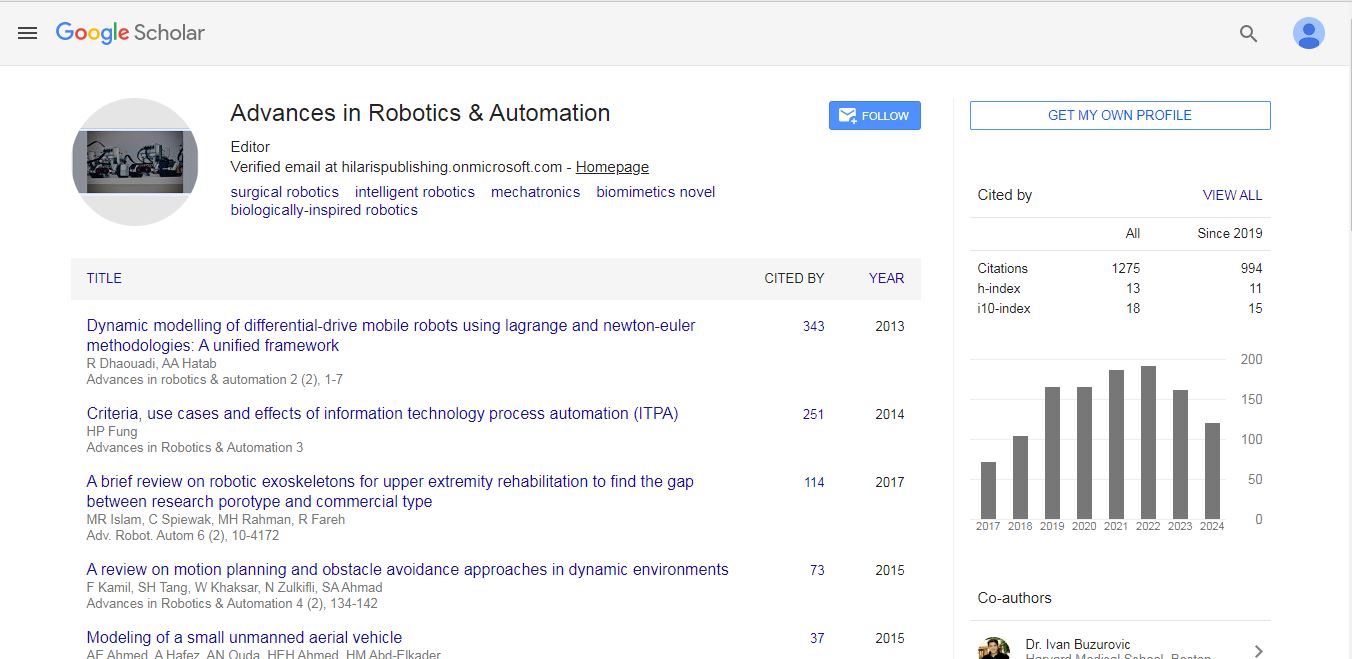
Advances in Robotics & Automation received 1275 citations as per Google Scholar report