Commentary - (2025) Volume 16, Issue 3
Received: 01-May-2025, Manuscript No. assj-25-172504;
Editor assigned: 05-May-2025, Pre QC No. P-172504;
Reviewed: 19-May-2025, QC No. Q-172504;
Revised: 22-May-2025, Manuscript No. R-172504;
Published:
29-May-2025
, DOI: 10.37421/2151-6200.2025.16.665
Citation: Lefevre, Hugo. "Arts & Digital: Well-being, Education, Heritage."Arts Social Sci 16(2025):665.
Copyright: © 2025 Lefevre H. This is an open-access article distributed under the terms of the Creative Commons Attribution License, which permits unrestricted use,distribution and reproduction in any medium, provided the original author and source are credited.
The intersection of arts and health is a dynamic field, with growing recognition of how cultural contexts, policy frameworks, and implementation challenges profoundly shape arts-based health interventions. There is a clear need for culturally sensitive approaches and robust evaluation methods to effectively integrate arts into global health strategies, emphasizing their potential to address diverse health needs across different populations [1].
Expanding this, the field of social prescription highlights how arts and cultural activities are being integrated into healthcare pathways. This involves mapping out various artistic interventions, observing their health and well-being outcomes, and establishing referral mechanisms. The core idea is to leverage arts to address non-medical needs and enhance holistic care within communities [5].
A significant body of evidence supports the therapeutic efficacy of art. For example, a meta-analysis, synthesizing findings from multiple studies, clearly demonstrates its positive impact, showing how creative expression can reduce symptoms of anxiety, depression, and trauma. The therapeutic process facilitates emotional processing and psychological well-being [4].
Similarly, arts-based interventions are critically assessed for their role in improving mental health outcomes for young people. Research consolidates findings on diverse artistic modalities like drama, music, and visual arts, demonstrating their capacity to address issues such as anxiety, depression, and trauma. The focus here is on tailored interventions and rigorous evaluation to maximize their impact on youth well-being [7].
For older adults, music therapy offers distinct therapeutic effects against anxiety and depression. A systematic review and meta-analysis provides strong evidence that music interventions can significantly reduce psychological distress, improve mood, and enhance quality of life in this demographic. Such findings support integrating music therapy into geriatric care as an effective approach [9].
Beyond direct therapy, engaging with visual arts has a notable influence on cognitive functions in older adults. Evidence synthesizes positive effects on memory, attention, and executive functions, exploring various forms of engagement from art-making to museum visits. This work discusses the neurocognitive mechanisms involved, advocating for arts-based interventions as a strategy to promote healthy aging and mitigate cognitive decline [6].
More broadly, the impact of various arts and cultural activities on the overall health and well-being of older adults has been systematically reviewed through controlled trials. Significant benefits are identified across mental, social, and physical health domains, including reduced loneliness, improved cognitive function, and enhanced mood. These observations strongly advocate for integrating arts into strategies for healthy aging and elder care [10].
Digital technology's transformative power extends significantly into the arts and culture sector. In art education, a systematic review explores how digital tools have reshaped teaching methodologies, learning outcomes, and student engagement. It identifies key trends, from virtual reality to interactive software, discussing both the challenges and opportunities these technologies present for fostering creativity and technical skills in art students [2].
Moreover, digital technologies exert a profound influence on the conservation and dissemination of cultural heritage. Tools such as 3D modeling, virtual reality, and digital archives are revolutionizing heritage management, making historical artifacts and sites globally more accessible and fostering deeper public engagement, all while addressing the inherent challenges of digital preservation [3].
This digital revolution has also led to critical examinations of the theoretical frameworks surrounding new media art itself. A review traces the conceptual shifts instigated by digital technology in artistic practice, exploring how these innovations have challenged traditional notions of aesthetics, authorship, and exhibition. It offers crucial insights into the evolving discourses that define contemporary art forms and their engagement with technological innovation [8].
Collectively, these diverse studies highlight a robust and evolving landscape where arts and digital technologies intersect, offering profound contributions to human well-being, education, and the enduring legacy of cultural heritage.
The global landscape of arts and health reveals a complex interplay, where cultural contexts, policy frameworks, and implementation challenges are central to shaping effective arts-based health interventions. There is a significant emphasis on developing culturally sensitive approaches and robust evaluation methods to properly integrate arts into global health strategies, recognizing their potential to address a wide array of health needs across diverse populations [1]. This integration often occurs through social prescription, an expanding field that incorporates arts and cultural activities directly into healthcare pathways. This involves careful consideration of the specific artistic interventions used, the observed health and well-being outcomes, and the established referral mechanisms, all aimed at addressing non-medical needs and enhancing holistic care within communities [5].
Art therapy stands out as a highly effective intervention for various mental health conditions. A comprehensive meta-analysis of multiple studies highlights its significant positive impact, demonstrating how engagement in creative expression can markedly reduce symptoms associated with anxiety, depression, and trauma. It provides a valuable non-pharmacological route for emotional processing and psychological well-being [4]. Extending this focus to specific demographics, arts-based interventions have shown considerable promise in improving mental health outcomes for young people. Diverse artistic modalities, including drama, music, and visual arts, offer powerful tools to address anxiety, depression, and trauma. The success of these interventions hinges on being tailored to specific needs and undergoing rigorous evaluation to maximize their impact on youth well-being [7].
For older adults, the therapeutic benefits of arts are equally profound. Music therapy, in particular, has been rigorously investigated for its effects on anxiety and depression. A systematic review and meta-analysis reveals that music interventions significantly reduce psychological distress, improve mood, and enhance the overall quality of life for this population, thus advocating for its inclusion in geriatric care as an effective non-pharmacological approach [9]. Furthermore, engaging with visual arts has a tangible influence on cognitive functions in older adults. Research synthesizes evidence of positive effects on memory, attention, and executive functions. This encompasses various forms of engagement, from active art-making to passive museum visits, and delves into the neurocognitive mechanisms involved, positioning arts-based interventions as a crucial strategy to promote healthy aging and mitigate cognitive decline [6].
Broadly, the impact of arts and cultural activities on the health and well-being of older adults has been substantiated through controlled trials. These studies identify significant benefits across mental, social, and physical health domains. These include a reduction in loneliness, improved cognitive function, and enhanced mood, underscoring the value of integrating arts into comprehensive strategies for healthy aging and elder care [10]. This demonstrates a holistic view of how artistic engagement contributes to a better quality of life for an aging population.
The advent of digital technology has also brought about a significant transformation in art education. A systematic review highlights its pervasive effects on teaching methodologies, learning outcomes, and student engagement. The integration of digital tools, ranging from virtual reality to interactive software, is identified as a key trend, presenting both challenges and opportunities for fostering creativity and technical skills in art students [2]. This shift redefines how art is taught and learned, preparing students for an increasingly digital artistic landscape.
Digital technologies are simultaneously revolutionizing the conservation and dissemination of cultural heritage. Through tools like 3D modeling, virtual reality, and digital archives, heritage management is being transformed, making historical artifacts and sites more accessible globally. This fosters deeper public engagement with culture while simultaneously addressing the complex challenges inherent in digital preservation. The digital realm provides unprecedented avenues for safeguarding and sharing the past [3].
Finally, the digital revolution has prompted critical examinations of the theoretical frameworks underlying new media art. This involves tracing the conceptual shifts in artistic practice brought about by digital technologies, exploring how they challenge traditional notions of aesthetics, authorship, and exhibition. Such analyses provide vital insights into the evolving discourses that define contemporary art forms and their intricate engagement with technological innovation, continuously pushing the boundaries of artistic expression [8].
These diverse studies collectively demonstrate a robust and expanding body of knowledge concerning the transformative power of arts and digital technologies across human well-being, education, and cultural preservation.
Across various disciplines, research consistently highlights the profound and multifaceted impact of arts and digital technologies on well-being, education, and cultural preservation. Arts-based interventions are increasingly vital in global health strategies, addressing diverse health needs through culturally sensitive approaches and robust evaluation methods. Social prescription further integrates arts and cultural activities into healthcare, offering holistic care and addressing non-medical needs within communities. Art therapy has demonstrated significant positive impacts across various mental health conditions, effectively reducing anxiety, depression, and trauma. Similarly, music therapy has proven effective in mitigating anxiety and depression among older adults, enhancing mood and quality of life. For older adults, engaging with visual arts also positively influences cognitive functions like memory and attention, advocating for arts-based interventions to promote healthy aging. In the realm of education, digital technology has transformed art education by introducing innovative teaching methodologies and enhancing student engagement with interactive tools. Beyond education, digital technologies, including 3D modeling and virtual reality, are revolutionizing the conservation and accessibility of cultural heritage globally, fostering public engagement while addressing preservation challenges. This digital shift has also spurred critical examinations of new media art theories, redefining aesthetics and authorship in contemporary art. Collectively, these studies underscore the powerful, evolving roles of arts and technology in fostering individual well-being, advancing education, and safeguarding cultural legacies.
None
None
Indexed at, Google Scholar, Crossref
Indexed at, Google Scholar, Crossref
Indexed at, Google Scholar, Crossref
Indexed at, Google Scholar, Crossref
Indexed at, Google Scholar, Crossref
Indexed at, Google Scholar, Crossref
Indexed at, Google Scholar, Crossref
Indexed at, Google Scholar, Crossref
Indexed at, Google Scholar, Crossref
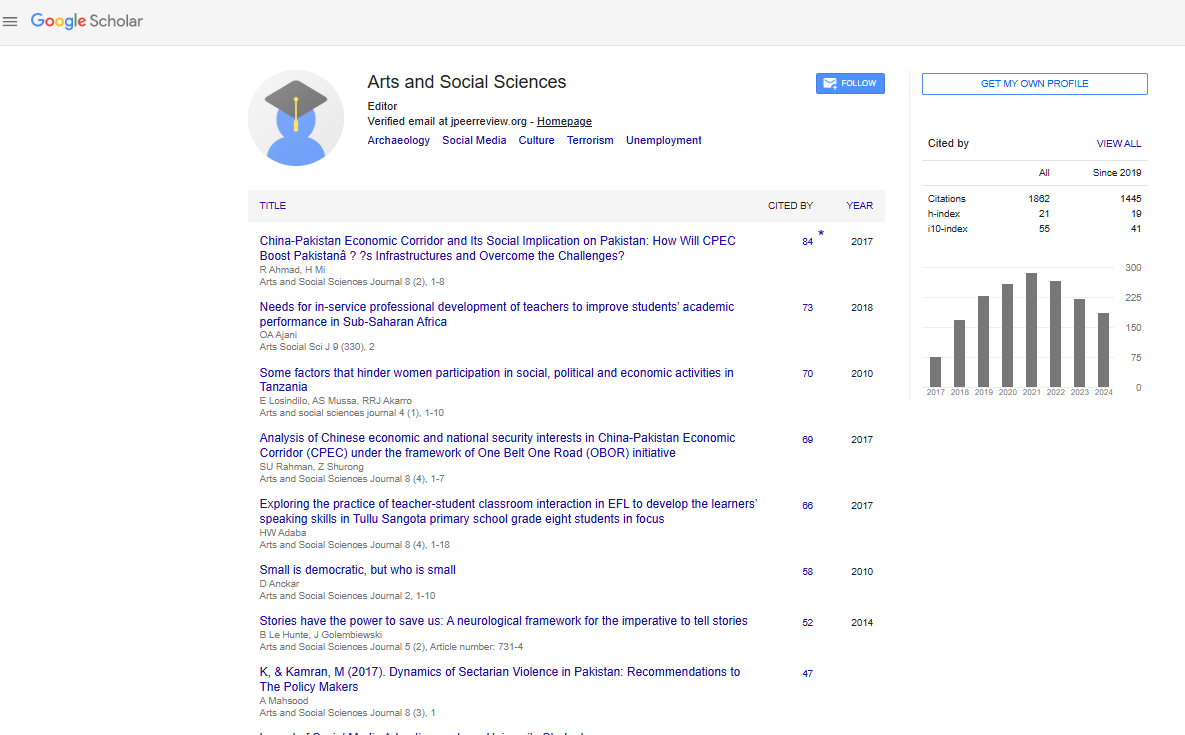
Arts and Social Sciences Journal received 1413 citations as per Google Scholar report