Short Communication - (2025) Volume 16, Issue 3
Received: 01-May-2025, Manuscript No. assj-25-172508;
Editor assigned: 05-May-2025, Pre QC No. P-172508;
Reviewed: 19-May-2025, QC No. Q-172508;
Revised: 22-May-2025, Manuscript No. R-172508;
Published:
29-May-2025
, DOI: 10.37421/2151-6200.2025.16.669
Citation: Walker, Ethan. ”Arts’ Digital Impact: Health, Education, Culture, Cities.” Arts Social Sci 16(2025):669.
Copyright: © 2025 Walker E. This is an open-access article distributed under the terms of the Creative Commons Attribution License, which permits unrestricted use, distribution and reproduction in any medium, provided the original author and source are credited.
This compilation of research underscores the pervasive influence and evolving landscape of arts across various societal sectors. One area of significant focus is the therapeutic potential of arts, where systematic reviews and meta-analyses consistently highlight the impact of arts-based interventions. Such interventions, including music, visual arts, and dance, contribute meaningfully to improvements in well-being, mood, and reduction in psychological distress, thereby emphasizing the broad therapeutic utility of artistic activities for diverse populations and mental health conditions. Further rigorous research is needed to fully grasp underlying mechanisms and optimize intervention designs[1].
Moving into educational contexts, the benefits of visual arts education for children's cognitive development are well-documented. Evidence suggests that participation in visual arts activities notably enhances various cognitive skills, such as problem-solving, critical thinking, creativity, and spatial reasoning. This advocates for the integration of comprehensive visual arts programs into educational curricula to foster holistic development and improve academic outcomes in young learners[2].
Cultural institutions, particularly museums, are experiencing a profound digital transformation. Scholarly literature reveals key trends in the adoption of digital technologies for exhibition design, audience engagement, collection management, and accessibility. For museums, strategically embracing digital solutions is crucial to maintain relevance and accessibility in the contemporary cultural landscape, while also addressing challenges like digital literacy and resource allocation[3].
The performing arts sector is similarly navigating the digital age, with technological advancements reshaping audience engagement. This involves new avenues for interaction and participation between artists, performances, and their audiences. Performing arts organizations are encouraged to leverage digital platforms to broaden reach, cultivate deeper engagement, and ensure sustainability amidst changing consumption patterns[4].
Art therapy offers another powerful therapeutic approach, with systematic reviews and meta-analyses evaluating its effectiveness in addressing trauma-related symptoms. Findings indicate that various art therapy modalities can significantly alleviate symptoms associated with Post-Traumatic Stress Disorder (PTSD), anxiety, and depression in individuals who have experienced trauma. This establishes art therapy's role as a valuable complementary treatment, particularly through its non-verbal approach to processing difficult emotions and fostering resilience[5].
Digital preservation presents both challenges and opportunities for cultural heritage institutions. While digital technologies facilitate the long-term safeguarding of artistic and historical artifacts, significant obstacles persist, including technological obsolescence, funding constraints, and copyright complexities. Insights into best practices and strategic frameworks are vital for effective digital preservation to ensure future accessibility[6].
Beyond institutional settings, street art plays a significant role in urban regeneration. Case studies demonstrate how artistic interventions foster community engagement and place-making, contributing to the revitalization of neglected urban areas. Such initiatives promote local identity, attract tourism, and encourage social cohesion, emphasizing the collaborative nature often involving local residents, artists, and policymakers[7].
Dance interventions, like other arts-based approaches, have wide-ranging effects on both physical and mental health. Regular participation in dance activities leads to notable improvements in cardiovascular fitness, balance, strength, and flexibility, alongside positive impacts on mood, stress reduction, and enhanced cognitive function. This champions dance as a holistic approach to promote overall well-being across diverse age groups and health conditions[8].
In music education, digital tools are transforming teaching and learning. Technologies such as interactive software, virtual instruments, and online collaboration platforms make music education more dynamic and accessible. Judicious integration of these tools can enhance student motivation, foster creativity, and improve musical proficiency, provided educators receive adequate training and support[9].
Finally, the revitalization of traditional crafts in the digital age highlights strategies for sustainable cultural preservation and economic development. Digital platforms and modern marketing techniques empower contemporary artisans to reach broader markets, share skills, and innovate while maintaining the authenticity of traditional art forms. Balancing technological integration with inherent cultural value and manual processes is crucial for long-term viability[10].
The extensive body of work available explores the significant impact of artistic endeavors across various domains. For instance, arts-based interventions, encompassing music, visual arts, and dance, have been systematically reviewed and meta-analyzed to reveal substantial improvements in mental health outcomes, including well-being, mood, and reduced psychological distress [1]. This therapeutic potential is further reinforced by studies on art therapy, which demonstrate its effectiveness in mitigating trauma-related symptoms such as Post-Traumatic Stress Disorder (PTSD), anxiety, and depression. Art therapy offers a crucial non-verbal avenue for processing complex emotions and building resilience [5]. Similarly, dance interventions are recognized for their holistic benefits, enhancing not only physical aspects like cardiovascular fitness, balance, and strength but also positively influencing mood, stress reduction, and cognitive function, advocating for dance as a comprehensive approach to well-being across diverse populations [8].
Beyond therapeutic applications, the educational value of arts is profoundly evident. Visual arts education, in particular, has been shown to foster significant cognitive development in children. Engagement in visual arts activities boosts critical skills like problem-solving, critical thinking, creativity, and spatial reasoning, underlining the importance of integrating comprehensive visual arts programs into educational frameworks to support holistic development and academic achievement [2]. In music education, the integration of digital tools presents new opportunities to transform traditional teaching methods. Interactive software, virtual instruments, and online collaboration platforms can make learning more dynamic and accessible, potentially enhancing student motivation, creativity, and musical proficiency, provided educators receive adequate training [9].
The digital age has also spurred transformative changes within cultural institutions. Museums are increasingly adopting digital technologies for exhibition design, enhancing audience engagement, streamlining collection management, and improving accessibility. Embracing these digital solutions is crucial for museums to maintain relevance and accessibility in the modern cultural landscape, though challenges like digital literacy and resource allocation must be addressed [3]. Concurrently, the performing arts sector is navigating this digital evolution, with technological advancements reshaping interactions between artists, performances, and audiences. Organizations are strategizing to leverage digital platforms to expand their reach, foster deeper engagement, and ensure long-term sustainability amid evolving consumption patterns [4].
Furthermore, the preservation and revitalization of cultural heritage are undergoing significant shifts. Digital preservation offers a powerful means to safeguard artistic and historical artifacts for future generations, yet institutions face considerable hurdles such as technological obsolescence, funding limitations, and copyright complexities. Best practices and strategic frameworks are essential for effective digital preservation [6]. Parallel to these efforts, traditional crafts are finding new avenues for sustainability and economic development through digital platforms and modern marketing. This allows artisans to reach wider markets and innovate while preserving the authenticity and cultural value of their craft [10]. Moreover, street art emerges as a potent tool for urban regeneration, fostering community engagement and place-making in revitalized urban areas. Collaborative efforts involving local residents, artists, and policymakers are key to successful urban art initiatives that promote local identity and social cohesion [7].
This collection of research highlights the expansive impact of arts across health, education, cultural preservation, and urban development. Arts-based interventions, including music, visual arts, dance, and art therapy, consistently show significant benefits for mental health, well-being, and reducing trauma symptoms. In education, visual arts boost children's cognitive development, while digital tools enhance student engagement and learning outcomes in music. The digital age is transforming cultural institutions; museums are adopting digital technologies for exhibition design and audience engagement, and performing arts organizations are leveraging digital platforms to broaden reach and ensure sustainability. Cultural heritage preservation faces digital challenges but also finds new opportunities. Traditional crafts are revitalized through digital means, balancing cultural authenticity with economic development. Additionally, street art plays a vital role in urban regeneration, fostering community engagement and place-making. This body of work collectively underscores the critical importance of artistic engagement, education, and preservation in our increasingly digital and interconnected world.
None
None
Indexed at, Google Scholar, Crossref
Indexed at, Google Scholar, Crossref
Indexed at, Google Scholar, Crossref
Indexed at, Google Scholar, Crossref
Indexed at, Google Scholar, Crossref
Indexed at, Google Scholar, Crossref
Indexed at, Google Scholar, Crossref
Indexed at, Google Scholar, Crossref
Indexed at, Google Scholar, Crossref
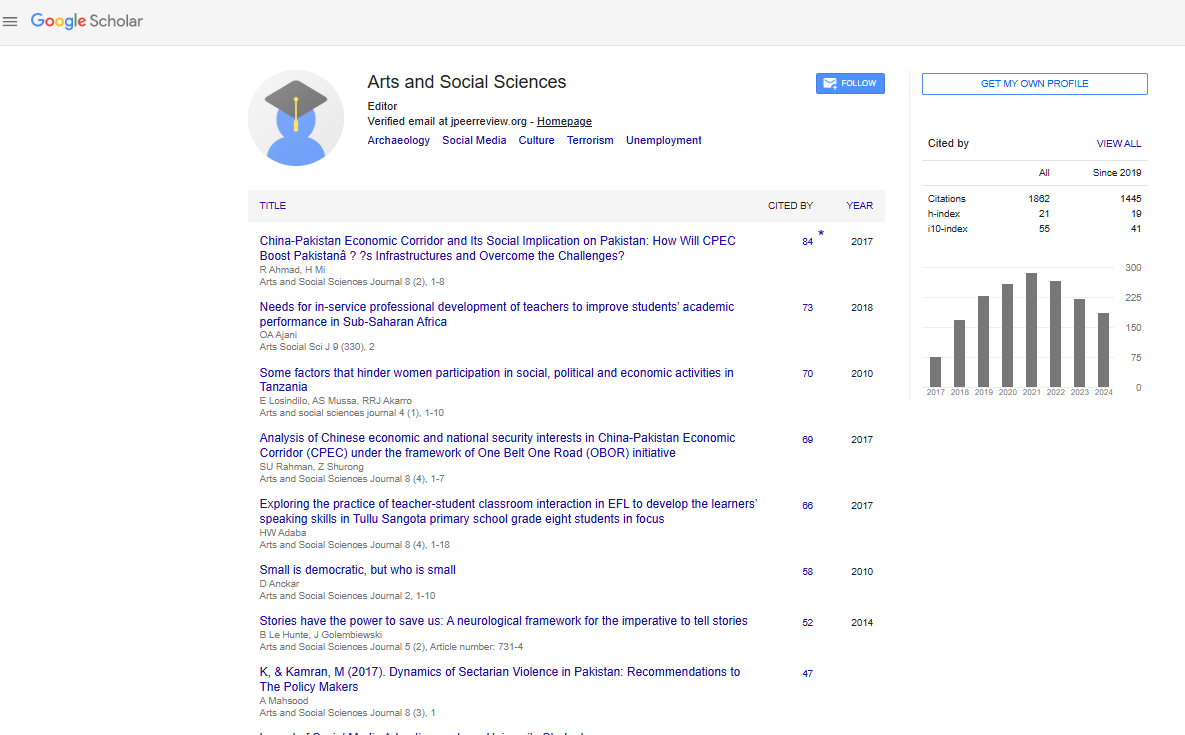
Arts and Social Sciences Journal received 1413 citations as per Google Scholar report