Short Communication - (2025) Volume 13, Issue 2
Received: 01-Apr-2025, Manuscript No. JCMG-25-165766;
Editor assigned: 03-Apr-2025, Pre QC No. P-165766;
Reviewed: 17-Apr-2025, QC No. Q-165766;
Revised: 22-Apr-2025, Manuscript No. R-165766;
Published:
09-Apr-2025
, DOI: 10.37421/2472-128X.2025.13.336
Citation: Graham, Ellisca. “Artificial Intelligence for Predicting Dysbiosis-related Disease Progression from Metagenomic Data.” J Clin Med Genomics 13 (2025): 336.
Copyright: © 2025 Graham E. This is an open-access article distributed under the terms of the Creative Commons Attribution License, which permits unrestricted use, distribution and reproduction in any medium, provided the original author and source are credited.
The human microbiome is composed of a vast array of microorganisms, including bacteria, fungi, viruses, and archaea, that collectively contribute to the health of their host. These microbes perform a wide range of vital functions, from aiding in digestion and modulating the immune system to producing essential vitamins and protecting against pathogenic microorganisms. However, when the balance of the microbiome is disrupted, it can lead to dysbiosis, a state in which harmful microorganisms may proliferate, and beneficial microbes are depleted. Dysbiosis has been associated with a variety of diseases, including Inflammatory Bowel Disease (IBD), obesity, diabetes, cardiovascular disease, and even mental health disorders like depression and anxiety. Understanding the underlying mechanisms of dysbiosis and its contribution to disease progression is crucial for developing effective therapeutic strategies [2].
Traditionally, studies of the microbiome and dysbiosis have relied on targeted techniques such as 16S rRNA sequencing, which focuses on identifying specific microbial taxa, or shotgun metagenomic sequencing, which captures the entire genetic content of microbial communities. While these techniques have provided valuable insights into the composition of the microbiome and its association with disease, they often fall short in predicting disease progression. Predicting the trajectory of a disease based on metagenomic data is a highly complex task, as it involves not only the identification of microbial taxa but also the functional potential of the microbiome, including gene expression patterns, metabolic pathways, and microbial interactions. Moreover, disease progression is influenced by a wide range of factors, including the host's genetic background, environmental exposures, and lifestyle factors. This makes it challenging to develop accurate predictive models using conventional statistical methods alone [3].
In recent years, artificial intelligence has emerged as a powerful tool for addressing these challenges. Machine learning algorithms, which allow computers to learn from data and make predictions without explicit programming, have shown promise in identifying patterns and relationships within large and complex datasets. AI can analyze metagenomic data at a scale and speed that would be impossible for human researchers, enabling the identification of subtle and complex patterns in microbial communities that are associated with disease progression. For example, AI-based approaches such as supervised learning algorithms can be trained on datasets of microbiome compositions and disease outcomes to predict the likelihood of disease onset or the progression of an existing condition. These algorithms can also identify biomarkers for disease, such as specific microbial taxa or gene sequences that are indicative of dysbiosis and disease risk [4].
The application of AI in predicting dysbiosis-related disease progression has shown promise in several areas of research. In the context of inflammatory bowel disease, AI models have been used to predict disease relapse based on the composition and functional profile of the gut microbiome. By analyzing metagenomic data from patients with IBD, AI algorithms can identify specific microbial signatures that are associated with disease flare-ups, allowing clinicians to predict when a patient is likely to experience a relapse and adjust their treatment accordingly. Similarly, in the case of metabolic diseases such as obesity and diabetes, AI models have been developed to predict the progression of these conditions based on changes in the gut microbiome. These models have the potential to provide early warnings of disease progression, allowing for timely interventions that could prevent or mitigate the onset of more serious health issues [5].
None.
None.
Google Scholar Cross Ref Indexed at
Google Scholar Cross Ref Indexed at
Google Scholar Cross Ref Indexed at
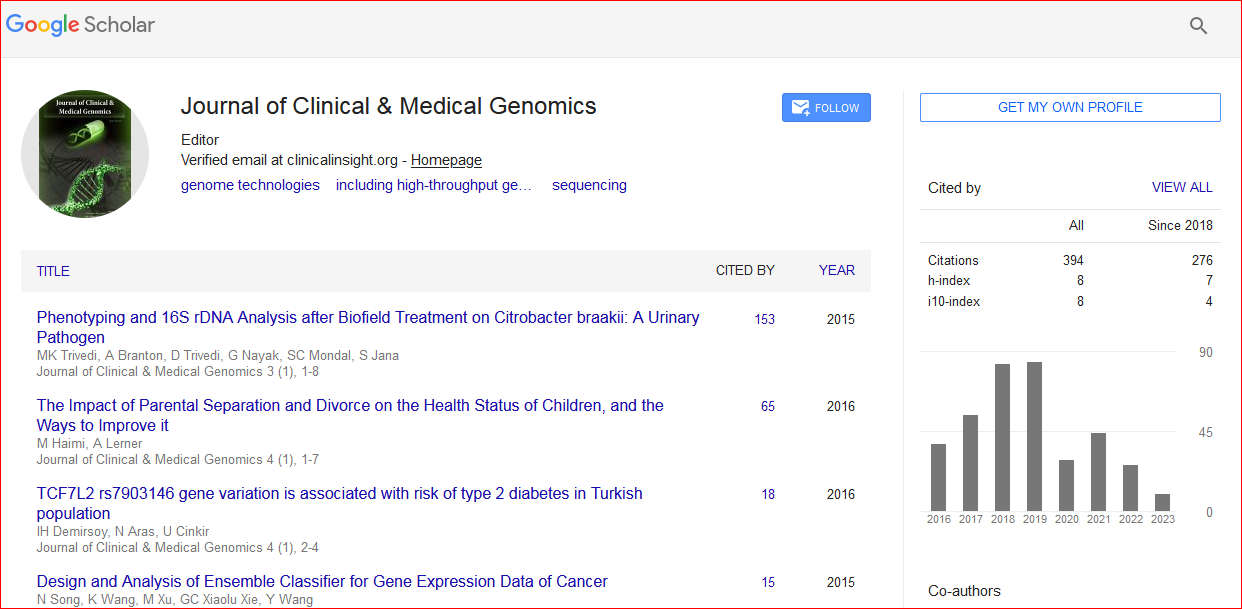
Journal of Clinical & Medical Genomics received 391 citations as per Google Scholar report