Commentary - (2025) Volume 16, Issue 3
Received: 01-May-2025, Manuscript No. assj-25-172503;
Editor assigned: 05-May-2025, Pre QC No. P-172503;
Reviewed: 19-May-2025, QC No. Q-172503;
Revised: 22-May-2025, Manuscript No. R-172503;
Published:
29-May-2025
, DOI: 10.37421/2151-6200.2025.16.664
Citation: Rossi, Isabella. ”Art: Therapy, Tech, Culture, Market Shifts.” Arts Social Sci 16(2025):664
Copyright: © 2025 Rossi I. This is an open-access article distributed under the terms of the Creative Commons Attribution License, which permits unrestricted use, distribution and reproduction in any medium, provided the original author and source are credited.
This systematic review explores the qualitative evidence on art therapy for adults with mental health disorders. It highlights how art therapy facilitates self-expression, emotional processing, and a sense of mastery, contributing to improved well-being and coping mechanisms for participants. The review identifies common themes such as enhanced self-awareness, communication, and a safe space for exploring difficult emotions, underscoring its therapeutic potential beyond conventional treatments[1].
This study examines the impact of interactive digital art installations on public engagement within urban environments. It reveals that these installations foster a dynamic dialogue between art and viewer, transforming passive observation into active participation. The findings suggest that technology-driven art experiences can democratize access to art, encourage social interaction, and stimulate critical reflection on public spaces[2].
This paper advocates for an interdisciplinary approach in K-12 arts education, arguing that integrating arts with other subjects like science and history enriches learning outcomes. It presents a framework for curriculum development that enhances creative problem-solving, critical thinking, and cultural understanding, moving beyond traditional siloed instruction. The study highlights the potential of arts education to foster holistic student development[3].
This research discusses the challenges and opportunities associated with the digital preservation of cultural heritage. It emphasizes the critical role of digital technologies in ensuring long-term access and safeguarding irreplaceable artifacts. The authors explore issues such as data integrity, interoperability, and funding models, proposing strategies for a more sustainable and accessible digital cultural archive[4].
This article investigates the role of participatory art practices in driving social justice within marginalized communities. It illustrates how collaborative art-making empowers individuals, facilitates dialogue, and challenges systemic inequalities. The study highlights art's capacity to build community cohesion, amplify unheard voices, and serve as a powerful tool for advocacy and resistance[5].
This systematic review synthesizes findings from fMRI studies on the neural basis of aesthetic experience, offering insights into how the brain processes and responds to art. It identifies key brain regions involved in aesthetic judgment, emotional engagement, and cognitive appraisal, underscoring the complex interplay between perception and internal states when encountering art. The review contributes to a deeper understanding of the biological underpinnings of artistic appreciation[6].
This scoping review examines the emergence of Non-Fungible Tokens (NFTs) and their disruptive influence on the traditional art market. It analyzes the opportunities, such as new revenue streams for artists and increased market liquidity, alongside challenges like market volatility, intellectual property concerns, and environmental impact. The research provides a comprehensive overview of how NFTs are reshaping art ownership and transactions[7].
This article discusses the evolution of art pedagogy in higher education, advocating for a shift towards experiential learning and the integration of digital tools. It highlights innovative teaching strategies that foster creativity, critical thinking, and professional readiness among art students. The authors argue for curricula that prepare students for a rapidly changing art world, emphasizing practical skills and theoretical grounding[8].
This pilot study investigates the efficacy of group art therapy for adolescents experiencing complex trauma. The findings suggest that art-making within a supportive group setting provides a safe outlet for emotional expression, reduces symptoms of trauma, and enhances coping skills. The study underscores art therapy's potential as a valuable intervention for youth grappling with the aftermath of traumatic experiences[9].
This article delves into the complexities of contemporary visual culture, exploring how digital media and ubiquitous imagery shape our perceptions and understanding of the world. It examines the proliferation of visual content, its impact on identity and communication, and the challenges of critically navigating a visually saturated environment. The authors discuss the theoretical frameworks necessary for analyzing visual phenomena in the digital age[10].
Art therapy serves as a potent intervention across various populations, demonstrating its capacity to foster healing and development. For adults grappling with mental health disorders, a systematic review of qualitative evidence illuminates how art therapy facilitates crucial processes like self-expression and emotional processing [1]. This therapeutic modality offers a unique pathway to improved well-being and helps individuals develop effective coping mechanisms. It consistently provides a safe environment for exploring difficult emotions, thereby enhancing self-awareness and communication skills, often extending therapeutic benefits beyond conventional treatment methods [1]. Similarly, for adolescents navigating complex trauma, group art therapy emerges as a valuable intervention. A pilot study indicated that within a supportive group setting, art-making provides a critical outlet for emotional expression. This approach not only aids in reducing trauma symptoms but also significantly strengthens coping skills, underscoring art therapy's role in supporting youth through challenging experiences [9]. The common thread across these applications is the creation of a non-verbal language for internal states, promoting insight and resilience.
Educational frameworks are increasingly recognizing the transformative power of art. In K-12 education, there is a compelling argument for adopting an interdisciplinary approach, integrating the arts with subjects such as science and history [3]. This integration goes beyond mere enrichment, demonstrably enhancing creative problem-solving, critical thinking, and cultural understanding among students. Such a framework moves past traditional, siloed instruction, aiming for holistic student development by fostering deeper connections across disciplines [3]. In higher education, art pedagogy is undergoing a significant evolution, advocating for shifts towards experiential learning and the strategic integration of digital tools [8]. Innovative teaching strategies are being embraced to cultivate creativity, refine critical thinking, and ensure professional readiness for art students. The goal is to design curricula that adequately prepare students for a rapidly changing art world, balancing robust practical skills with a strong theoretical foundation [8]. This pedagogical evolution highlights a broader commitment to making art education more relevant and impactful for future generations.
The digital landscape is profoundly redefining art and its interaction with the public, alongside shaping contemporary visual culture. Interactive digital art installations exemplify this shift by transforming public engagement within urban environments [2]. These installations move beyond passive observation, fostering dynamic dialogues between the art piece and its audience, thus encouraging active participation. The implications are significant: technology-driven art experiences can democratize access to art, stimulate social interaction, and prompt critical reflection on public spaces [2]. Parallel to this, contemporary visual culture, deeply saturated by digital media and ubiquitous imagery, presents its own complexities. This proliferation of visual content fundamentally shapes our perceptions and understanding of the world, impacting identity formation and communication. Navigating such a visually dense environment critically requires developing new theoretical frameworks to analyze these pervasive visual phenomena effectively in the digital age [10]. This dual impact of digital media underscores its central role in both artistic creation and cultural interpretation.
Ensuring the longevity and accessibility of art, especially cultural heritage, faces modern challenges and opportunities, while art concurrently serves as a powerful force for social change. The digital preservation of cultural heritage is critical for safeguarding irreplaceable artifacts and ensuring long-term access [4]. However, this endeavor is fraught with complexities, including maintaining data integrity, ensuring interoperability across platforms, and securing sustainable funding models. Strategic approaches are essential to build more resilient and accessible digital cultural archives [4]. Simultaneously, participatory art practices are emerging as crucial drivers for social justice within marginalized communities [5]. Collaborative art-making empowers individuals by providing platforms for expression, facilitating dialogue, and directly challenging systemic inequalities. This form of art is instrumental in fostering community cohesion, amplifying voices that might otherwise go unheard, and serving as a compelling tool for advocacy and resistance against various forms of injustice [5]. Here, technology and community engagement converge in preserving cultural memory and fighting for equity.
Exploring the cognitive and market dimensions of art provides further insights into its multifaceted nature. The neural basis of aesthetic experience is a compelling area of study, with systematic reviews of fMRI studies offering insights into how the human brain processes and responds to art [6]. These investigations identify specific brain regions involved in aesthetic judgment, emotional engagement, and cognitive appraisal, highlighting the intricate interplay between sensory perception and internal psychological states during artistic appreciation. This research deepens our understanding of the biological underpinnings of why and how we respond to art [6]. Concurrently, the traditional art market is experiencing significant disruption due to the advent of Non-Fungible Tokens (NFTs) [7]. A scoping review on NFTs in the art market reveals both substantial opportunities, such as creating new revenue streams for artists and increasing market liquidity, and significant challenges, including market volatility, complex intellectual property issues, and environmental impact concerns. This phenomenon clearly indicates a fundamental reshaping of art ownership, value, and transaction mechanisms [7].
The landscape of art and its applications is incredibly diverse, spanning therapeutic interventions, educational innovations, and profound technological shifts. Art therapy shows significant promise for improving mental well-being in adults and helping adolescents cope with complex trauma, offering safe spaces for self-expression and emotional processing. Education is adapting through interdisciplinary approaches in K-12 settings and integrating digital tools and experiential learning in higher education to better prepare students for the evolving art world. Digital advancements are transforming how we interact with art, as seen in interactive installations that foster public engagement and critical reflection. These technologies are also vital for the digital preservation of cultural heritage, though they present challenges related to data integrity and funding. Art also acts as a powerful catalyst for social justice, using participatory practices to empower marginalized communities, facilitate dialogue, and challenge inequalities. Concurrently, the complexities of contemporary visual culture, shaped by digital media, necessitate new frameworks for understanding. Research into the neural basis of aesthetic experience reveals the brainâ??s intricate response to art. The art market itself is being reshaped by Non-Fungible Tokens (NFTs), presenting new opportunities for artists alongside challenges like market volatility and environmental concerns. Overall, art remains a dynamic field, deeply intertwined with human well-being, technological progress, societal change, and cognitive understanding.
None
None
Indexed at, Google Scholar, Crossref
Indexed at, Google Scholar, Crossref
Indexed at, Google Scholar, Crossref
Indexed at, Google Scholar, Crossref
Indexed at, Google Scholar, Crossref
Indexed at, Google Scholar, Crossref
Indexed at, Google Scholar, Crossref
Indexed at, Google Scholar, Crossref
Indexed at, Google Scholar, Crossref
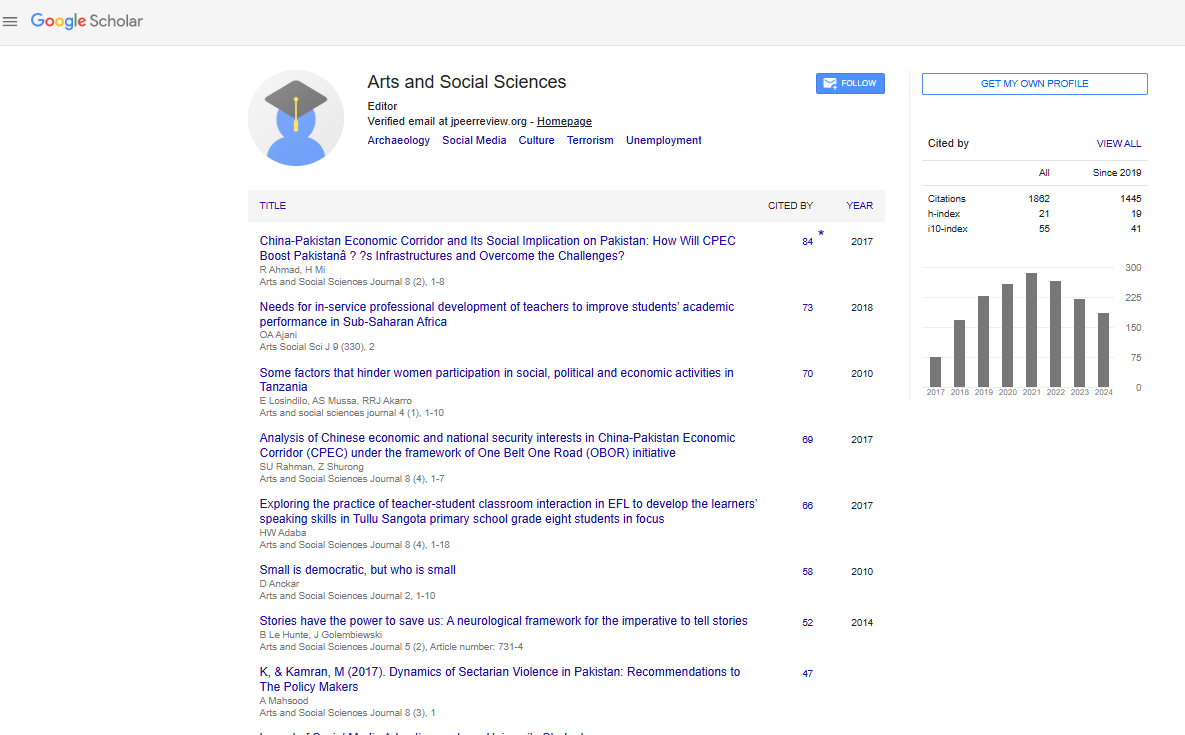
Arts and Social Sciences Journal received 1413 citations as per Google Scholar report