Brief Report - (2025) Volume 16, Issue 3
Received: 01-May-2025, Manuscript No. assj-25-172502;
Editor assigned: 03-May-2025, Pre QC No. P-172502;
Reviewed: 19-May-2025, QC No. Q-172502;
Revised: 22-May-2025, Manuscript No. R-172502;
Published:
29-May-2025
, DOI: 10.37421/2151-6200.2025.16.663
Citation: Wu, Mei-Ling. ”Art, Technology, and Human Experience.” Arts Social Sci 16(2025):663.
Copyright: © 2025 Wu M. This is an open-access article distributed under the terms of the Creative Commons Attribution License, which permits unrestricted use, distribution and reproduction in any medium, provided the original author and source are credited
A systematic review extensively demonstrates the effectiveness of arts-based interventions in enhancing mental health and overall well-being. This research synthesizes compelling evidence across various artistic modalities, highlighting their considerable potential to alleviate psychological distress, improve emotional regulation, and foster vital social connections within diverse populations. The findings strongly suggest that engaging with the arts provides significant therapeutic benefits, thus supporting their essential integration into contemporary mental health care frameworks and broader public health strategies [1].
Digital technologies are fundamentally reshaping contemporary art practices and aesthetic experiences, prompting a re-evaluation of established norms. This exploration advocates for a new paradigm in aesthetics that explicitly accounts for the interactive, ephemeral, and decentralized nature inherent in digital art. The authors meticulously analyze the profound implications these advancements hold for artistic creation, public reception, and critical discourse, ultimately suggesting that digital aesthetics profoundly challenges traditional notions of artistic authorship and inherent value [2].
In light of unprecedented global disruptions and continuously evolving societal needs, there is an urgent necessity for comprehensive curriculum reform in art education. This paper proposes a forward-looking framework designed to prioritize adaptability, foster robust interdisciplinary learning, and encourage critical engagement with pressing contemporary issues. The authors strongly advocate for an art education model that rigorously prepares students for a rapidly changing global landscape, cultivating both profound creativity and essential cultural literacy to thrive in the modern world [3].
A systematic review specifically explores the vital application of digital technologies in the preservation of invaluable cultural heritage. This study thoroughly evaluates various advanced digital tools and innovative methodologies, ranging from precise 3D scanning and immersive virtual reality experiences to comprehensive digital archiving solutions. It assesses their effectiveness in meticulously documenting, skillfully restoring, and making heritage broadly accessible. The research highlights the transformative potential of these technologies in safeguarding crucial cultural assets for the benefit of future generations, while also realistically addressing associated practical challenges [4].
This article delves deeply into the burgeoning and complex role of Artificial Intelligence (AI) in artistic creation, raising critical questions about its profound impact on traditional human authorship. It rigorously investigates the myriad ways AI tools are currently employed to generate art, meticulously analyze intricate aesthetic patterns, and even collaboratively co-create with human artists. The work explores whether this phenomenon signifies an exciting new era of boundless creative potential or presents a fundamental challenge to deeply ingrained notions of artistic originality and the unique human element in creative expression [5].
This paper meticulously examines how the â??post-digital conditionâ?? â?? characterized by the pervasive and deep integration of digital technologies across all aspects of life â?? necessitates the development of new, sophisticated methodologies for art history and visual culture studies. It argues compellingly for analytical approaches that fully account for the inherent fluidity, networked nature, and constant evolutionary dynamic of visual media. This perspective moves decisively beyond traditional interpretations to embrace the complex and symbiotic interplay between digital and analog elements in contemporary art practices and theory [6].
A critical perspective meticulously explores the profound emancipatory potential inherent in Black performance art. It highlights its crucial role in challenging entrenched dominant narratives, vigorously reclaiming cultural identities, and actively fostering social justice within communities. The authors thoughtfully analyze specific seminal works and influential movements, clearly demonstrating how Black artists strategically utilize performance as an extraordinarily powerful medium for resistance, profound healing, and robust community building, offering both alternative aesthetics and incisive critical insights into deeply lived experiences [7].
This study thoroughly investigates the proven efficacy of digital storytelling as an innovative method for significantly enhancing visitor engagement in diverse museum settings. Through a detailed case study approach, it convincingly demonstrates how thoughtfully designed interactive narratives and compelling digital media can cultivate more immersive and profoundly personalized experiences. This effectively fosters deeper, more meaningful connections between visitors and the exhibitions they explore. The findings provide practical, actionable insights for museum professionals keenly interested in leveraging technology to improve audience participation and learning outcomes more effectively [8].
This article thoroughly explores the crucial and expanding role of creative practice, specifically focusing on environmental art, in fostering meaningful public engagement with urgent ecological issues and actively shaping environmental consciousness. It argues persuasively that art possesses a unique capacity to provide fresh perspectives and forge powerful emotional connections to complex environmental challenges, thereby strongly motivating audiences towards heightened awareness and decisive action. The authors discuss various artistic interventions that effectively bridge the gap between abstract scientific understanding and concrete public perception, inspiring a collective response [9].
This paper delves deeply into the nuanced concept of everyday aesthetics, particularly examining its relevance in the unique and challenging context of the recent global pandemic. It presents a compelling argument for a thorough re-evaluation of beauty as it is encountered within mundane, routine experiences. The research explores how drastically altered daily routines and a heightened sense of domesticity during widespread global lockdowns significantly shifted societal focus towards the inherent aesthetic qualities of ordinary objects, familiar spaces, and transient moments. The authors discuss how this re-evaluation can profoundly enrich our understanding of aesthetic value, extending well beyond conventional, traditional art forms [10].
Arts-based interventions have emerged as potent tools for enhancing mental health and overall well-being, synthesizing evidence across various artistic modalities. These interventions effectively address psychological distress, improve emotional regulation, and foster social connection in diverse populations, supporting their integration into mental health care and public health strategies [1]. Beyond direct therapeutic applications, Black performance art exemplifies an emancipatory aesthetic, actively challenging dominant narratives and reclaiming cultural identities. It serves as a powerful medium for resistance, healing, and community building, offering critical insights into lived experiences and fostering social justice [7]. Moreover, environmental art significantly contributes to public engagement with ecological issues. It shapes environmental consciousness by providing unique perspectives and emotional connections to complex environmental challenges, motivating audiences towards greater awareness and action [9]. This interplay shows art's diverse capabilities in fostering both individual and collective well-being and awareness.
The art world is undergoing a profound transformation driven by digital technologies, fundamentally reshaping contemporary art practices and aesthetic experiences. This shift calls for a new paradigm in aesthetics that considers the interactive, ephemeral, and decentralized nature of digital art, challenging traditional notions of artistic authorship and value [2]. This technological impact extends crucially to cultural heritage preservation, where digital tools and methodologies are vital. Techniques like 3D scanning, virtual reality, and digital archiving are effectively documenting, restoring, and making heritage accessible, safeguarding cultural assets for future generations despite associated challenges [4]. The pervasive integration of digital technologies, often termed the â??post-digital condition,â?? necessitates new methodologies for art history and visual culture studies. These approaches must account for the fluidity and networked nature of visual media, moving beyond traditional interpretations to embrace the complex interplay between the digital and the analog in contemporary art [6].
Artificial Intelligence (AI) is playing an increasingly burgeoning role in artistic creation, prompting critical questions about its impact on human authorship. AI tools are now used to generate art, analyze aesthetic patterns, and even co-create with artists. This phenomenon invites discussion on whether AI signals a new era of creative potential or fundamentally challenges traditional notions of artistic originality and the irreplaceable human element in art [5].
Responding to global disruptions and evolving societal needs, there's an urgent call for curriculum reform in art education. A forward-looking framework is proposed that prioritizes adaptability, interdisciplinary learning, and critical engagement with contemporary issues. This aims to prepare students for a rapidly changing world, fostering creativity and cultural literacy essential for future success [3].
Digital storytelling demonstrates significant efficacy in enhancing visitor engagement within museum settings. Through interactive narratives and digital media, it creates more immersive and personalized experiences, fostering deeper connections between visitors and exhibitions. This approach offers practical insights for museum professionals aiming to improve audience participation and learning outcomes [8]. Concurrently, the recent pandemic prompted a re-evaluation of everyday aesthetics, highlighting beauty within mundane experiences. Altered routines and heightened domesticity shifted focus to the aesthetic qualities of ordinary objects, spaces, and moments. This discussion enriches the understanding of aesthetic value beyond traditional art forms, emphasizing the profound beauty found in daily life [10].
Recent research highlights the significant therapeutic benefits of arts-based interventions, demonstrating their effectiveness in enhancing mental health and overall well-being. These interventions, applicable across various artistic modalities, address psychological distress, improve emotional regulation, and foster social connection, advocating for their integration into mental health care and public health strategies. Meanwhile, digital technologies are fundamentally reshaping contemporary art practices and aesthetic experiences. This shift calls for a new paradigm in aesthetics that considers the interactive, ephemeral, and decentralized nature of digital art, challenging traditional ideas of artistic authorship and value. Digital tools also play a transformative role in cultural heritage preservation, utilizing methods like 3D scanning and virtual reality to document, restore, and make heritage accessible, ensuring cultural assets are safeguarded for future generations. The emergence of Artificial Intelligence (AI) in artistic creation raises critical questions about human authorship, as AI tools generate, analyze, and even co-create art. This development suggests either a new era of creative potential or a challenge to traditional artistic originality. These pervasive digital integrations, often termed the â??post-digital condition,â?? demand new methodologies for art history and visual culture studies, moving beyond traditional interpretations to embrace the complex interplay between digital and analog media. In response to evolving societal needs, art education requires urgent curriculum reform, prioritizing adaptability, interdisciplinary learning, and critical engagement with contemporary issues to prepare students for a rapidly changing world. Culturally, Black performance art showcases emancipatory potential, challenging dominant narratives, reclaiming identities, and fostering social justice through powerful mediums of resistance and community building. Furthermore, digital storytelling effectively enhances visitor engagement in museums, creating immersive and personalized experiences. Environmental art acts as a crucial tool for public engagement with ecological issues, fostering environmental consciousness by providing unique perspectives and emotional connections to complex challenges. Finally, the pandemic has led to a re-evaluation of everyday aesthetics, refocusing on beauty within mundane experiences and broadening our understanding of aesthetic value beyond conventional art forms.
None
None
Indexed at, Google Scholar, Crossref
Indexed at, Google Scholar, Crossref
Indexed at, Google Scholar, Crossref
Indexed at, Google Scholar, Crossref
Indexed at, Google Scholar, Crossref
Indexed at, Google Scholar, Crossref
Indexed at, Google Scholar, Crossref
Indexed at, Google Scholar, Crossref
Indexed at, Google Scholar, Crossref
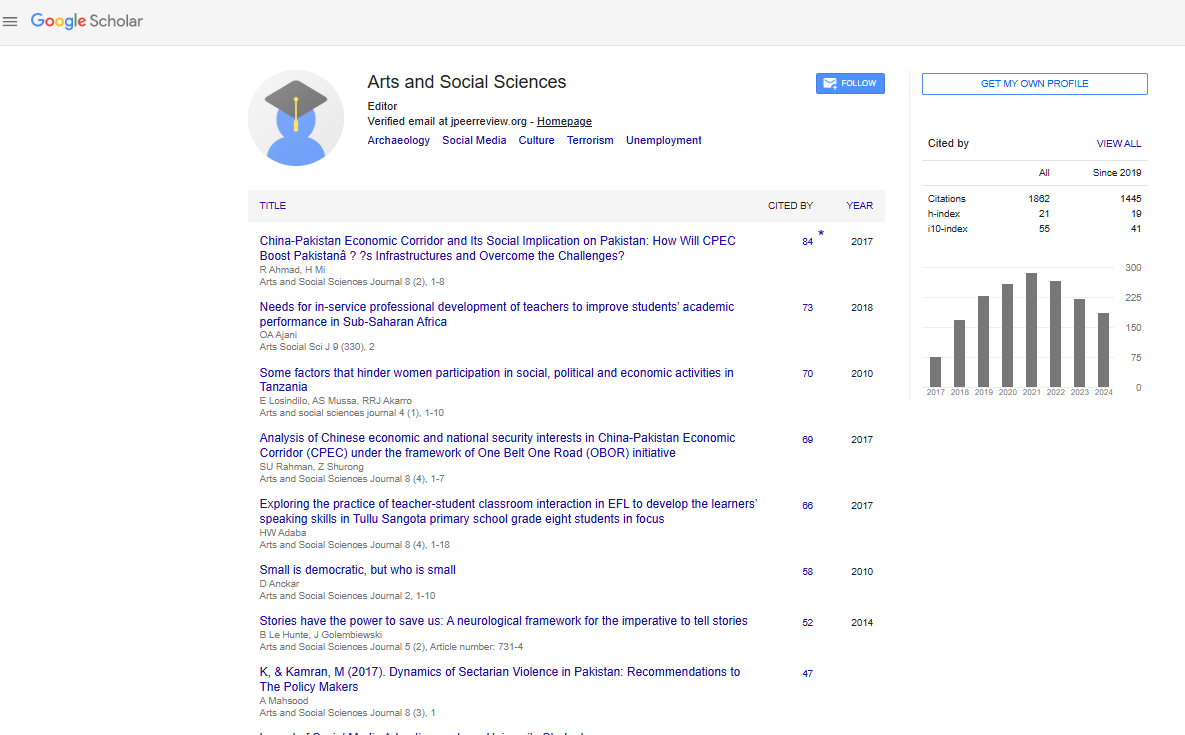
Arts and Social Sciences Journal received 1413 citations as per Google Scholar report