Perspective - (2025) Volume 14, Issue 5
Received: 01-Sep-2025, Manuscript No. aim-25-177775;
Editor assigned: 03-Sep-2025, Pre QC No. P-177775;
Reviewed: 17-Sep-2025, QC No. Q-177775;
Revised: 22-Sep-2025, Manuscript No. R-177775;
Published:
29-Sep-2025
, DOI: 10.37421/2427-5162.2025.14.593
Citation: Nakamura, Yuki. ”Aromatherapy: Relieving Distress, Enhancing Quality of Life.” Alt Integr Med 14 (2025):593.
Copyright: © 2025 Nakamura Y. This is an open-access article distributed under the terms of the Creative Commons Attribution License, which permits unrestricted use, distribution and reproduction in any medium, provided the original author and source are credited.
A systematic review and meta-analysis provided compelling evidence that aromatherapy can substantially reduce levels of stress, anxiety, and depression. This highlights its potential as an efficacious complementary therapy aimed at enhancing mental well-being, particularly for individuals navigating various forms of psychological distress, thereby broadening the scope of interventions available for mental health support [1].
Further research, specifically a meta-analysis, meticulously examined the efficacy of aromatherapy in managing pain experienced by surgical patients. The definitive conclusion was that aromatherapy significantly decreases pain intensity, positioning it as a valuable and non-pharmacological adjunct therapy in comprehensive post-operative care regimens, potentially reducing reliance on conventional analgesics [2].
A randomized controlled trial demonstrated that lavender aromatherapy offers notable benefits for hemodialysis patients, specifically improving anxiety levels, enhancing sleep quality, and alleviating fatigue. These findings underscore aromatherapy's role as a helpful, non-invasive intervention addressing common and debilitating patient complaints within a demanding medical context [3].
Another systematic review and meta-analysis concentrated on the impact of aromatherapy on chronic low back pain, revealing its capability to effectively lessen pain intensity and boost functional ability. This makes aromatherapy a viable complementary approach within integrated chronic pain management strategies, offering an alternative or adjunct to traditional treatments [4].
The utility of aromatherapy extends to oncology, as evidenced by a comprehensive review that explored its effects on chemotherapy-related symptoms in cancer patients. This research concluded that aromatherapy can mitigate adverse symptoms such as nausea, vomiting, and fatigue, thus providing a gentle supportive intervention throughout the challenging course of cancer treatment [5].
Beyond general applications, specific essential oils have been studied for their targeted effects, such as bergamot essential oil, whose inhalation was investigated for its influence on stress responses in healthy adults. The study found that bergamot oil significantly lowered heart rate and blood pressure, alongside reducing subjective feelings of stress, suggesting its potential for acute stress relief [6].
A meta-analysis focusing on elderly patients suffering from osteoarthritis elucidated aromatherapyâ??s positive impact on both pain and sleep quality. The study reported a significant reduction in pain intensity and marked improvements in sleep, establishing aromatherapy as a safe and effective adjunctive therapy specifically tailored for this vulnerable demographic [7].
The broader application of aromatherapy for mental health in specific populations was further affirmed by a systematic review and meta-analysis assessing its effects on anxiety and depression in individuals with chronic diseases. This investigation concluded that aromatherapy notably alleviates these symptoms, presenting a beneficial complementary approach to bolster mental health in this vulnerable group [8].
Pre-operative anxiety, a common concern in surgical settings, was the subject of a randomized controlled trial investigating Citrus aurantium (bitter orange) inhalation aromatherapy. The study reported a significant decrease in anxiety levels among patients awaiting elective surgery, thereby supporting its practical use as a calming intervention in clinical preparations [9].
Finally, a comprehensive systematic review and meta-analysis synthesized evidence regarding aromatherapyâ??s efficacy in managing pain, anxiety, and sleep quality among cancer patients. The findings consistently indicated significant improvements across all three outcomes, reinforcing aromatherapyâ??s position as a valuable supportive care intervention during complex cancer treatment pathways [10].
A robust systematic review and meta-analysis substantiated the therapeutic potential of aromatherapy in addressing prevalent psychological conditions, specifically stress, anxiety, and depression. The cumulative evidence from this rigorous methodology strongly advocates for its integration as an effective complementary approach to foster mental well-being, particularly benefiting individuals experiencing pronounced psychological distress, indicating a broad utility [1]. In the context of post-operative care, a targeted meta-analysis rigorously evaluated aromatherapy's capacity to modulate pain perception in surgical patients. The conclusive findings revealed a statistically significant reduction in pain intensity, highlighting aromatherapy's promise as a potent non-pharmacological adjunct. This offers clinicians an additional tool to improve patient comfort and recovery post-surgery [2]. A carefully designed randomized controlled trial investigating hemodialysis patients revealed that the application of lavender aromatherapy led to substantial improvements across several critical patient complaints. Specifically, it significantly mitigated anxiety, enhanced the quality of sleep, and reduced fatigue, collectively supporting its practical application as a valuable intervention for improving holistic patient outcomes [3]. Addressing chronic pain, a systematic review and meta-analysis specifically evaluated aromatherapy's influence on chronic low back pain. The analysis demonstrated that aromatherapy not only effectively diminished pain intensity but also considerably improved patients' functional abilities, thereby affirming its role as a viable and beneficial complementary strategy within comprehensive pain management protocols [4]. A thorough systematic review specifically concentrated on the multifaceted symptoms experienced by cancer patients undergoing chemotherapy. The review concluded that aromatherapy effectively contributed to alleviating common and debilitating symptoms such as nausea, vomiting, and fatigue, establishing it as a gentle yet effective supportive intervention crucial for enhancing the quality of life during cancer treatment [5]. An experimental study rigorously assessed the physiological and psychological effects of inhaling bergamot essential oil on healthy adults experiencing stress. The objective measurements indicated a significant decrease in both heart rate and blood pressure, corroborated by subjective reports of reduced stress, collectively substantiating its potential as an accessible intervention for acute stress relief [6]. For the specific demographic of elderly patients afflicted with osteoarthritis, a comprehensive meta-analysis explored the dual benefits of aromatherapy on pain and sleep quality. The results conclusively showed a significant reduction in pain intensity coupled with an undeniable improvement in sleep patterns, positioning aromatherapy as a safe, effective, and valuable adjunctive therapy for this population's complex needs [7]. Extending the application of aromatherapy to individuals managing chronic diseases, a systematic review and meta-analysis investigated its impact on anxiety and depression. The pooled data compellingly demonstrated a significant reduction in these pervasive symptoms, underscoring aromatherapy's utility as a complementary therapeutic avenue to bolster mental health resilience within this vulnerable patient group [8]. The challenge of pre-operative anxiety was directly addressed by a randomized controlled trial that assessed the impact of Citrus aurantium inhalation aromatherapy. The study conclusively reported a significant reduction in anxiety levels among patients scheduled for elective surgery, thereby providing empirical support for its integration as a simple yet effective calming strategy in pre-surgical preparations [9]. A culminating systematic review and meta-analysis synthesized evidence regarding aromatherapy's multifaceted benefits for cancer patients, specifically focusing on pain, anxiety, and sleep quality. The consistent findings across studies indicated significant improvements in all three domains, solidifying aromatherapy's status as an indispensable supportive care intervention that profoundly enhances the overall well-being of cancer patients [10].
A growing body of research consistently demonstrates the efficacy of aromatherapy across various clinical contexts, particularly in managing psychological distress and physical discomfort. Systematic reviews and meta-analyses highlight its significant role in reducing stress, anxiety, and depression, positioning it as a valuable complementary therapy for mental well-being. Furthermore, aromatherapy has proven effective in mitigating pain, including post-operative pain in surgical patients, chronic low back pain, and osteoarthritis-related pain in the elderly, often improving functional ability and sleep quality. Specific studies confirm the benefits of lavender aromatherapy for anxiety, sleep, and fatigue in hemodialysis patients, and bergamot essential oil for acute stress relief in healthy adults, by lowering physiological stress markers. In oncology, aromatherapy offers a supportive intervention by alleviating chemotherapy-related symptoms like nausea, vomiting, and fatigue, and generally improving pain, anxiety, and sleep quality in cancer patients. Citrus aurantium inhalation has also shown promise in reducing pre-operative anxiety. Collectively, these findings establish aromatherapy as a safe, effective, and versatile non-pharmacological intervention, enhancing patient outcomes and quality of life across diverse populations and health challenges.
None
None
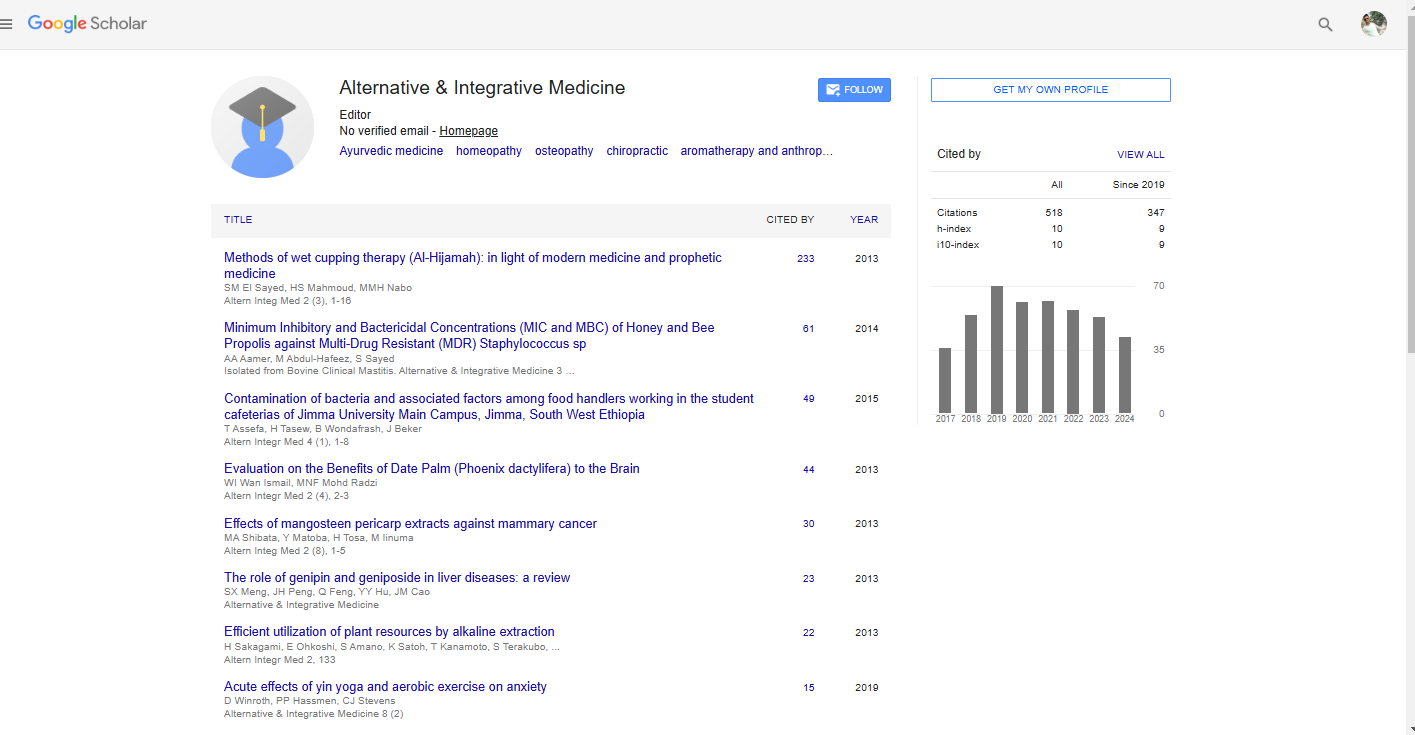
Alternative & Integrative Medicine received 476 citations as per Google Scholar report