Short Communication - (2025) Volume 14, Issue 5
Received: 01-Oct-2025, Manuscript No. jnc-25-173977;
Editor assigned: 03-Oct-2025, Pre QC No. P-173977;
Reviewed: 17-Oct-2025, QC No. Q-173977;
Revised: 22-Oct-2025, Manuscript No. R-173977;
Published:
29-Oct-2025
, DOI: 10.37421/2167-1168.2025.14.726
Citation: Becker, Thomas. ”APRNs: Driving Healthcare Quality and Access.” J Nurs Care 14 (2025):726.
Copyright: © 2025 Becker T. This is an open-access article distributed under the terms of the Creative Commons Attribution License, which permits unrestricted use, distribution and reproduction in any medium, provided the original author and source are credited.
Research spanning a decade consistently demonstrates the significant positive impact of Advanced Practice Registered Nurses (APRNs) on patient outcomes, healthcare quality, and overall costs. Their contributions are seen across various clinical settings, solidifying their role in improving patient care and enhancing system efficiency [1].
Despite their proven value, integrating and utilizing APRNs within healthcare systems often faces specific challenges. Common barriers include restrictive regulatory frameworks and a general lack of understanding regarding the extensive scope of the APRN role. Conversely, facilitators such as collaborative practice models and robust leadership support are vital in promoting their effective deployment [2].
A key area where APRNs make a substantial difference is in broadening access to primary healthcare services. This is particularly evident in underserved regions and for vulnerable populations, where APRNs are instrumental in expanding healthcare reach and significantly reducing patient wait times for appointments [3].
Effective preparation for complex clinical responsibilities is paramount for APRNs, and competency-based education models are crucial in this regard. These models are designed to ensure standardized competencies, which are essential for delivering high-quality patient care and fostering professional readiness among these practitioners [4].
The COVID-19 pandemic highlighted the adaptability and critical role of APRNs in healthcare delivery. They were pivotal in rapidly scaling up telehealth services, adopting new care models to maintain continuity of care and extend health services access when traditional in-person visits became restricted [5].
Beyond direct patient care, APRNs are increasingly involved in healthcare leadership and policy development. Their unique clinical expertise, combined with a holistic patient perspective, allows them to powerfully influence policy decisions, advocating for system improvements and better patient outcomes [6].
In integrated mental healthcare settings, APRNs provide invaluable contributions by bridging gaps in service delivery. They offer essential assessment, diagnosis, and management services, operating within collaborative care models to ensure comprehensive mental health support [7].
APRNs are uniquely positioned to address health disparities, leveraging their comprehensive approach to care. Their emphasis on holistic patient care, dedicated patient education, and deep community engagement makes them highly effective agents in reducing inequities and improving health outcomes for marginalized populations [8].
Economically, APRNs represent a highly valuable component of the healthcare workforce. Evidence strongly supports their cost-effectiveness across diverse clinical environments, demonstrating that they provide high-quality care while frequently contributing to reduced healthcare expenditures [9].
Finally, effective interprofessional collaboration is a cornerstone of optimal team-based care and patient outcomes, particularly with APRNs. Studies underscore the critical importance of mutual respect, clear role understanding, and open communication to foster successful collaborative practices [10].
Advanced Practice Registered Nurses (APRNs) have consistently demonstrated a profound positive impact on critical aspects of healthcare. Research spanning a decade underscores their significant contributions to improving patient outcomes, elevating healthcare quality, and managing costs effectively across various clinical settings. These professionals are recognized for their intrinsic value in refining patient care processes and enhancing overall system efficiency [1]. This pervasive influence makes them indispensable to modern healthcare delivery. APRNs also play an undeniably vital role in expanding access to primary healthcare services. This is particularly crucial in underserved geographical areas and for vulnerable populations, where their presence is instrumental in broadening healthcare reach and substantially reducing often-prohibitive appointment wait times. Their direct involvement ensures more equitable access to essential health services [3]. Economically, the cost-effectiveness of APRNs across diverse clinical environments is a well-documented advantage. There is compelling evidence that they consistently deliver high-quality care while frequently contributing to a reduction in overall healthcare expenditures. This makes APRNs not only clinically valuable but also an economically sound and strategic component of the broader healthcare workforce [9]. Their ability to deliver value at a lower cost profile reinforces their essential role.
The successful integration and optimal utilization of APRNs within existing healthcare systems are shaped by a complex interplay of factors. Common barriers encountered include restrictive regulatory frameworks that can limit their scope of practice, alongside a persistent lack of clear understanding within the wider healthcare community regarding the comprehensive and diverse roles of APRNs. Conversely, certain elements act as powerful facilitators, notably the implementation of collaborative practice models and the provision of strong, visible leadership support, which together are crucial for promoting their effective deployment and maximizing their impact [2]. To ensure APRNs are robustly prepared for their multifaceted and often complex clinical responsibilities, competency-based education models are absolutely crucial. These educational frameworks are meticulously designed to establish and reinforce standardized competencies, which are fundamental not only for upholding high-quality patient care but also for fostering unwavering professional readiness among these highly skilled practitioners. Such rigorous training is foundational to their efficacy [4].
APRNs have consistently demonstrated remarkable adaptability, particularly when faced with emergent healthcare challenges and shifts in service delivery. A prime example occurred during the COVID-19 pandemic, where they proved instrumental in rapidly expanding telehealth services. They swiftly embraced and adapted to new care delivery models, thereby ensuring vital continuity of care and significantly widening access to health services at a time when traditional in-person visits faced severe limitations [5]. Their agility in crisis proved invaluable. Beyond their direct patient care and clinical roles, APRNs are progressively stepping into more prominent positions within healthcare leadership and policy development. Their unique blend of extensive clinical insights, combined with a holistic, patient-centered perspective, empowers them to exert significant influence on policy decisions. This enables them to effectively advocate for systemic improvements and drive initiatives that result in better overall patient outcomes across the healthcare landscape [6].
The crucial contributions of APRNs also extend to highly specialized and often underserved areas, such as integrated mental healthcare settings. Here, they are absolutely vital in bridging existing service delivery gaps, offering essential assessment, accurate diagnosis, and comprehensive management services. These are provided effectively within collaborative care models, ensuring that patients receive holistic and integrated mental health support [7]. Moreover, APRNs are exceptionally well-positioned to actively address pervasive health disparities within communities. Their inherent focus on holistic care, coupled with dedicated patient education and profound community engagement, positions them as highly effective agents in reducing inequities and demonstrably improving health outcomes for marginalized populations. They act as key drivers of health equity [8]. Finally, fostering robust interprofessional collaboration is an indispensable cornerstone for achieving optimal team-based care and superior patient outcomes, especially when APRNs are central to the team. Studies emphatically underscore the critical importance of mutual respect among professionals, a clear and shared understanding of each role, and consistently effective communication. These elements are paramount for cultivating successful collaborative practices that truly benefit patients [10].
Advanced Practice Registered Nurses (APRNs) significantly impact patient outcomes, healthcare quality, and costs, consistently contributing positively across various settings. Their value in improving patient care and efficiency is well-documented. APRNs play a crucial role in improving access to primary healthcare, especially in underserved areas and for vulnerable populations, expanding healthcare reach and reducing appointment wait times. These professionals are also highly cost-effective, providing high-quality care while often reducing overall healthcare expenditures. During the COVID-19 pandemic, APRNs were pivotal in scaling telehealth services, rapidly adapting to new delivery models to ensure continuity of care. Their involvement extends to healthcare leadership and policy development, where they use clinical expertise to advocate for improved systems and patient outcomes. APRNs are uniquely positioned to address health disparities through holistic care, patient education, and community engagement, working to reduce inequities for marginalized populations. Factors influencing APRN integration include barriers like regulatory restrictions and lack of role understanding, contrasted with facilitators such as collaborative practice models and strong leadership support. The importance of competency-based education is also highlighted, ensuring APRNs are well-prepared for complex clinical roles and high-quality patient care. Moreover, APRNs make significant contributions in integrated mental healthcare, bridging service gaps with essential assessment, diagnosis, and management. Effective interprofessional collaboration, built on mutual respect and clear role understanding, is essential for optimizing patient outcomes when APRNs are part of the team.
None
None
1. Patricia RC, Lori AL, Deborah WW. "Advanced practice registered nurses: A 10-year review of research on outcomes, quality, and costs.".Nursing Outlook 71 (2023):101968.
Indexed at, Google Scholar, Crossref
2. Julie MS, Sarah JW, Robert TB. "Barriers and facilitators to advanced practice nurse utilization: A systematic review and meta-synthesis.".J Adv Nurs 78 (2022):56-70.
Indexed at, Google Scholar, Crossref
3. Maria LR, David KC, Sarah MW. "The impact of advanced practice registered nurses on access to primary healthcare: A scoping review.".Prim Health Care Res Dev 22 (2021):e45.
Indexed at, Google Scholar, Crossref
4. Karen LB, Michael RJ, Rebecca AT. "Competency-based education for advanced practice registered nurses: A systematic review.".J Prof Nurs 36 (2020):569-577.
Indexed at, Google Scholar, Crossref
5. Jessica MD, Christopher JE, Megan LW. "Advanced practice registered nurses and the expansion of telehealth services during the COVID-19 pandemic.".J Am Assoc Nurse Pract 33 (2021):5-11.
Indexed at, Google Scholar, Crossref
6. Sarah LP, Michael DG, Jennifer AL. "Advanced practice registered nurses in healthcare leadership and policy development: A qualitative study.".Policy Polit Nurs Pract 21 (2020):111-119.
Indexed at, Google Scholar, Crossref
7. Laura KW, Steven MB, Hannah JK. "The role of advanced practice registered nurses in integrated mental healthcare settings: A narrative review.".Issues Ment Health Nurs 40 (2019):709-715.
Indexed at, Google Scholar, Crossref
8. Emily TC, Daniel SM, Jessica RG. "Addressing health disparities through advanced practice registered nurse roles: A conceptual analysis.".Public Health Nurs 39 (2022):13-20.
Indexed at, Google Scholar, Crossref
9. Benjamin FT, Sarah GW, Robert HD. "The cost-effectiveness of advanced practice registered nurses in various clinical settings: A systematic review.".Health Policy 128 (2023):104683.
Indexed at, Google Scholar, Crossref
10. Olivia PA, Samuel JB, Nora KC. "Advanced practice registered nurses and interprofessional collaboration: A qualitative study on perceptions and experiences.".J Interprof Care 34 (2020):760-768.
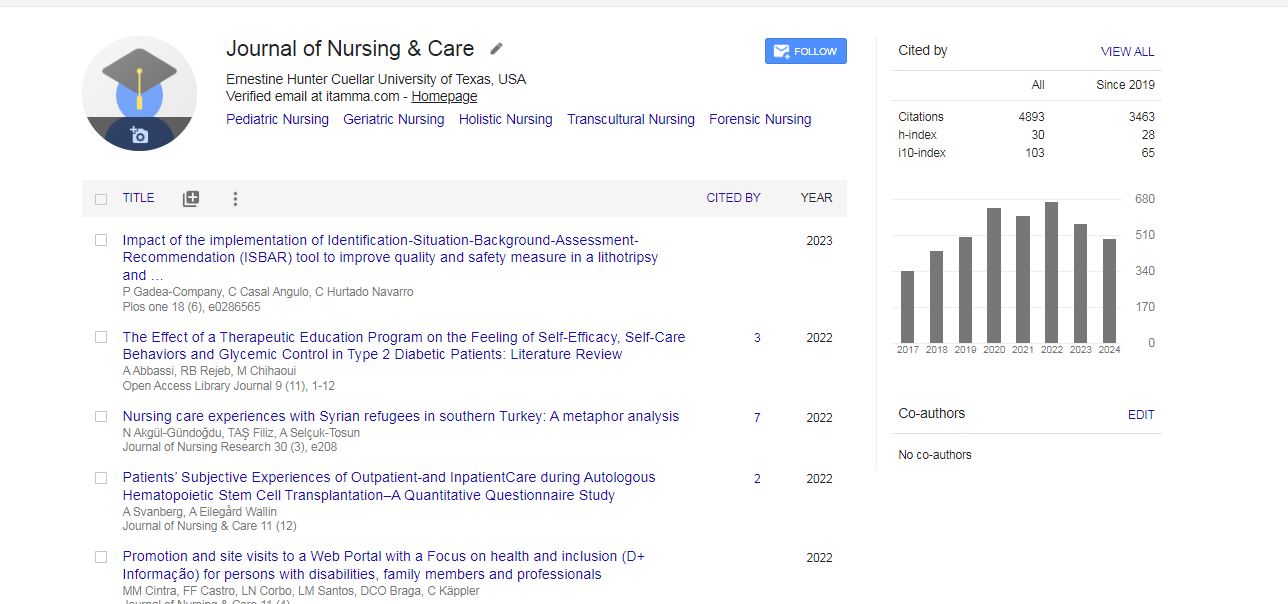
Journal of Nursing & Care received 4230 citations as per Google Scholar report