Brief Report - (2025) Volume 10, Issue 6
Received: 02-Nov-2025, Manuscript No. apn-26-179344;
Editor assigned: 04-Nov-2025, Pre QC No. P-179344;
Reviewed: 16-Nov-2025, QC No. Q-179344;
Revised: 23-Nov-2025, Manuscript No. R-179344;
Published:
30-Nov-2025
, DOI: 10.37421/2573-0347.2025.10.458
Citation: Lindström, Jonas. âAPNs Driving Quality Improvement: Strategies and Impact.â J Adv Practice Nurs 10 (2025):458.
Copyright: © 2025 Lindström J. This is an open-access article distributed under the terms of the Creative Commons Attribution License, which permits unrestricted use,
distribution and reproduction in any medium, provided the original author and source are credited.
Advanced Practice Nurses (APNs) are recognized as pivotal leaders in advancing quality improvement (QI) initiatives across diverse healthcare settings. Their comprehensive clinical acumen, inherent leadership qualities, and steadfast commitment to evidence-based practice empower them to expertly identify areas necessitating enhancement, strategically implement changes, and rigorously evaluate their impact on patient care and operational efficiency. This article aims to elucidate key strategies that APNs employ to drive QI, encompassing sophisticated data analysis for trend identification, the development of patient-centered care models, robust interprofessional collaboration, and the adept implementation of novel technologies and refined protocols designed to elevate patient safety and satisfaction. The overarching focus is on practical, nurse-led approaches that demonstrably yield measurable improvements in healthcare delivery. [1] Furthermore, research underscores the profound capacity of advanced practice registered nurses (APRNs) to spearhead quality improvement projects by adeptly harnessing their specialized expertise in diagnostic reasoning and the systematic synthesis of evidence. This perspective emphasizes the indispensable nature of a methodical approach, commencing with the precise identification of problems through meticulous data collection and subsequent analysis, proceeding to the thoughtful development and diligent implementation of interventions grounded in robust evidence. The study unequivocally highlights the substantial positive influence that APRN-led QI endeavors exert on patient outcomes and the overall efficiency of healthcare systems, underscoring their critical role. [2] Moreover, this article delves into the indispensable function of nurse practitioners (NPs) in cultivating an organizational culture that prioritizes safety and fosters a commitment to continuous quality improvement. It meticulously outlines practical, actionable strategies that NPs can readily employ, such as active participation in root cause analyses, the proactive development of patient safety protocols, and the crucial role of educating fellow healthcare professionals. The findings strongly suggest that NPs, owing to their direct and consistent patient contact and their demonstrated leadership capabilities, are uniquely situated to identify and effectively mitigate potential risks, thereby substantially enhancing both patient safety and the overall quality of care provided. [3] The seamless integration of advanced practice nurses (APNs) into collaborative interprofessional teams is posited as an absolutely crucial element for achieving successful quality improvement outcomes within the complex landscape of healthcare. This paper meticulously explores the manifold ways in which APNs contribute significantly to QI efforts, primarily by adeptly facilitating clear and effective communication channels, championing evidence-based decision-making processes, and consistently advocating for the unique needs and preferences of patients. It further details specific strategies designed to empower APNs to collaborate effectively with physicians, pharmacists, and other allied health professionals, thereby working towards the attainment of shared QI goals, ultimately leading to demonstrably better patient outcomes and a reduction in overall healthcare expenditures. [4] An investigation into the practical application of Lean Six Sigma methodologies by advanced practice nurses (APNs) specifically for process improvement within critical care settings is presented. It vividly demonstrates how APNs are exceptionally well-equipped to lead multidisciplinary teams in the systematic identification and elimination of inefficiencies or waste, the reduction of medical errors, and the enhancement of patient flow through critical care units. The research thoughtfully provides a comprehensive framework that APNs can utilize to effectively implement these data-driven QI tools, resulting in tangible improvements in operational efficiency, a significant reduction in patient lengths of stay, and a marked enhancement in patient safety within these high-acuity environments. [5] The strategic utilization of technology by advanced practice nurses (APNs) emerges as a profoundly powerful and indispensable strategy for achieving significant advancements in quality improvement. This article meticulously explores the diverse ways in which APNs can effectively leverage critical technological tools, including sophisticated electronic health records (EHRs), accessible telehealth platforms, and advanced data analytics tools, to meticulously monitor patient outcomes, identify emergent trends in care delivery, and subsequently implement highly targeted and effective interventions. It strongly emphasizes the vital role of APNs in actively championing the widespread adoption of innovative technologies with the ultimate goal of enhancing the overall quality of care delivery and bolstering patient safety. [6] This qualitative study offers a deep and insightful exploration into the lived experiences of advanced practice nurses (APNs) who are actively engaged in leading quality improvement projects within primary care settings. It meticulously identifies a spectrum of common facilitators that promote success and barriers that can impede progress, such as the availability of organizational support, the effectiveness of interdisciplinary communication, and the pervasive issue of time constraints. The findings derived from this study provide invaluable insights into practical strategies that can be implemented to better support APNs in their dedicated QI endeavors, ultimately leading to a significant improvement in both the quality and accessibility of essential primary healthcare services for all patients. [7] Advanced practice nurses (APNs) are positioned to play a pivotal and indispensable role in the systematic implementation of evidence-based practice (EBP) as a cornerstone strategy for achieving meaningful quality improvement. This article meticulously outlines the detailed process through which APNs can effectively lead the critical integration of EBP into established clinical workflows. This comprehensive process encompasses the diligent searching for relevant evidence, the rigorous critical appraisal of research findings, and the effective dissemination of acquired knowledge. The authors compellingly argue that APNs possess a unique and advantageous position that enables them to effectively bridge the often-observed gap between cutting-edge research and its practical application in everyday clinical practice, thereby leading to demonstrably enhanced patient care and improved health outcomes. [8] A systematic review meticulously examines the tangible impact of interventions spearheaded by advanced practice nurses (APNs) on patient satisfaction levels. This comprehensive review synthesizes critical findings from a multitude of diverse studies, consistently demonstrating that APN-led initiatives, which characteristically focus on crucial aspects such as patient education, effective communication, and well-coordinated care, significantly contribute to the enhancement of patient experiences and elevate overall satisfaction levels. The authors definitively conclude that APNs are highly effective leaders in their capacity to foster and improve the patient-centeredness of healthcare delivery. [9] This perspective piece thoughtfully outlines a conceptual framework specifically designed to empower advanced practice nurses (APNs) to effectively lead quality improvement within the specialized domain of nursing education. It particularly emphasizes the paramount importance of developing curricula that are firmly grounded in current evidence, integrating innovative simulation-based learning experiences, and establishing robust methods for the assessment of critical clinical competencies. The authors propose that APNs, given their inherent dual focus on both direct clinical practice and educational responsibilities, are exceptionally well-suited to spearhead QI initiatives within nursing programs, thereby ensuring the improved preparedness of future generations of nurses entering the profession. [10]
Advanced Practice Nurses (APNs) are instrumental in driving quality improvement (QI) initiatives within healthcare settings. Their clinical expertise, leadership capabilities, and focus on evidence-based practice allow them to identify areas for enhancement, implement change, and evaluate outcomes. This article explores key strategies APNs employ, including data analysis for identifying trends, patient-centered care model development, interprofessional collaboration, and the implementation of new technologies and protocols to elevate patient safety and satisfaction. The focus is on practical, nurse-led approaches that yield measurable improvements. [1] This research highlights how advanced practice registered nurses (APRNs) can effectively lead quality improvement projects by leveraging their expertise in diagnostic reasoning and evidence synthesis. It emphasizes the importance of a systematic approach, beginning with problem identification through data collection and analysis, followed by the development and implementation of evidence-based interventions. The study underscores the positive impact of APRN-led QI on patient outcomes and healthcare system efficiency. [2] This article examines the critical role of nurse practitioners (NPs) in fostering a culture of safety and continuous quality improvement. It outlines practical strategies NPs can employ, such as participating in root cause analyses, developing patient safety protocols, and educating other healthcare professionals. The findings suggest that NPs, through their direct patient contact and leadership skills, are uniquely positioned to identify and mitigate risks, thereby enhancing patient safety and care quality. [3] The integration of advanced practice nurses (APNs) into interprofessional teams is crucial for successful quality improvement in healthcare. This paper explores how APNs contribute to QI by facilitating communication, promoting evidence-based decision-making, and advocating for patient needs. It details strategies for APNs to effectively collaborate with physicians, pharmacists, and other allied health professionals to achieve shared QI goals, leading to better patient outcomes and reduced healthcare costs. [4] This study investigates the application of Lean Six Sigma methodologies by advanced practice nurses (APNs) for process improvement in critical care settings. It demonstrates how APNs can lead teams in identifying and eliminating waste, reducing errors, and enhancing patient flow. The research provides a framework for APNs to implement these data-driven QI tools, resulting in improved efficiency, reduced lengths of stay, and enhanced patient safety in high-acuity environments. [5] The utilization of technology by advanced practice nurses (APNs) is a powerful strategy for quality improvement. This article explores how APNs can leverage electronic health records (EHRs), telehealth platforms, and data analytics tools to monitor patient outcomes, identify trends, and implement targeted interventions. It emphasizes the role of APNs in championing the adoption of innovative technologies to enhance care delivery and patient safety. [6] This qualitative study explores the experiences of advanced practice nurses (APNs) leading quality improvement projects in primary care. It identifies common facilitators and barriers to their leadership, such as organizational support, interdisciplinary communication, and time constraints. The findings offer insights into how to better support APNs in their QI endeavors, ultimately improving the quality and accessibility of primary healthcare services. [7] Advanced practice nurses (APNs) play a pivotal role in implementing evidence-based practice (EBP) as a strategy for quality improvement. This article outlines the process by which APNs can lead the integration of EBP into clinical workflows, including searching for evidence, critically appraising research, and disseminating findings. The authors argue that APNs are uniquely positioned to bridge the gap between research and practice, leading to enhanced patient care and outcomes. [8] This systematic review examines the impact of advanced practice nurse (APN)-led interventions on patient satisfaction. The review synthesizes findings from multiple studies demonstrating that APN-led initiatives, often focusing on patient education, communication, and coordinated care, significantly improve patient experiences and satisfaction levels. The authors conclude that APNs are effective leaders in enhancing the patient-centeredness of care. [9] This perspective piece outlines a conceptual framework for advanced practice nurses (APNs) to lead quality improvement in nursing education. It emphasizes the importance of curriculum development based on current evidence, simulation-based learning, and the assessment of clinical competencies. The authors propose that APNs, with their dual focus on practice and education, are ideally suited to drive QI within nursing programs, thereby improving the preparedness of future nurses. [10]
Advanced Practice Nurses (APNs) are central to driving quality improvement (QI) in healthcare through various strategies. They utilize data analysis to identify trends and develop patient-centered care models. Effective interprofessional collaboration is highlighted as a key component, alongside the implementation of new technologies and protocols to enhance patient safety and satisfaction. APRNs lead QI projects by leveraging their expertise in diagnostic reasoning and evidence synthesis, employing systematic approaches from problem identification to intervention implementation, which positively impacts patient outcomes and system efficiency. Nurse practitioners (NPs) are crucial in fostering a culture of safety and continuous improvement by participating in root cause analyses and developing safety protocols. Lean Six Sigma methodologies are applied by APNs in critical care for process improvement, reducing errors and enhancing patient flow. APNs also utilize technology, such as EHRs and telehealth, to monitor outcomes and implement interventions. Their role in implementing evidence-based practice (EBP) is vital for bridging research and practice. Furthermore, APN-led interventions have shown to significantly improve patient satisfaction, and a framework exists for APNs to lead QI in nursing education, ensuring better preparedness of future nurses.
None
None
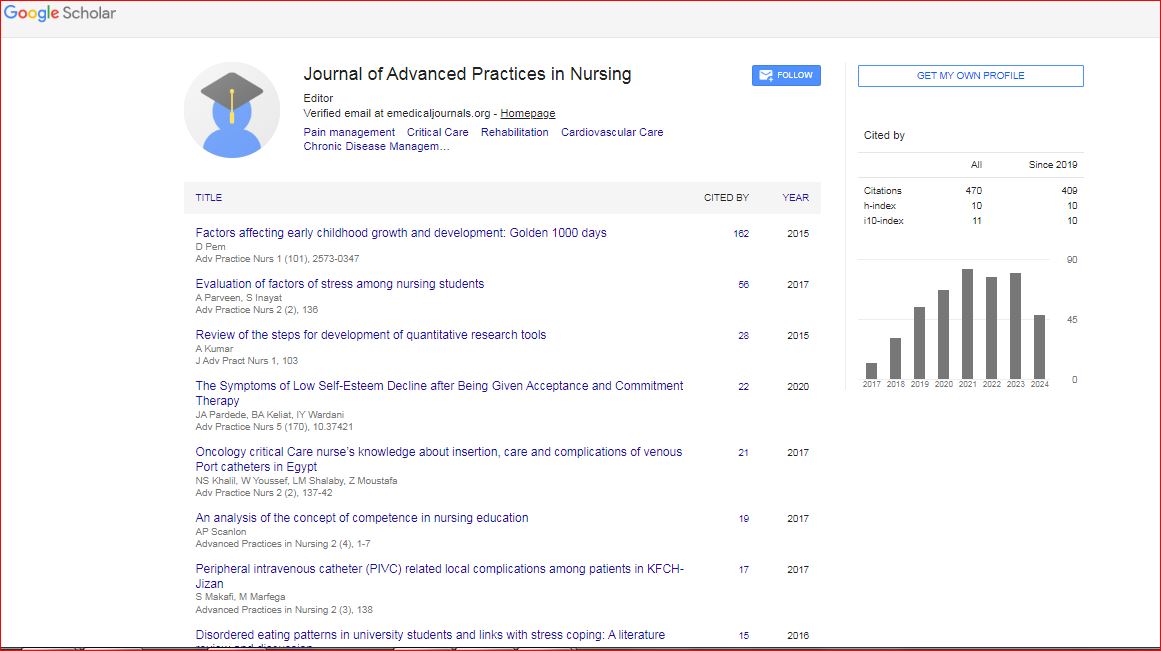
Journal of Advanced Practices in Nursing received 410 citations as per Google Scholar report