Commentary - (2025) Volume 14, Issue 5
Received: 01-Oct-2025, Manuscript No. jnc-25-173983;
Editor assigned: 03-Oct-2025, Pre QC No. P-173983;
Reviewed: 17-Oct-2025, QC No. Q-173983;
Revised: 22-Oct-2025, Manuscript No. R-173983;
Published:
29-Oct-2025
, DOI: 10.37421/2167-1168.2025.14.730
Citation: Cooper, Daniel. ”APNs: Driving Quality, Access, and Efficiency.” J Nurs Care 14 (2025):730.
Copyright: © 2025 Cooper D. This is an open-access article distributed under the terms of the Creative Commons Attribution License, which permits unrestricted use, distribution and reproduction in any medium, provided the original author and source are credited.
The role of Advanced Practice Nurses (APNs) has become increasingly critical in navigating the complexities of modern healthcare systems. These highly skilled professionals are recognized for their diverse contributions, impacting everything from patient outcomes to healthcare system efficiency. Understanding their influence requires a look at various studies that illuminate the scope, effectiveness, and implementation factors of APN roles. Effective implementation of advanced clinical nurse practitioner roles across various healthcare environments relies heavily on foundational elements. Robust organizational support is crucial, providing the necessary framework and resources for these roles to thrive. A clearly defined scope of practice is equally important, allowing APNs to operate at their full capacity without ambiguity. Moreover, seamless team integration is vital, ensuring collaborative practice within multidisciplinary settings. These critical factors highlight where strategic efforts must focus to strengthen and optimize APN contributions [1].
The leadership capabilities of APNs are a significant driver of positive healthcare results. Studies consistently demonstrate that when these nurses assume leadership positions, there is a clear correlation with improved patient outcomes, enhanced care quality, and more efficient healthcare delivery. This underscores the profound value APN leadership brings to systemic improvements and operational effectiveness [2].
Similarly, Clinical Nurse Specialists (CNS), an integral part of advanced practice nursing, make substantial contributions to healthcare quality and patient outcomes. Their impact is evident across various settings, particularly in bolstering patient safety, optimizing care processes, and reducing hospital readmissions, directly improving patient well-being and system efficiency [3].
To ensure comprehensive and effective care, particularly in primary settings, advanced practice nurses require specific core competencies. A systematic review identifies essential skills and knowledge areas that enable APNs to perform their expanded roles. These competencies encompass advanced assessment, diagnostic reasoning, complex care planning, and patient education, ensuring they can address a broad spectrum of patient needs within primary health settings [4].
Furthermore, the involvement of APNs generally leads to higher patient satisfaction and significant improvements in the overall quality of healthcare delivery, as indicated by a systematic review and meta-analysis. This positive influence extends to patient experience, highlighting the humanistic value APNs add to care provision [5].
APNs also play a critical role in specialized areas such as mental health services. Here, they contribute significantly to assessment, diagnosis, treatment, and ongoing care for individuals with mental health conditions. Their involvement has shown positive impacts on patient recovery and overall well-being, often filling crucial gaps in mental healthcare access and provision [6].
Beyond specialized care, APNs are instrumental in improving access to primary healthcare. Their role in expanding service availability, especially in underserved areas, demonstrates their capacity to make healthcare more accessible for a wider patient population, thereby addressing health disparities [7].
In the realm of chronic disease management, APNs prove highly effective in improving patient outcomes. Systematic reviews confirm their ability to enhance adherence to treatment plans and bolster self-management capabilities for individuals living with chronic conditions, leading to better long-term health [8].
Moreover, APNs are pivotal in fostering interprofessional collaboration within healthcare teams. A qualitative study highlights their central role in facilitating communication, coordinating care, and enhancing team dynamics, ultimately improving the efficiency and cohesiveness of patient care delivery through strong teamwork [9].
Finally, the economic benefits of integrating APNs are substantial. A systematic review assessing the cost-effectiveness of advanced practice nurses across diverse healthcare environments concludes that their integration often results in significant cost savings. Crucially, these economic efficiencies are achieved without any compromise to the quality of care, thus demonstrating their considerable economic value to health systems and supporting sustainable healthcare models [10].
These collective findings underscore the profound and multifaceted contributions of APNs to a higher quality, more accessible, and economically viable healthcare landscape.
Advanced Practice Nurses (APNs) represent a cornerstone of modern healthcare delivery, offering specialized expertise and a broad scope of practice that significantly impacts various aspects of patient care and system efficiency. The successful integration and optimal functioning of these roles depend on several foundational factors. Studies consistently reveal that organizational support is paramount, as it provides the essential resources and an enabling environment for APNs to flourish in their expanded capacities [1]. Complementary to this, a clearly defined scope of practice is crucial, ensuring that APNs can utilize their advanced training effectively without professional ambiguities. Furthermore, their seamless integration into existing healthcare teams is vital, promoting interprofessional collaboration and coordinated patient care across diverse healthcare settings [1].
The impact of APNs extends significantly into leadership and quality improvement. When Advanced Practice Nurses assume leadership roles, evidence indicates a direct correlation with enhanced patient outcomes and superior care quality. Their leadership capabilities contribute to more efficient healthcare delivery, streamlining processes and optimizing resource utilization [2]. This positive influence on quality is further exemplified by Clinical Nurse Specialists (CNS), who are integral to advancing healthcare quality. Their work has a confirmed impact on improving patient safety, optimizing care processes, and critically, reducing hospital readmissions across various settings. These contributions highlight their role in elevating the standards of patient care and system performance [3]. To facilitate such high-level contributions, particularly in primary care, APNs require a distinct set of core competencies. These essential skills and knowledge areas enable them to deliver comprehensive and effective care within their expanded roles, addressing complex patient needs proactively [4].
A significant benefit of APN involvement is the demonstrable improvement in patient satisfaction and overall quality of care. Research, including systematic reviews and meta-analyses, indicates that patients often report higher satisfaction levels when APNs are part of their care team. This satisfaction stems from thorough explanations, attentive care, and a sense of continuity. Concurrently, the presence of APNs is associated with improvements in the overall quality of healthcare delivery, signifying their multifaceted value beyond clinical outcomes to patient experience [5]. The specialized contributions of APNs are also evident in mental health services, where they play critical roles in assessment, diagnosis, treatment, and ongoing care for individuals with mental health conditions. Their efforts lead to positive impacts on patient recovery and overall well-being, providing much-needed expertise in a often underserved area [6].
Beyond direct clinical and specialized care, APNs are instrumental in broadening access to healthcare services, particularly in primary care settings. Systematic reviews highlight their significant role in expanding the availability of services, especially in areas that traditionally face shortages of healthcare professionals. By extending care into underserved communities, APNs contribute substantially to making healthcare more accessible for a broader patient population, thereby mitigating health disparities [7]. Their effectiveness is also pronounced in chronic disease management, where they significantly improve patient outcomes, enhance adherence to treatment plans, and empower individuals with chronic conditions to better manage their health [8].
Crucially, APNs also act as catalysts for improved interprofessional collaboration within healthcare teams. A qualitative study on this subject reveals their pivotal role in facilitating communication, ensuring effective care coordination, and fostering positive team dynamics. This collaborative approach, championed by APNs, ultimately leads to more cohesive and efficient patient care delivery [9]. Finally, the integration of advanced practice nurses into various healthcare environments proves to be cost-effective. Systematic reviews conclude that their inclusion often results in considerable cost savings for health systems, all while maintaining or even enhancing the quality of care provided. This economic value, combined with their clinical and access-enhancing contributions, underscores the strategic importance of APNs in shaping a sustainable and high-quality healthcare future [10].
Advanced Practice Nurses (APNs) are central to the evolution of healthcare, as evidenced by a comprehensive body of research exploring their multifaceted contributions. Here's the thing, successful implementation of advanced clinical nurse practitioner roles hinges on robust organizational support, clearly defined scopes of practice, and effective team integration [1]. These elements are critical for strengthening these expanded roles across diverse healthcare settings. APN leadership capabilities notably affect healthcare results, leading to better patient outcomes, improved care quality, and more efficient service delivery [2]. Similarly, Clinical Nurse Specialists make significant contributions to healthcare quality, particularly in enhancing patient safety, streamlining care processes, and reducing hospital readmissions [3]. In primary care, specific core competencies are essential for APNs to provide comprehensive and effective care in their expanded capacities [4]. What this really means is that APNs generally lead to higher patient satisfaction and improvements in overall healthcare quality [5]. Their roles extend significantly into mental health services, where they are critical in assessment, diagnosis, treatment, and ongoing care, showing positive impacts on patient recovery and well-being [6]. APNs also play a crucial role in improving access to primary healthcare, expanding service availability especially in underserved areas [7]. Their effectiveness is clearly demonstrated in chronic disease management, where they improve patient outcomes, treatment adherence, and self-management capabilities [8]. Beyond direct patient care, APNs are pivotal in fostering interprofessional collaboration within healthcare teams, facilitating communication, coordinating care, and enhancing team dynamics [9]. Furthermore, integrating APNs often yields significant cost savings without compromising care quality, highlighting their economic value to health systems [10]. Overall, APNs are indispensable for delivering high-quality, accessible, and cost-effective healthcare.
None
None
1. Sowndharya S, Deborah S, Patricia D. "Factors influencing the implementation of advanced clinical nurse practitioner roles in various healthcare settings: A scoping review".Int J Nurs Stud 144 (2023):104523.
Indexed at, Google Scholar, Crossref
2. Soyoung K, Hyunjin P, Jinsuk L. "The impact of Advanced Practice Nurse leadership on healthcare outcomes: A systematic review".J Adv Nurs 78 (2022):1542-1558.
Indexed at, Google Scholar, Crossref
3. Denise B, Ruth M, Paula H. "Clinical Nurse Specialists' contributions to healthcare quality and patient outcomes: An integrative review".J Nurs Scholarsh 53 (2021):147-158.
Indexed at, Google Scholar, Crossref
4. Mijin H, Youngmee K, Jeonghee L. "Developing core competencies for advanced practice nurses in primary care: A systematic review".J Nurs Educ 59 (2020):485-492.
Indexed at, Google Scholar, Crossref
5. Xiaoqing M, Weiyan Z, Shuang J. "The effect of advanced practice nurses on patient satisfaction and quality of care: A systematic review and meta-analysis".J Nurs Manag 27 (2019):755-766.
Indexed at, Google Scholar, Crossref
6. Kathleen K, Maria ADM, George K. "Advanced practice nursing in mental health: A systematic review of roles and outcomes".Arch Psychiatr Nurs 43 (2023):24-33.
Indexed at, Google Scholar, Crossref
7. Simona DD, Michele V, Laura DV. "The contribution of advanced practice nurses to improving access to primary healthcare: A systematic review".J Clin Nurs 31 (2022):156-172.
Indexed at, Google Scholar, Crossref
8. Eunyoung K, Jinhee K, Soohyun L. "The effectiveness of advanced practice nurses in chronic disease management: A systematic review".Int J Nurs Stud 117 (2021):103901.
Indexed at, Google Scholar, Crossref
9. Zohar CYC, Wing MT, Chun KC. "Exploring the role of advanced practice nurses in interprofessional collaboration within healthcare teams: A qualitative study".J Interprof Care 34 (2020):460-469.
Indexed at, Google Scholar, Crossref
10. Yan Y, Xuesong L, Ying W. "Cost-effectiveness of advanced practice nurses in various healthcare settings: A systematic review".Int J Nurs Pract 25 (2019):e12739.
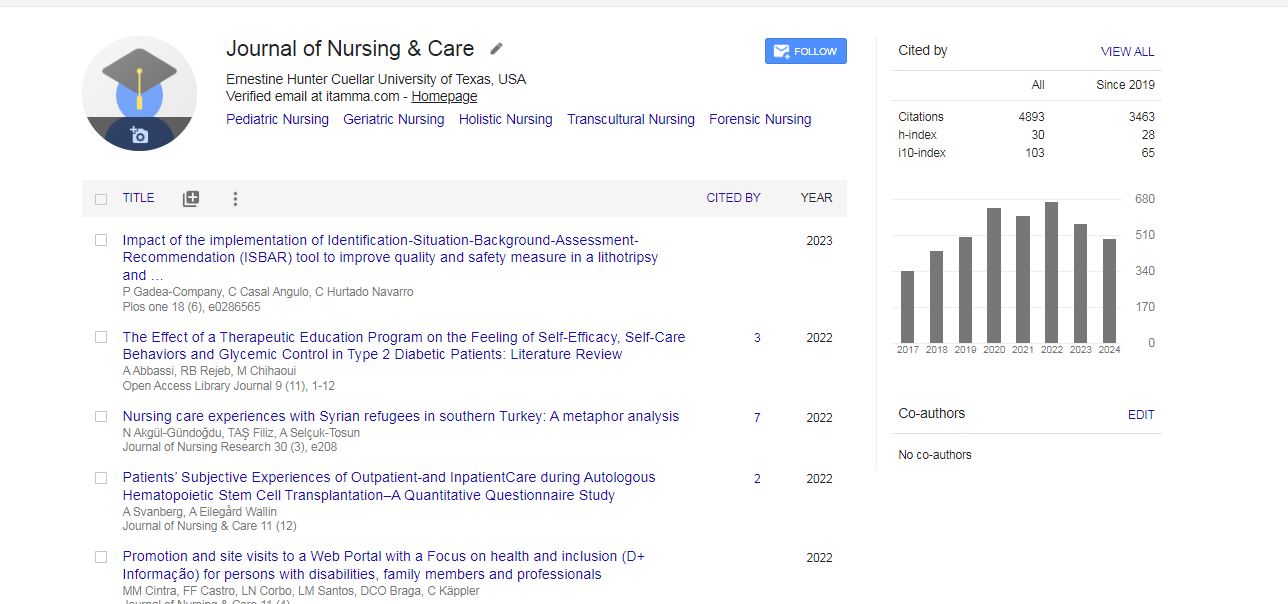
Journal of Nursing & Care received 4230 citations as per Google Scholar report