Opinion - (2025) Volume 14, Issue 6
Received: 31-Oct-2025, Manuscript No. jmmd-26-184710;
Editor assigned: 03-Nov-2025, Pre QC No. P-184710;
Reviewed: 17-Nov-2025, QC No. Q-184710;
Revised: 21-Nov-2025, Manuscript No. R-184710;
Published:
29-Nov-2025
, DOI: 10.37421/2161-0703.2025.14.554
Citation: Haddad, Omar. ”Antimicrobial Resistance in Urinary Tract Infections: A Growing Threat.” J Med Microb Diagn 14 (2025):554.
Copyright: © 2025 Haddad O. This is an open-access article distributed under the terms of the Creative Commons Attribution License, which permits unrestricted use, distribution and reproduction in any medium, provided the original author and source are credited.
The landscape of urinary tract infections (UTIs) is characterized by a dynamic interplay of prevalent bacterial pathogens and their evolving resistance patterns to commonly employed antibiotics. This understanding is paramount for guiding effective empirical treatment strategies and shaping robust public health initiatives, particularly in the face of the escalating challenge of antimicrobial resistance [1].
The susceptibility of common uropathogens to a spectrum of antibiotics is a critical area of investigation, with regional trends in resistance necessitating informed local treatment guidelines. Continuous antibiogram surveillance is emphasized as a vital tool for directing clinical decisions and addressing the growing problem of resistance [2].
Specific pathogens causing UTIs and their associated resistance profiles are continuously being examined, offering insights into the shifting epidemiology of these infections. The necessity of maintaining up-to-date antibiograms to ensure appropriate antibiotic selection is a recurring theme in current research [3].
The distribution of key bacterial species responsible for UTIs and their sensitivity to various antibiotics is a subject of ongoing reporting. Emerging resistance mechanisms and their clinical ramifications are highlighted, underscoring the importance of localized data for optimal UTI management [4].
An updated perspective on the frequent bacterial agents implicated in UTIs and their increasing resistance to antibiotics is crucial. Healthcare professionals are strongly urged to consult local antibiograms to ensure the best possible patient care, especially given the widespread nature of resistance [5].
The prevalence of diverse bacterial species causing UTIs and their susceptibility to critical antibiotics are areas of active research. The rising concern over multidrug-resistant organisms and the need for informed prescribing practices, grounded in regional antibiograms, are significant considerations [6].
An analysis of the dominant pathogens in UTIs and their corresponding resistance profiles provides a critical snapshot of the current antimicrobial susceptibility landscape. These findings are vital for informing empirical antibiotic therapy and developing strategies to combat resistance development [7].
Data on common uropathogens and their susceptibility to various antibiotics highlight the substantial challenges posed by antimicrobial resistance. The indispensability of local antibiograms for the effective management of UTIs is consistently emphasized in relevant studies [8].
The distribution of bacterial pathogens responsible for UTIs and their resistance patterns to frequently used antibiotics are detailed in numerous studies. The imperative for continuous monitoring of resistance trends to inform treatment strategies and combat the proliferation of multidrug-resistant organisms is evident [9].
An examination of the most common bacterial culprits of UTIs and their variable resistance to antimicrobial agents reveals a complex and evolving picture. The dynamic nature of pathogen distribution and resistance necessitates the regular updating of antibiograms to ensure the continued efficacy of treatment regimens [10].
The current epidemiological landscape of urinary tract infections (UTIs) is heavily influenced by the prevalent bacterial pathogens and their increasingly concerning resistance patterns to commonly used antibiotics. Understanding this distribution is not merely academic; it is crucial for the effective implementation of empirical treatment protocols and the formulation of robust public health strategies, especially as the challenge of antimicrobial resistance continues to grow globally [1].
Investigating the susceptibility of common uropathogens to a range of antibiotics is essential for understanding local resistance trends. These trends are instrumental in guiding the development and refinement of local treatment guidelines. The importance of consistent and regular antibiogram surveillance cannot be overstated, as it provides the necessary data to guide clinical decisions and effectively combat escalating resistance [2].
Research efforts are focused on examining the prevalence of specific pathogens responsible for UTIs and their corresponding resistance profiles. This ongoing work provides invaluable insights into the changing epidemiology of these infections. Consequently, the need for up-to-date antibiograms to ensure the selection of appropriate antibiotics for patients remains a critical priority [3].
Reports on the distribution of key bacterial species that cause UTIs, along with their sensitivity patterns to a diverse array of antibiotics, are vital for clinical practice. These reports often highlight emerging resistance mechanisms and their significant clinical implications, thereby reinforcing the importance of utilizing local data for effective UTI management [4].
An updated perspective on the common bacterial agents that are responsible for UTIs and their evolving resistance to antibiotics is critical for healthcare providers. The studies strongly emphasize the critical need for healthcare professionals to consult local antibiograms to ensure optimal patient care, particularly in settings where widespread resistance is a significant concern [5].
The research landscape also includes detailed analyses of the prevalence of different bacterial species that cause UTIs and their susceptibility to key antibiotics. These studies frequently highlight the growing concern surrounding multidrug-resistant organisms and underscore the necessity of informed prescribing practices that are guided by regional antibiograms [6].
A detailed analysis of the dominant pathogens implicated in UTIs and their resistance profiles offers a crucial snapshot of the current antimicrobial susceptibility landscape. The findings derived from such analyses are indispensable for guiding empirical antibiotic therapy and for the development of effective strategies aimed at mitigating the further development of resistance [7].
Studies presenting data on common uropathogens and their susceptibility to various antibiotics consistently underscore the profound challenges posed by antimicrobial resistance. These findings reiterate the importance of local antibiograms as a cornerstone for the effective management of UTIs in clinical settings [8].
Research into the distribution of bacterial pathogens responsible for UTIs and their resistance patterns to commonly used antibiotics highlights a significant public health concern. The studies consistently emphasize the need for continuous monitoring of resistance trends to inform treatment strategies and to effectively combat the rise of multidrug-resistant organisms [9].
An examination of the most frequent bacterial culprits responsible for UTIs and their varying degrees of resistance to antimicrobial agents reveals a complex and dynamic situation. This research emphasizes the ever-changing nature of pathogen distribution and resistance, advocating strongly for the regular update of antibiograms to ensure the sustained efficacy of treatment regimens [10].
This collection of research highlights the critical issue of antimicrobial resistance in urinary tract infections (UTIs). Studies from various regions investigate the prevalence of uropathogens and their susceptibility patterns to different antibiotics. A recurring theme across these findings is the increasing resistance of common bacteria to standard treatments, emphasizing the need for updated local antibiograms to guide effective empirical therapy. The dynamic nature of pathogen distribution and resistance necessitates continuous surveillance and informed prescribing practices to combat the growing threat of multidrug-resistant organisms and ensure optimal patient outcomes.
None
None
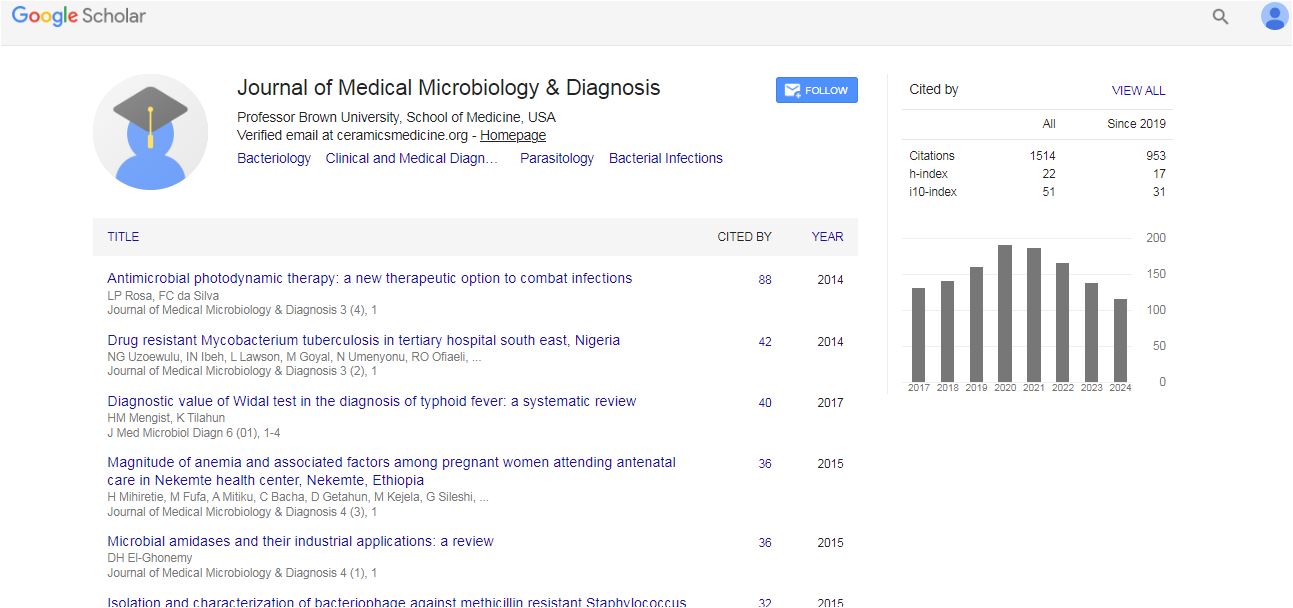
Medical Microbiology & Diagnosis received 14 citations as per Google Scholar report