Commentary - (2025) Volume 9, Issue 5
Received: 01-Oct-2025, Manuscript No. ahbs-26-182518;
Editor assigned: 03-Oct-2025, Pre QC No. P-182518;
Reviewed: 17-Oct-2025, QC No. Q-182518;
Revised: 22-Oct-2025, Manuscript No. R-182518;
Published:
29-Oct-2025
, DOI: 10.37421/2952-8097.2025.9.333
Citation: Duarte, Helena. ”Antibiotics’ Impact on Animal Behavior:
Gut-Brain Axis.” J Anim Health Behav Sci 09 (2025):333.
Copyright: © 2025 Duarte H. This is an open-access article distributed under the terms of the Creative Commons Attribution License, which permits unrestricted use,
distribution and reproduction in any medium, provided the original author and source are credited.
The intricate connection between antimicrobial use in veterinary medicine and animal behavior is a growing area of scientific inquiry, revealing profound physiological and psychological impacts. These effects are largely mediated through the gut microbiome, a complex ecosystem that plays a pivotal role in modulating host behavior via the gut-brain axis. Antimicrobial agents, while crucial for treating bacterial infections, can disrupt this delicate balance, leading to a cascade of consequences that influence an animal's mental state and social interactions. The review by Silva et al. highlights how antibiotic-induced alterations in the gut-brain axis can manifest as increased anxiety, aggression, and aberrant social behaviors in both livestock and companion animals, underscoring the importance of this interaction for optimizing animal welfare [1].
Further elucidating these mechanisms, Santos et al. delve into the concept of antibiotic-induced dysbiosis, emphasizing its significant impact on the production of short-chain fatty acids (SCFAs). These SCFAs are vital for maintaining brain health, and their reduced levels following antibiotic exposure have been linked to neuroinflammation and behavioral deficits, including impaired learning and heightened fear responses. This research underscores the mechanistic links between antibiotic administration, gut dysbiosis, and subsequent behavioral changes, calling for judicious antibiotic stewardship [2].
In young animals, the timing of antibiotic exposure is particularly critical, as demonstrated by Ferreira et al. Their studies on pigs indicate that broad-spectrum antibiotic administration during critical developmental periods can permanently alter the development of the enteric nervous system and brain regions involved in social cognition. This can result in reduced affiliative behaviors and increased aggression later in life, highlighting the long-term consequences of early antibiotic interventions [3].
Companion animals are not immune to these effects, as noted by Ribeiro et al. They report common behavioral manifestations in pets treated with antibiotics, such as increased vocalization, restlessness, and appetite changes. These symptoms are often attributed to disruptions in the gut-brain axis, particularly the altered production of key neurotransmitters like serotonin, which are influenced by the gut microbiota. The review also suggests potential mitigation strategies, such as probiotic use [4].
The practice of using sub-therapeutic antibiotic doses in livestock, primarily for growth promotion, also carries behavioral implications beyond the well-documented issue of antimicrobial resistance. Martinez et al. investigated these subtle behavioral shifts in cattle, observing changes in feeding patterns, social hierarchies, and exploratory behaviors. These alterations can significantly impact herd dynamics and overall animal welfare, indicating that even low-dose antibiotic use can have discernible behavioral consequences [5].
Beyond gut-mediated effects, emerging research points to direct neurotoxic effects of certain antibiotics. Sanchez et al. examine the evidence for direct neurotoxicity of commonly used veterinary antibiotics, suggesting that some agents can directly impact the central nervous system independent of gut microbiome alterations. These neurotoxic effects can lead to behavioral syndromes characterized by lethargy, disorientation, and motor function changes across various animal species [6].
The cumulative impact of repeated antibiotic courses, especially in intensive farming systems, is another critical consideration. Fernandez et al. studied broiler chickens and found that multiple antibiotic treatments, even with different classes of drugs, increased fearfulness and reduced foraging activity. This research highlights the cumulative behavioral burden associated with intensive antimicrobial use in production animals [7].
In light of these varied impacts, veterinary antimicrobial stewardship programs are increasingly being urged to incorporate behavioral considerations into their decision-making processes. Silva et al. propose a framework for evaluating the behavioral side effects of antibiotics, advocating for the selection of agents less likely to disrupt the gut-brain axis and influence animal disposition. This emphasizes the need for evidence-based antimicrobial selection to ensure optimal animal well-being [8].
Understanding the specific effects on the enteric nervous system (ENS) is key to comprehending antibiotic-induced behavioral changes. Pereira et al. explore how early-life antibiotic exposure can disrupt ENS maturation, leading to altered gut motility and brain communication, which are implicated in anxiety-like behaviors. Their research investigates the effects of common veterinary antibiotics on ENS development in rodent models [9].
Finally, unraveling the molecular pathways involved is essential for developing targeted interventions. Rodrigues et al. investigate the role of antibiotic-induced changes in tryptophan metabolism and serotonin signaling. Alterations in these pathways profoundly influence mood, appetite, and social interactions, offering potential targets for counteracting antibiotic-related behavioral changes and improving animal welfare [10].
The profound influence of antimicrobial agents on animal behavior, particularly through their interaction with the gut microbiome and the subsequent modulation of the gut-brain axis, is a significant concern in veterinary medicine. Silva et al. provide a comprehensive overview of how antibiotic use can disrupt gut microbiome composition, leading to alterations in neurotransmitter production and consequently affecting host behavior. Their findings highlight the potential for increased anxiety, aggression, and altered social interactions in livestock and companion animals, emphasizing the need to understand these links for improved animal welfare and therapeutic strategy development [1].
Further elaborating on the mechanistic underpinnings, Santos et al. investigate the detrimental effects of antibiotic-induced gut dysbiosis on the production of short-chain fatty acids (SCFAs). These SCFAs are crucial for maintaining neural health, and their depletion due to antibiotic exposure is associated with neuroinflammation and a range of behavioral deficits, including impaired cognitive functions like learning and exacerbated fear responses. This research underscores the critical need for careful antibiotic stewardship to prevent such detrimental outcomes [2].
The developmental trajectory of young animals is particularly susceptible to the impact of antibiotics. Ferreira et al. demonstrate that early-life exposure to broad-spectrum antibiotics can have lasting effects on social behavior and stress responsiveness. Their studies in pigs reveal that such exposure can disrupt the maturation of the enteric nervous system and specific brain regions, ultimately leading to reduced prosocial behaviors and increased aggression in adulthood, thus stressing the importance of the timing and duration of antibiotic treatments [3].
Ribeiro et al. focus on the observable behavioral changes in companion animals following antimicrobial therapy. They document common manifestations such as increased vocalization, restlessness, and reduced appetite, linking these symptoms to gut-brain axis disruptions. Specifically, they point to alterations in serotonin production, which is heavily influenced by gut microbiota, and propose the use of probiotics as a potential strategy to mitigate these side effects [4].
The widespread use of sub-therapeutic antibiotic doses in livestock for growth promotion also warrants attention for its behavioral consequences. Martinez et al. explore these subtle behavioral alterations in cattle, noting shifts in feeding behaviors, social dynamics, and exploration. These changes can have cascading effects on herd management and overall animal welfare, indicating that even low-dose antibiotic use is not without behavioral impact [5].
Beyond the gastrointestinal tract, certain antibiotics may exert direct neurotoxic effects, independent of gut microbiome alterations. Sanchez et al. review the evidence for direct neurotoxicity of veterinary antibiotics, describing how these agents can directly affect the central nervous system, leading to behavioral syndromes such as lethargy, disorientation, and motor impairments in various animal species [6].
In intensive farming environments, the cumulative effects of repeated antibiotic administrations are a significant concern. Fernandez et al. examine how multiple antibiotic courses influence the behavior of broiler chickens, revealing an increase in fearfulness and a decrease in foraging activity. This study highlights the combined behavioral burden that animals may experience due to frequent antibiotic treatments [7].
To address these multifaceted issues, veterinary antimicrobial stewardship programs need to integrate behavioral impact assessments. Silva et al. propose a structured framework for evaluating the behavioral side effects of different antibiotics. Their approach advocates for the selection of antimicrobial agents that pose a lower risk to the gut-brain axis and animal disposition, thereby promoting optimal animal well-being through informed drug choices [8].
A deeper understanding of how antibiotics affect the enteric nervous system (ENS) is crucial for explaining their behavioral consequences. Pereira et al. investigate the impact of early-life antibiotic exposure on ENS development. They find that disruptions in ENS maturation can lead to altered gut motility and impaired gut-brain communication, which are implicated in the development of anxiety-like behaviors in animals [9].
Finally, identifying the molecular mechanisms underlying these behavioral changes is paramount for developing effective countermeasures. Rodrigues et al. focus on the role of antibiotic-induced alterations in tryptophan metabolism and serotonin signaling. By understanding how these pathways are affected, researchers can identify targets for interventions aimed at counteracting antibiotic-related behavioral disruptions and improving the mental health of animals [10].
Antimicrobial use in veterinary medicine significantly impacts animal behavior, primarily through disruption of the gut microbiome and the gut-brain axis. Antibiotics can lead to increased anxiety, aggression, and altered social interactions by affecting neurotransmitter production and short-chain fatty acid levels. Early-life and repeated antibiotic exposure, as well as sub-therapeutic use for growth promotion, have lasting behavioral consequences. Some antibiotics may also have direct neurotoxic effects. These behavioral changes include restlessness, appetite disturbances, and alterations in fearfulness and exploratory behaviors. Recognizing and mitigating these effects is crucial for animal welfare, with strategies like probiotic use and improved antimicrobial stewardship being explored. Research is ongoing to understand the molecular pathways, such as tryptophan metabolism and serotonin signaling, involved in these antibiotic-induced behavioral shifts.
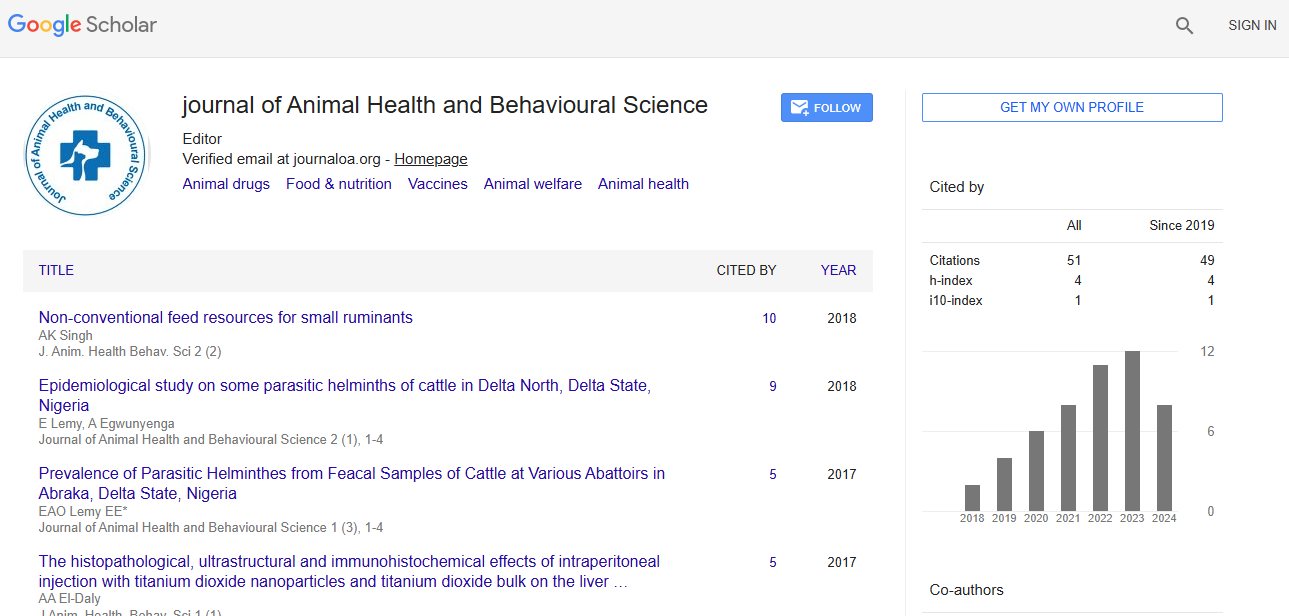
Journal of Animal Health and Behavioural Science received 38 citations as per Google Scholar report