Opinion - (2025) Volume 11, Issue 5
Received: 01-Oct-2025, Manuscript No. abp-25-173892;
Editor assigned: 03-Oct-2025, Pre QC No. P-173892;
Reviewed: 17-Oct-2025, QC No. Q-173892;
Revised: 22-Oct-2025, Manuscript No. R-173892;
Published:
29-Oct-2025
, DOI: 10.37421/2472-0496.2025.11.343
Citation: El-Gamal, Aisha. ”Anorexia: Neuroscience, Personalized Care, Recovery Advances.” Abnorm Behav Psychol 11 (2025):343.
Copyright: © 2025 El-Gamal A. This is an open-access article distributed under the terms of the Creative Commons Attribution License, which permits unrestricted use, distribution and reproduction in any medium, provided the original author and source are credited.
Understanding and treating anorexia nervosa (AN) has seen significant advancements, with a strong emphasis on innovative therapeutic strategies, crucial early intervention, and highly individualized patient care. There is a strong movement towards integrating insights from neuroscience directly into clinical practice, which is proving instrumental in shaping more effective and sustainable strategies for patients striving for long-term recovery from this complex disorder [1].
A deeper dive into the neurobiological underpinnings of AN is providing invaluable insights, specifically through the examination of both structural and functional brain abnormalities. Comprehensive neuroimaging studies have been instrumental in synthesizing findings that pinpoint specific neural circuits, revealing their involvement in altered reward processing, distorted body image perception, and challenges with impulse controlâ??all of which are recognized as central to the disorder's intricate pathology [2].
The effectiveness and profound importance of early intervention strategies for AN cannot be overstated. Research consistently stresses that commencing timely and specialized treatment dramatically improves the overall prognosis for individuals and works to significantly reduce the potential for the illness to become chronic. This understanding strongly advocates for widespread enhancement of screening protocols and the establishment of more accessible care pathways, particularly tailored for adolescents and young adults identified as being at risk [3].
Current clinical practice guidelines offer a robust framework for treating eating disorders, including AN, specifically within adolescent populations. These guidelines meticulously synthesize evidence-based approaches, offering clear recommendations for comprehensive care models. Such models crucially integrate essential medical management, targeted nutritional rehabilitation, and various forms of psychotherapy, all operating within a cohesive, multidisciplinary framework to support optimal outcomes [4].
A prevalent challenge in treating AN is the remarkably high rate of comorbidity with other psychological conditions, notably anxiety and mood disorders. This intricate interplay between AN and co-occurring mental health issues highlights a critical need for integrated treatment approaches. These comprehensive strategies are essential to effectively address the entire spectrum of psychological distress that patients frequently experience, moving beyond just the eating disorder symptoms [5].
The etiology of AN is understood as a complex and multifactorial phenomenon, arising from an intricate interplay of both genetic and environmental factors. Accumulated evidence consistently points to inherent genetic predispositions, which then interact with various external influences including cultural pressures, individual psychological vulnerabilities, and broader social elements, all collectively contributing to the disorder's development and persistence [6].
Recent strides in the neuroscience of eating disorders, including AN, are significantly advancing our understanding of these conditions. Specifically, research synthesizes findings on key brain circuits that are implicated in appetite regulation, how reward is processed, and interoception. These insights offer a deeper understanding into the core biological mechanisms that not only perpetuate the disorder but also crucially guide the development of more precise and targeted therapeutic interventions [7].
In an increasingly digital world, the potential of digital interventions for AN, encompassing mobile applications, online platforms, and teletherapy services, is being systematically evaluated. These technologies hold promise for complementing traditional care models, expanding vital access to specialized treatment, and providing ongoing support throughout the recovery journey. Concurrently, researchers are identifying critical areas requiring further investigation and development within this burgeoning field [8].
An emerging area of significant interest is the role of gut microbiota in both the pathogenesis and maintenance of eating disorders, particularly AN. Systematic reviews discuss compelling findings on dysbiosisâ??an imbalance in gut floraâ??and its potential far-reaching impact on crucial brain-gut axis communication, inflammatory processes, and various metabolic functions. These discoveries are opening up entirely new and promising avenues for innovative therapeutic interventions [9].
Finally, it is paramount to acknowledge and address the substantial burden experienced by caregivers of individuals living with AN. Systematic reviews dedicated to this topic meticulously identify common stressors, profound psychological impacts on families, and their critical support needs. This research strongly advocates for the integration of comprehensive family support strategies directly alongside patient treatment, recognizing that this holistic approach is vital for improving overall patient and family outcomes [10].
Anorexia nervosa (AN) is a severe eating disorder characterized by significant advancements in its understanding and treatment. Modern approaches increasingly emphasize novel therapeutic strategies, alongside a critical focus on early intervention and personalized care. Integrating contemporary neuroscience with established clinical practice is proving crucial for developing more effective strategies leading to long-term recovery [1]. Recognizing the urgency, early intervention strategies are continuously being reviewed for their importance and effectiveness. Timely, specialized treatment is shown to significantly improve prognosis and reduce the illnessâ??s chronicity, advocating strongly for enhanced screening and accessible care pathways, especially for at-risk adolescents and young adults [3].
The neurobiological underpinnings of AN are being systematically investigated, examining structural and functional brain abnormalities. Neuroimaging studies have synthesized findings on specific neural circuits involved in altered reward processing, body image distortion, and impulse control, all considered central to the disorder's pathology [2]. This neurological perspective is complemented by an understanding of AN's multifactorial etiology, which involves a complex interplay of genetic and environmental factors. Research highlights genetic predispositions interacting with cultural, psychological, and social elements [6]. Further progress in the neuroscience of eating disorders, including AN, illuminates brain circuits linked to appetite regulation, reward processing, and interoception. These insights offer a deeper understanding of the biological mechanisms perpetuating the disorder and guide the creation of targeted treatments [7].
Comorbidity is a significant challenge in AN, with high rates observed between eating disorders, particularly AN, and anxiety and mood disorders. This intricate interplay between conditions necessitates integrated treatment approaches to address the full spectrum of psychological distress experienced by patients [5]. To this end, current clinical practice guidelines for treating eating disorders, including AN in adolescents, provide a comprehensive framework. These guidelines synthesize evidence-based approaches, recommending a multidisciplinary framework that integrates medical management, nutritional rehabilitation, and psychotherapy for holistic patient care [4].
Innovation in treatment delivery includes the evaluation of digital interventions for AN. This encompasses apps, online platforms, and teletherapy, assessing how these technologies can complement traditional care, expand access to treatment, and support recovery. This area also identifies critical needs for further research and development [8]. Parallel to technological advancements, research is exploring the emerging role of gut microbiota in the pathogenesis and maintenance of AN. Studies discuss findings on dysbiosis and its potential impact on brain-gut axis communication, inflammation, and metabolic processes, suggesting new avenues for therapeutic interventions [9].
Finally, the significant burden experienced by caregivers of individuals with AN is a crucial consideration. Systematic reviews investigate common stressors, psychological impacts, and support needs of families, advocating for integrated family support strategies alongside patient treatment to improve overall outcomes for both patients and their support networks [10].
Recent advancements in anorexia nervosa (AN) treatment underscore the importance of novel therapeutic approaches, early intervention, and personalized care, increasingly integrating neuroscience for long-term recovery [1]. Research highlights the neurobiological underpinnings of AN, identifying structural and functional brain abnormalities involved in reward processing, body image distortion, and impulse control [2]. Early and specialized interventions are crucial for improving prognosis and reducing chronicity, particularly for adolescents and young adults [3]. Clinical practice guidelines recommend comprehensive, multidisciplinary care, combining medical, nutritional, and psychotherapeutic strategies [4]. AN often presents with high comorbidity with anxiety and mood disorders, necessitating integrated treatment for broad psychological distress [5]. The disorder's etiology is understood as a complex interplay of genetic and environmental factors, including cultural, psychological, and social influences [6]. Further neuroscientific progress reveals insights into brain circuits for appetite regulation and reward processing, guiding targeted treatments [7]. Digital interventions, such as apps and teletherapy, are being explored for their potential to enhance access and support recovery [8]. Emerging research also points to the significant role of gut microbiota in AN pathogenesis, with dysbiosis potentially affecting brain-gut communication and metabolism, opening new therapeutic avenues [9]. Finally, the substantial burden on caregivers of individuals with AN is recognized, advocating for integrated family support strategies to improve overall outcomes [10].
None
None
1. Walter HK, Christina EW, Karin S. "Eating disorders: Progress in the treatment of anorexia nervosa.".World Psychiatry 22 (2023):153-154.
Indexed at, Google Scholar, Crossref
2. Federico A, Alessia S, Giovanni AD. "Neurobiology of anorexia nervosa: A systematic review of structural and functional neuroimaging studies.".Brain Sci 12 (2022):1597.
Indexed at, Google Scholar, Crossref
3. Tao L, Wei Z, Qi C. "Early intervention in anorexia nervosa: A critical review.".Front Psychiatry 14 (2023):1140097.
Indexed at, Google Scholar, Crossref
4. Gary SG, Wendy S, Mark ST. "Clinical practice guidelines for the treatment of eating disorders in adolescents: A narrative review.".J Can Acad Child Adolesc Psychiatry 30 (2021):141-158.
Indexed at, Google Scholar, Crossref
5. Susanne U, Anna B, Claes N. "Comorbidity of eating disorders with anxiety and mood disorders: A narrative review.".J Eat Disord 8 (2020):64.
Indexed at, Google Scholar, Crossref
6. Zeynep Y, A. SK, Cynthia MB. "Anorexia nervosa: a complex interplay of genetic and environmental factors.".Transl Psychiatry 9 (2019):6.
Indexed at, Google Scholar, Crossref
7. Katherine MC, Secondo F, Nancy Z. "Advances in the neuroscience of eating disorders.".Curr Psychiatry Rep 25 (2023):65-76.
Indexed at, Google Scholar, Crossref
8. Myrto A, Konstantinos V, Lampros Z. "Digital interventions for anorexia nervosa: A systematic review.".Digital Health 8 (2022):20552076211070203.
Indexed at, Google Scholar, Crossref
9. Chao Z, Chang Z, Dong L. "The role of gut microbiota in eating disorders: A systematic review.".Front Psychiatry 12 (2021):619020.
Indexed at, Google Scholar, Crossref
10. Jo W, Glenn W, Noraini M. "Caring for a loved one with anorexia nervosa: A systematic review of caregiver burden and support.".Eat Behav 36 (2020):101340.
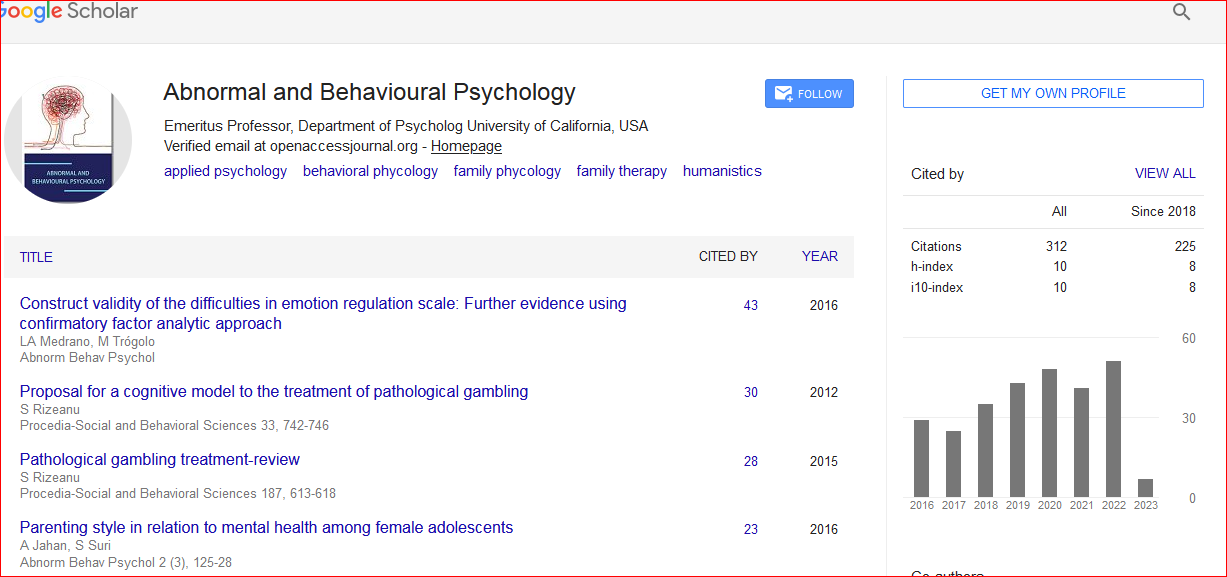
Abnormal and Behavioural Psychology received 361 citations as per Google Scholar report