Perspective - (2025) Volume 9, Issue 3
Received: 02-Jun-2025, Manuscript No. ahbs-26-182447;
Editor assigned: 04-Jun-2025, Pre QC No. P-182447;
Reviewed: 18-Jun-2025, QC No. Q-182447;
Revised: 23-Jun-2025, Manuscript No. R-182447;
Published:
30-Jun-2025
, DOI: 10.37421/2952-8097.2025.9.320
Citation: Bianchi, Luca. ”Animal Cognition: Research, Development,
and Interventions.” J Anim Health Behav Sci 09 (2025):320.
Copyright: © 2025 Bianchi L. This is an open-access article distributed under the terms of the Creative Commons Attribution License, which permits unrestricted use,
distribution and reproduction in any medium, provided the original author and source are credited.
The intricate study of cognitive functions in animal models forms a cornerstone of veterinary research, offering profound insights into neurological disorders and behavioral interventions [1].
Understanding memory, attention, and problem-solving capabilities in animals is crucial for enhancing animal welfare, particularly in domesticated and livestock species [1].
This research aims to bridge the gap between observed learning behaviors and underlying neurological mechanisms, guiding strategies for training and stress mitigation [1].
Early life stress significantly impacts cognitive development and learning behaviors, leading to long-term alterations in memory and emotional regulation [2].
Adverse early experiences highlight the critical role of a supportive environment for optimal cognitive development and suggest targets for intervention [2].
The investigation into training methodologies for working animals reveals the comparative efficacy of different techniques on learning and cognitive flexibility [3].
Operant conditioning and positive reinforcement approaches are assessed for their impact on task acquisition, retention, and adaptability [3].
Environmental enrichment plays a vital role in promoting cognitive health and improving learning abilities in captive animals [4].
Varied and stimulating environments positively influence neural plasticity, problem-solving skills, and reduce abnormal behaviors [4].
The neurobiological basis of social learning and cooperation in animal populations is explored, examining how social interactions shape learning trajectories and group behaviors [5].
Cognitive phenotyping in laboratory animals provides a translational approach to understanding neurological disorders, enabling researchers to investigate complex cognitive processes like memory and attention [1].
This understanding is essential for developing effective behavioral interventions and improving the welfare of various animal species, including those in veterinary research settings [1].
By linking observed learning behaviors to underlying neurological mechanisms, this research informs strategies for training, management, and the mitigation of stress-related disorders in animals [1].
The impact of early life stress on cognitive development is a significant area of study, detailing how adverse experiences during critical periods can lead to lasting changes in learning capacity and memory consolidation [2].
Findings emphasize the importance of a supportive early environment for optimal cognitive development and identify potential intervention points to counteract the detrimental effects of stress [2].
Research comparing different training methodologies for working animals assesses their influence on learning behavior and cognitive flexibility, offering practical insights for optimizing performance and well-being [3].
Studies investigate the efficacy of operant conditioning techniques against positive reinforcement-based approaches, evaluating their impact on task acquisition, retention, and adaptability to novel situations [3].
Environmental enrichment is examined for its role in fostering cognitive health and enhancing learning abilities in captive animals, highlighting its positive effects on neural plasticity and problem-solving skills [4].
The review of studies underscores the ethical and practical implications of environmental enrichment for both animal welfare and research outcomes, particularly in reducing abnormal repetitive behaviors [4].
The neurobiology of social learning and cooperation in animal populations is explored, focusing on how social interactions influence individual learning and the development of complex group behaviors, offering insights into neural circuits and hormonal mechanisms [5].
This collection of research delves into various facets of cognitive function and learning in animals. It covers the investigation of cognitive processes in veterinary research using animal models, the detrimental effects of early life stress on cognitive development, and the impact of different training methodologies on learning and flexibility. The importance of environmental enrichment for cognitive health and the neurobiological underpinnings of social learning are also explored. Furthermore, the influence of chronic pain on cognitive performance, the role of nutritional interventions in cognitive development, and pharmacological approaches to cognitive deficits are examined. The use of virtual reality for cognitive assessment and training, as well as the impact of genetic background on cognitive abilities, are also highlighted as crucial areas of study.
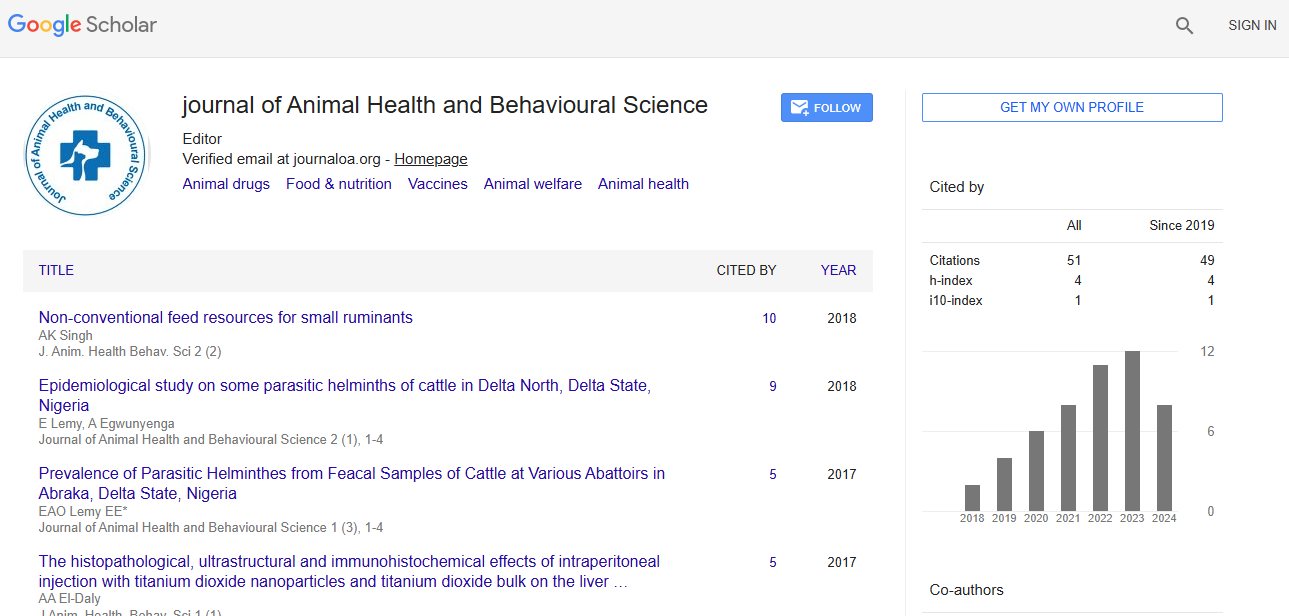
Journal of Animal Health and Behavioural Science received 38 citations as per Google Scholar report