Opinion - (2025) Volume 15, Issue 1
, Manuscript No. jnt-25-161751;
Editor assigned: 03-Jan-2025, Pre QC No. P-161751;
Reviewed: 17-Jan-2025, QC No. Q-161751;
Revised: 23-Jan-2025, Manuscript No. R-161751;
Published:
31-Jan-2025
, DOI: 10.37421/2161-0959.2025.15.549
Citation: Qian, Megan. “Angiotensin Imbalance in Patients with Arterial Aneurysms.” J Nephrol Ther 15 (2025): 549.
Copyright: © 2025 Qian M. This is an open-access article distributed under the terms of the Creative Commons Attribution License, which permits unrestricted use, distribution, and reproduction in any medium, provided the original author and source are credited.
Arterial aneurysms are a significant vascular pathology characterized by
the abnormal dilation of blood vessels due to the weakening of the arterial wall.
These aneurysms can occur in various regions, including the aorta, cerebral
arteries, and peripheral vasculature, leading to life-threatening complications
such as rupture and dissection. One of the critical physiological pathways
implicated in the development and progression of arterial aneurysms is
the Renin-Angiotensin System (RAS). Dysregulation of angiotensin, a key
component of this system, has been increasingly recognized as a contributing
factor in aneurysm pathophysiology.
Arterial aneurysms are a significant vascular pathology characterized by the abnormal dilation of blood vessels due to the weakening of the arterial wall. These aneurysms can occur in various regions, including the aorta, cerebral arteries, and peripheral vasculature, leading to life-threatening complications such as rupture and dissection. One of the critical physiological pathways implicated in the development and progression of arterial aneurysms is the Renin-Angiotensin System (RAS). Dysregulation of angiotensin, a key component of this system, has been increasingly recognized as a contributing factor in aneurysm pathophysiology. Understanding the mechanisms underlying angiotensin imbalance in patients with arterial aneurysms is crucial for developing targeted therapeutic strategies and improving clinical outcomes. The RAS plays a fundamental role in blood pressure regulation, fluid homeostasis, and vascular remodeling. Angiotensin II, the primary effector molecule of this system, is generated from angiotensin I through the enzymatic activity of angiotensin-converting enzyme (ACE). Angiotensin II exerts potent vasoconstrictive effects by binding to angiotensin type 1 receptors (AT1R), promoting vascular smooth muscle cell contraction, oxidative stress, inflammation, and extracellular matrix remodeling. While these processes are essential for normal vascular function, excessive activation of the angiotensin pathway can contribute to arterial wall weakening, increased proteolytic degradation of structural proteins, and heightened susceptibility to aneurysm formation.
Clinical and experimental studies have demonstrated that angiotensin II is a key mediator in aneurysm development. Chronic hypertension, a major risk factor for aneurysm formation, is closely linked to angiotensin II overactivity. Elevated levels of angiotensin II contribute to endothelial dysfunction, increased vascular permeability, and recruitment of inflammatory cells such as macrophages and T-lymphocytes to the vascular wall. These immune cells release pro-inflammatory cytokines and matrix metalloproteinases (MMPs), which degrade elastin and collagen, two crucial components of arterial integrity. As a result, arterial walls become structurally compromised, leading to progressive dilation and aneurysm expansion. In addition to its proinflammatory effects, angiotensin II is involved in oxidative stress-mediated vascular injury. Through activation of Nicotinamide Adenine Dinucleotide Phosphate (NADPH) oxidase, angiotensin II induces the production of reactive oxygen species (ROS), which further damage vascular cells and promote apoptosis. Oxidative stress exacerbates endothelial dysfunction by reducing nitric oxide bioavailability, impairing vasodilation, and enhancing vascular stiffness. These molecular events create a feed-forward cycle that accelerates aneurysm pathogenesis and increases the likelihood of rupture [1].
While angiotensin II is primarily associated with detrimental vascular effects, the RAS also comprises counter-regulatory components that exert protective influences. The angiotensin-converting enzyme 2 (ACE2)- angiotensin (1-7)-Mas receptor axis serves as a critical modulator that opposes the harmful actions of angiotensin II. Angiotensin (1-7), generated through ACE2-mediated degradation of angiotensin II, binds to the Mas receptor and promotes vasodilation, anti-inflammatory signaling, and reduced oxidative stress. This alternative pathway has been shown to mitigate vascular damage, preserve endothelial function, and inhibit aneurysm progression. However, in patients with arterial aneurysms, an imbalance favoring angiotensin II over angiotensin (1-7) is frequently observed, leading to unchecked vascular injury and heightened disease severity. The dysregulation of angiotensin signaling in aneurysm patients has prompted interest in therapeutic interventions targeting the RAS. Angiotensin receptor blockers and ACE inhibitors are widely used antihypertensive agents that mitigate the effects of angiotensin II by either blocking AT1R activation or reducing angiotensin II synthesis. Clinical evidence suggests that these medications may confer protective benefits in aneurysm patients by reducing inflammation, limiting MMP activity, and preserving vascular integrity. Studies in animal models of aneurysms have demonstrated that ARBs, such as losartan, can attenuate aneurysm growth and prevent rupture by shifting the balance toward the ACE2-angiotensin (1-7)- Mas receptor pathway. Similar effects have been observed with ACEIs, which lower angiotensin II levels and indirectly enhance the availability of angiotensin [2,3].
Despite the promising effects of RAS-modulating therapies, the clinical efficacy of these interventions in human aneurysm patients remains an area of ongoing investigation. Retrospective cohort studies and observational analyses have provided mixed results, with some studies reporting reduced aneurysm expansion rates in patients receiving ARBs or ACEIs, while others show no significant impact. These discrepancies may be attributed to variations in patient demographics, aneurysm location, medication dosages, and concomitant risk factors such as smoking, hyperlipidemia, and genetic predisposition. Furthermore, the complex interplay between systemic and local RAS activity complicates the ability to predict individual treatment responses. Recent advancements in molecular research have shed light on novel biomarkers associated with angiotensin dysregulation in aneurysm pathology. Circulating levels of angiotensin II, angiotensin (1-7), ACE2, and inflammatory mediators have been proposed as potential indicators of disease progression and therapeutic response. Additionally, genetic polymorphisms affecting RAS components have been implicated in aneurysm susceptibility, highlighting the need for personalized approaches to treatment. The development of precision medicine strategies that incorporate genetic profiling, biomarker assessment, and individualized RAS-targeted therapies holds promise for optimizing patient outcomes.
The role of angiotensin dysregulation in aneurysm pathophysiology also extends beyond systemic circulation to localized vascular microenvironments. Studies have identified intra-aneurysmal RAS activation, with evidence of increased angiotensin II synthesis and receptor expression within aneurysm walls. This localized RAS activity may operate independently of systemic angiotensin levels, suggesting that aneurysm-specific therapeutic targeting may be required. Localized drug delivery systems, such as nanoparticle-based approaches or intra-arterial infusions of RAS inhibitors, are being explored as potential strategies to enhance therapeutic efficacy while minimizing systemic side effects. Another emerging area of research involves the impact of aging and sex differences on angiotensin dysregulation in aneurysm formation. Aging is associated with increased RAS activity, reduced ACE2 expression, and heightened oxidative stress, all of which contribute to vascular aging and aneurysm susceptibility. Additionally, sex-specific variations in angiotensin receptor expression and hormonal influences may explain differences in aneurysm prevalence and progression between males and females. Understanding these age- and sex-related differences could inform tailored treatment approaches and improve risk stratification [4,5].
In conclusion, angiotensin imbalance plays a critical role in the development and progression of arterial aneurysms. The overactivation of angiotensin IImediated pathways leads to vascular inflammation, oxidative stress, and extracellular matrix degradation, culminating in arterial wall weakening and aneurysm expansion. The counter-regulatory ACE2-angiotensin (1-7)- Mas receptor axis provides a protective mechanism that is often impaired in aneurysm patients, exacerbating disease severity. Pharmacological interventions targeting the RAS, including ARBs and ACEIs, hold promise for mitigating aneurysm progression, though clinical outcomes remain variable. Advances in biomarker research, genetic profiling, and localized therapeutic delivery are paving the way for more precise and effective treatment strategies. Further investigation into the complex interplay of angiotensin dysregulation, systemic versus localized RAS activity, and patient-specific factors will be essential for refining therapeutic approaches and improving outcomes for individuals with arterial aneurysms.
None.
None.
Google Scholar, Crossref, Indexed at
Google Scholar, Crossref, Indexed at
Google Scholar, Crossref, Indexed at
Google Scholar, Crossref, Indexed at
Google Scholar, Crossref, Indexed at
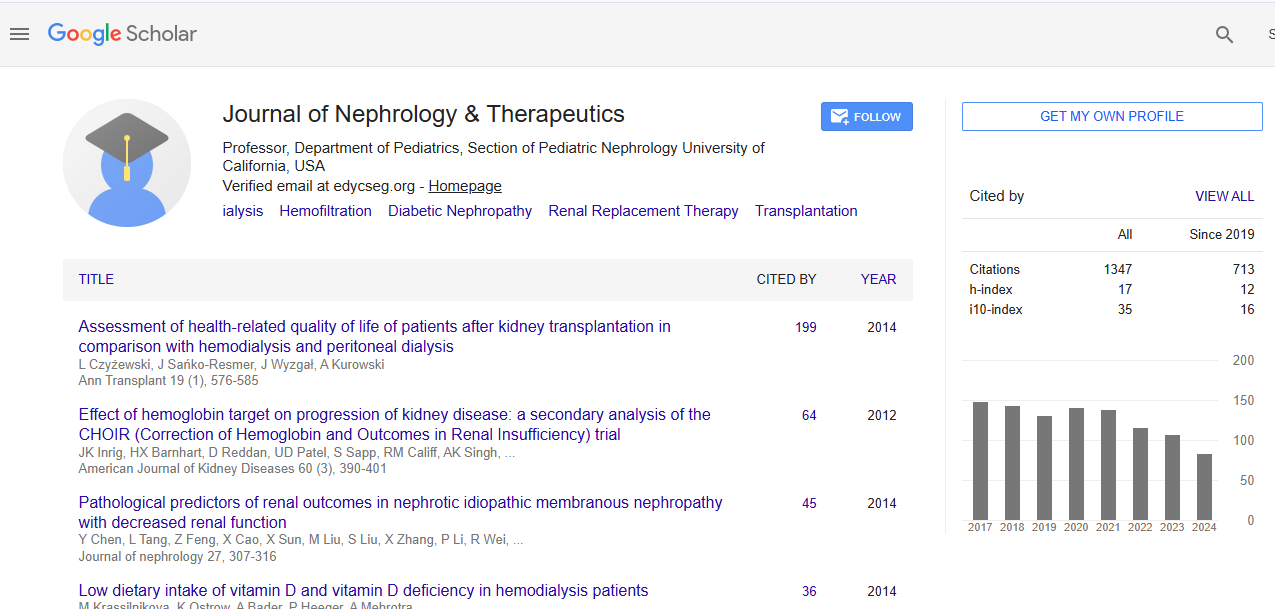
Journal of Nephrology & Therapeutics received 784 citations as per Google Scholar report