Brief Report - (2025) Volume 9, Issue 3
Received: 02-Jun-2025, Manuscript No. jcao-26-187135;
Editor assigned: 04-Jun-2025, Pre QC No. P-187135;
Reviewed: 18-Jun-2025, QC No. Q-187135;
Revised: 23-Jun-2025, Manuscript No. R-187135;
Published:
30-Jun-2025
, DOI: 10.37421/2684-6004.2025.9.294
Citation: Muller, Eva. ”Anesthetic Management of High-Risk Surgical Patients.” J Clin Anesthesiol 09 (2025):294.
Copyright: © 2025 Muller E. This is an open-access article distributed under the terms of the Creative Commons Attribution License, which permits unrestricted use, distribution and reproduction in any medium, provided the original author and source are credited.
The anesthetic management of high-risk surgical patients is a complex and evolving field, demanding meticulous attention to detail and a comprehensive understanding of patient-specific vulnerabilities. This specialized area of anesthesia focuses on optimizing patient outcomes by mitigating the inherent risks associated with surgery in individuals with significant comorbidities or compromised physiological states. The goal is to ensure patient safety, minimize peri-operative complications, and facilitate prompt recovery through a tailored and evidence-based approach. Advanced strategies and a multidisciplinary perspective are paramount in navigating these challenging cases, underscoring the critical role of the anesthesiologist in the peri-operative care continuum [1].
The integration of cutting-edge monitoring technologies plays a pivotal role in the peri-operative management of high-risk surgical patients. These advanced tools, including echocardiography and sophisticated neuromonitoring, provide real-time physiological data that empowers anesthesiologists to make critical decisions and implement precise interventions. By offering continuous insights into a patient's status, these technologies aid in the early detection of subtle changes and the prevention of adverse events, particularly in intricate surgical scenarios where conventional monitoring may be insufficient [2].
Patients with severe cardiovascular disease undergoing non-cardiac surgery present a unique set of anesthetic challenges. The focus in these cases shifts to optimizing cardiac function, proactively managing potential hemodynamic instability, and implementing strategies to reduce myocardial injury. Individualized anesthetic plans, the judicious use of vasoactive agents, and close collaboration with surgical and cardiology teams are essential to minimize the risk of peri-operative cardiac events in this vulnerable population [3].
The principles of enhanced recovery after surgery (ERAS) are increasingly being applied to high-risk surgical patients to improve outcomes. Implementing ERAS protocols can significantly contribute to faster recovery, a reduction in complication rates, and shorter hospital stays. Key interventions within these protocols, such as multimodal analgesia, early mobilization, and optimized fluid management, are specifically adapted to address the unique needs of vulnerable patient groups, promoting a smoother and more efficient post-operative recovery [4].
Elderly patients undergoing major surgery are inherently considered high-risk due to age-related physiological changes. Anesthetic considerations for this demographic require a deep understanding of altered pharmacokinetics and pharmacodynamics, impacting drug metabolism and efficacy. Strategies to optimize anesthetic depth, effectively manage post-operative delirium, and promote functional recovery are crucial. A personalized and cautious approach is fundamental to ensuring the safety and well-being of older surgical candidates [5].
Patients with chronic respiratory diseases, including conditions like COPD and severe asthma, face elevated risks of peri-operative respiratory complications. Anesthetic management for these individuals necessitates optimizing lung function pre-operatively, employing lung-protective ventilation strategies, and diligently managing airway reactivity. The overarching objective is to minimize pulmonary morbidity and ensure adequate oxygenation throughout the surgical period [6].
Anesthetic management in patients with renal impairment undergoing surgery demands careful consideration of the implications of compromised renal function. Altered kidney function can significantly impact drug metabolism and excretion, fluid and electrolyte balance, and increase the risk of acute kidney injury. Strategies involving judicious fluid management, careful drug selection, and intra-operative monitoring are vital for protecting renal function in this high-risk group [7].
Diabetes mellitus significantly increases the peri-operative risks for surgical patients, necessitating specialized anesthetic considerations. The focus extends to maintaining optimal glycemic control, managing both hyperglycemia and hypoglycemia, and acknowledging the profound impact of diabetes on cardiovascular and renal systems. A proactive approach to optimize metabolic control is crucial for minimizing surgical risks and ensuring favorable outcomes [8].
The anesthetic management of critically ill patients undergoing surgery represents one of the most challenging high-risk scenarios. These patients often present with complex conditions such as sepsis, acute respiratory distress syndrome, and multi-organ dysfunction. Successful management hinges on individualized resuscitation, robust organ support, and precise anesthetic titration to maintain hemodynamic stability and facilitate recovery [9].
Regional anesthesia techniques offer a valuable adjunct in the anesthetic management of high-risk surgical patients. These techniques can provide superior analgesia, reduce the reliance on systemic opioids, and potentially improve outcomes by minimizing the systemic effects associated with general anesthesia. Careful patient selection and appropriate block selection are key to maximizing the benefits of regional anesthesia in vulnerable populations [10].
The anesthetic management of high-risk surgical patients is a sophisticated discipline that demands a thorough pre-operative assessment, precise risk stratification, and a collaborative, multidisciplinary approach to achieve optimal outcomes. Key elements include the careful management of hemodynamic stability, the implementation of peri-operative organ protection strategies, and the judicious application of anesthetic techniques tailored to mitigate potential complications arising from significant comorbidities. The practice is firmly rooted in evidence-based guidelines and embraces emerging trends to enhance patient safety and promote efficient recovery [1].
Advanced monitoring techniques, such as echocardiography and sophisticated neuromonitoring, are integral to the peri-operative care of high-risk surgical patients. These technologies provide real-time physiological data that directly informs critical anesthetic decisions, enabling more accurate interventions and bolstering patient safety. Their utility lies in their capacity to detect subtle physiological changes and proactively prevent adverse events, particularly within complex surgical environments [2].
For patients with severe cardiovascular disease undergoing non-cardiac surgery, anesthetic management focuses on optimizing cardiac function and addressing hemodynamic instability. Strategies are designed to minimize myocardial injury through individualized anesthetic plans, careful administration of vasoactive agents, and close collaboration with surgical and cardiology teams, all aimed at reducing peri-operative cardiac events [3].
Enhanced Recovery After Surgery (ERAS) protocols are being increasingly applied to high-risk surgical patients to accelerate recovery and decrease complication rates. Specific interventions, including multimodal analgesia, early mobilization, and optimized fluid management, are adapted to the specific needs of vulnerable patient populations to facilitate a smoother post-operative course [4].
The physiological changes associated with aging render elderly patients at higher risk during major surgery. Anesthetic management requires an understanding of how aging affects drug pharmacokinetics and pharmacodynamics. Strategies focus on optimizing anesthetic depth, preventing delirium, and promoting post-operative functional recovery through a personalized and cautious approach [5].
Patients with chronic respiratory diseases, such as COPD and severe asthma, require specific anesthetic considerations to minimize peri-operative respiratory complications. Pre-operative optimization of lung function, the use of lung-protective ventilation, and management of airway reactivity are key components of care, aiming to reduce pulmonary morbidity and ensure adequate oxygenation [6].
Anesthesia for patients with renal dysfunction undergoing surgery necessitates careful management of fluid and electrolyte balance and drug pharmacokinetics. The risk of acute kidney injury is elevated, requiring judicious fluid administration, cautious drug selection, and intra-operative monitoring to preserve renal function [7].
Diabetic patients undergoing surgery represent a high-risk group due to the potential for peri-operative complications related to glycemic control and the impact of diabetes on cardiovascular and renal systems. Anesthetic strategies prioritize maintaining optimal metabolic control and proactively addressing potential complications to ensure favorable surgical outcomes [8].
Critically ill patients undergoing surgery pose significant anesthetic challenges due to comorbidities like sepsis and multi-organ dysfunction. Management involves individualized resuscitation, organ support, and precise anesthetic titration to maintain stability and facilitate recovery in these extremely vulnerable individuals [9].
Regional anesthesia techniques offer distinct advantages for high-risk surgical patients, providing effective analgesia, reducing opioid requirements, and minimizing systemic side effects. Careful patient selection and appropriate block choice are essential to harness the benefits of regional anesthesia in this population [10].
This collection of research addresses the complex anesthetic management of high-risk surgical patients. It covers a broad spectrum of challenges, including pre-operative assessment, risk stratification, and multidisciplinary approaches. Key areas explored are hemodynamic management, organ protection, and tailored anesthetic techniques for patients with significant comorbidities. The role of advanced monitoring, such as echocardiography and neuromonitoring, is highlighted for real-time physiological data to inform anesthetic decisions. Specific patient populations discussed include those with severe cardiovascular disease, chronic respiratory diseases, renal impairment, diabetes, and the elderly, each presenting unique considerations. The application of Enhanced Recovery After Surgery (ERAS) protocols and the use of regional anesthesia are also detailed as strategies to improve patient outcomes. Management of critically ill patients undergoing surgery is presented as a particularly challenging scenario requiring individualized care.
None
None
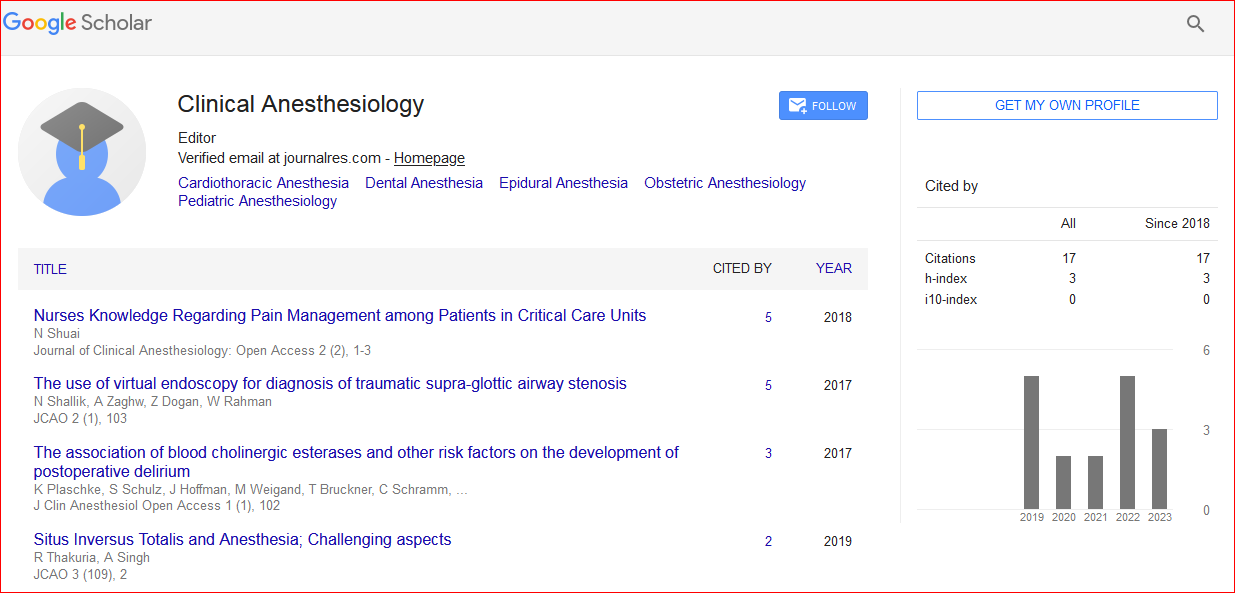
Journal of Clinical Anesthesiology: Open Access received 31 citations as per Google Scholar report