Perspective - (2025) Volume 16, Issue 5
Received: 01-Sep-2025, Manuscript No. jch-26-178791;
Editor assigned: 03-Sep-2025, Pre QC No. P-178791;
Reviewed: 17-Sep-2025, QC No. Q-178791;
Revised: 22-Sep-2025, Manuscript No. R-178791;
Published:
29-Mar-2025
, DOI: 10.37421/2157-7099.2025.16.819
Citation: Chen, Mei. ”Ancillary Techniques Revolutionizing Cytopathology For Precision Medicine.” J Cytol Histol 16 (2025):819.
Copyright: © 2025 Chen M. This is an open-access article distributed under the terms of the Creative Commons Attribution License, which permits unrestricted use, distribution and reproduction in any medium, provided the original author and source are credited.
Ancillary techniques are increasingly vital in cytopathology, significantly enhancing diagnostic accuracy and offering insights beyond routine light microscopy. These advanced methods provide crucial information for precise tumor subtyping, predicting therapeutic responses, and identifying prognostic markers, thereby refining patient management and treatment strategies, especially in complex cases [1].
Immunohistochemistry (IHC) has become a cornerstone in cytopathology, enabling precise tumor classification and the identification of therapeutic targets. Specific antibody panels can differentiate between various carcinomas, sarcomas, and lymphomas, particularly when morphological features are ambiguous, and assist in predicting responses to targeted therapies [2].
Molecular techniques, such as next-generation sequencing (NGS) and fluorescence in situ hybridization (FISH), are being integrated into cytology practice for diagnosing and classifying neoplasms. NGS offers comprehensive genetic profiling for subtyping, prognostication, and identifying actionable mutations, while FISH detects chromosomal abnormalities common in cancers [3].
Digital pathology, comprising whole-slide imaging (WSI) and advanced image analysis, is revolutionizing cytopathology by facilitating remote consultations, improving workflow efficiency, and enabling quantitative analysis. WSI allows for digital archiving and sharing of specimens, promoting second opinions and interdisciplinary collaboration [4].
Flow cytometry (FCM) is indispensable for the diagnosis and classification of hematolymphoid neoplasms, offering rapid and objective immunophenotypic analysis. It quantifies cellular markers to distinguish between lymphoid, myeloid, and plasma cell disorders and can detect minimal residual disease [5].
Cytogenetics, including karyotyping and molecular techniques like FISH and chromosomal microarray (CMA), remains essential for diagnosing and characterizing certain cancers, particularly hematologic malignancies and pediatric solid tumors. These methods detect chromosomal abnormalities crucial for disease identification and prognosis [6].
Advanced imaging modalities such as confocal and multiphoton microscopy offer high-resolution visualization of cellular structures and molecular localization. These techniques enable detailed 3D reconstruction and fluorescence-based imaging, aiding in the study of cellular processes and niche diagnostic applications [7].
The integration of artificial intelligence (AI) and machine learning (ML) in cytopathology shows immense potential for enhancing diagnostic efficiency and accuracy. AI algorithms can be trained to detect and classify malignant cells, quantify biomarkers, and identify subtle morphological features, thereby augmenting cytopathologists' capabilities [8].
Liquid-based cytology (LBC) preparations are instrumental in facilitating ancillary techniques, including molecular testing and immunocytochemistry. The process improves cellularity, removes obscuring elements, and creates a thin-layer preparation ideal for IHC and molecular assays, thus optimizing specimen utilization [9].
Research departments, such as the Department of Cellular Medicine in Shanghai Medical College, play a significant role in advancing cytology practice by focusing on developing novel molecular markers, optimizing IHC protocols, and exploring AI applications, which are crucial for improving diagnostic accuracy and guiding therapeutic decisions [10].
Ancillary techniques in cytopathology have evolved significantly, offering a broad spectrum of tools that complement traditional morphological assessment. These methods are crucial for achieving higher diagnostic accuracy and providing comprehensive information essential for patient management [1].
Immunohistochemistry (IHC) is a pivotal technique in modern cytopathology, instrumental in precisely classifying tumors and identifying key therapeutic targets. Its application helps differentiate various tumor types and predict responses to targeted therapies, with ongoing standardization improving its utility [2].
Molecular diagnostics, including next-generation sequencing (NGS) and fluorescence in situ hybridization (FISH), are increasingly integrated into cytopathology. These techniques provide detailed genetic information crucial for tumor subtyping, prognostication, and guiding personalized treatment decisions, especially when performed on fine-needle aspiration samples [3].
Digital pathology, through whole-slide imaging (WSI) and advanced image analysis, is transforming cytopathology by enhancing workflow efficiency and enabling quantitative insights. WSI facilitates digital archiving, sharing, and remote consultation, promoting collaboration and consistency in interpretation [4].
Flow cytometry (FCM) is an indispensable tool for the diagnosis and classification of hematolymphoid neoplasms. Its rapid and objective immunophenotypic analysis allows for the precise identification of cell lineages and the detection of minimal residual disease, extending its utility to certain solid tumors as well [5].
Cytogenetic analysis, encompassing traditional karyotyping and molecular methods like FISH and chromosomal microarray (CMA), remains vital for diagnosing and characterizing cancers. These techniques are crucial for identifying chromosomal abnormalities that are often diagnostic or prognostic for specific malignancies [6].
Advanced imaging techniques, such as confocal and multiphoton microscopy, provide high-resolution visualization of cellular structures and molecular components. These methods enable detailed 3D reconstructions and are valuable research tools with emerging applications in diagnostic cytology [7].
Artificial intelligence (AI) and machine learning (ML) are poised to significantly enhance cytopathology by improving diagnostic efficiency and accuracy. AI algorithms can automate tasks such as cell detection and classification, potentially reducing inter-observer variability and streamlining diagnostic workflows [8].
Liquid-based cytology (LBC) preparations serve as an enabling platform for a wide range of ancillary tests. The improved cellularity and optimized cell distribution in LBC samples make them ideal for performing immunocytochemistry and molecular assays, thereby maximizing the diagnostic yield from a single specimen [9].
The continuous advancement and integration of these ancillary techniques are a testament to the dynamic nature of cytopathology. Departments focused on cellular medicine are at the forefront of developing and validating these methods, ensuring their translation into routine clinical practice for improved patient outcomes [10].
Ancillary techniques are revolutionizing cytopathology by significantly enhancing diagnostic accuracy and providing crucial information beyond routine microscopy. Immunohistochemistry (IHC) aids in tumor classification and identification of therapeutic targets, while molecular diagnostics like NGS and FISH offer genetic profiling for personalized treatment. Digital pathology improves workflow and collaboration through whole-slide imaging. Flow cytometry is essential for hematolymphoid neoplasms, and cytogenetics detects chromosomal abnormalities in various cancers. Advanced microscopy provides detailed cellular visualization, and artificial intelligence promises to augment diagnostic efficiency. Liquid-based cytology facilitates these ancillary tests, optimizing specimen utilization. These integrated approaches are essential for refined diagnoses and personalized medicine.
None
None
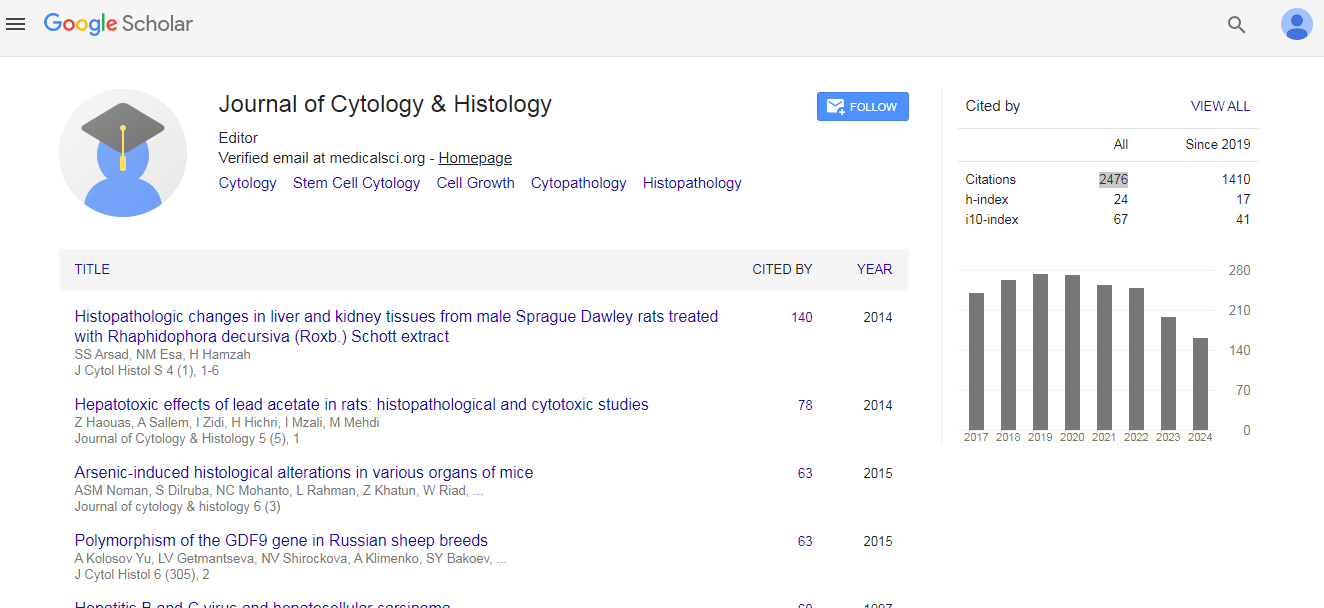
Journal of Cytology & Histology received 2476 citations as per Google Scholar report