Brief Report - (2025) Volume 12, Issue 2
Received: 01-Apr-2025, Manuscript No. jreac-26-185801;
Editor assigned: 03-Apr-2025, Pre QC No. P-185801;
Reviewed: 17-Apr-2025, QC No. Q-185801;
Revised: 22-Apr-2025, Manuscript No. R-185801;
Published:
29-Apr-2025
, DOI: 10.37421/2380-2391.2025.12.418
Citation: Okoye, Daniel. ”Analytical Challenges for Emerging Aquatic Contaminants.” J Environ Anal Chem 12 (2025):418.
Copyright: © 2025 Okoye D. This is an open-access article distributed under the terms of the Creative Commons Attribution License, which permits unrestricted use, distribution and reproduction in any medium, provided the original author and source are credited.
The intricate challenge of identifying and quantifying emerging contaminants within aquatic environments has become a paramount concern for environmental scientists and regulatory bodies worldwide. These substances, often present at trace levels and possessing diverse chemical properties, necessitate the development and application of highly advanced analytical methodologies to ensure accurate detection and reliable data generation. The low concentrations, complex matrices, and varied chemical characteristics of these emerging contaminants pose significant analytical hurdles, demanding innovative approaches that enhance sensitivity and selectivity [1].
The escalating presence of per- and polyfluoroalkyl substances (PFAS) in water bodies across the globe has spurred significant advancements in analytical strategies. Researchers are continually refining sample preparation and chromatographic separation techniques to effectively resolve complex PFAS mixtures, a crucial step in understanding their environmental fate and impact. The critical role of high-resolution mass spectrometry in achieving the required sensitivity and identifying individual PFAS congeners, even at trace levels, cannot be overstated [2].
Microplastics have emerged as another pervasive contaminant of concern in aquatic ecosystems, presenting substantial analytical challenges for accurate quantification and characterization. Various spectroscopic and imaging techniques, such as FTIR and Raman spectroscopy, are being evaluated for their efficacy in identifying and sizing microplastic particles within water samples. The trade-offs between speed, resolution, and the ability to detect different polymer types are key considerations in method selection [3].
The detection of pharmaceuticals and their transformation products in water systems requires analytical methods that are both highly sensitive and selective. Liquid chromatography coupled with tandem mass spectrometry (LC-MS/MS) has become a cornerstone technique in this field. However, understanding and mitigating matrix effects in environmental samples, along with addressing the complexities of analyzing polar and ionizable compounds, remain active areas of research [4].
Novel contaminants, including those originating from personal care products and pesticides, introduce further analytical complexities when present in intricate aquatic matrices. Gas chromatography-mass spectrometry (GC-MS) and its advancements are instrumental in analyzing volatile and semi-volatile organic compounds. The development of comprehensive analytical schemes capable of covering a broad spectrum of emerging contaminants, supported by robust library searching and confirmation protocols, is essential [5].
The imperative for on-site and in-situ analytical tools for emerging contaminants has grown significantly, driven by the need for rapid environmental monitoring and response. Progress in developing electrochemical and optical sensors for detecting pollutants such as heavy metals and pesticides is noteworthy. The sensitivity, selectivity, and long-term stability of these sensors in aquatic environments are critical factors for their practical application [6].
Endocrine-disrupting compounds (EDCs) in water present unique analytical complexities due to their often very low concentrations and diverse chemical structures. Advanced extraction techniques like solid-phase microextraction (SPME), coupled with highly sensitive detection methods such as LC-HRMS, are being employed to address these challenges. The development of comprehensive analytical workflows to identify and quantify a wide array of EDCs and their metabolites is a key focus [7].
The identification and quantification of contaminants of emerging concern (CECs) in drinking water sources are vital for safeguarding public health. Advanced analytical techniques, including high-throughput screening methods and non-target analysis, are being applied to monitor CECs and evaluate the effectiveness of water treatment processes. Robust quality assurance and quality control measures are indispensable for ensuring the reliability of the generated data [8].
Assessing the occurrence and fate of nanomaterials in aquatic environments poses distinct analytical challenges, particularly concerning sample collection, preparation, and the characterization of engineered nanomaterials undergoing aggregation and transformation. Advanced techniques like single-particle inductively coupled plasma mass spectrometry (SP-ICP-MS) and electron microscopy are crucial for elemental and structural analysis, respectively [9].
Analyzing emerging pollutants, such as pesticides and veterinary drugs, in reclaimed wastewater introduces specific analytical hurdles due to the complex composition and fluctuating concentrations of these contaminants. Techniques like LC-MS/MS and GC-MS/MS are commonly utilized, with sample pre-concentration and clean-up steps being critical for overcoming matrix effects and achieving necessary sensitivity. Continuous method development is vital to encompass a broader range of emerging contaminants and their metabolites [10].
The analysis of emerging contaminants in aquatic systems is characterized by significant analytical hurdles, primarily stemming from their low concentrations, the complexity of environmental matrices, and their diverse chemical properties. To address these challenges, researchers are exploring innovative methodologies, including hyphenated techniques and miniaturized sensors, which offer enhanced sensitivity, selectivity, and on-site monitoring capabilities. Method validation and the development of standardized protocols are crucial for ensuring reliable data generation in this field [1].
Per- and polyfluoroalkyl substances (PFAS) represent a growing group of contaminants in water requiring sophisticated analytical strategies for their detection and quantification. Advancements in sample preparation and chromatographic separation techniques are vital for resolving complex PFAS mixtures. High-resolution mass spectrometry plays a pivotal role in achieving the necessary sensitivity and specificity to identify individual PFAS congeners, even at trace levels, although limitations in current analytical standards necessitate ongoing method development [2].
Microplastics in aquatic ecosystems pose considerable analytical challenges regarding their accurate quantification and characterization. Various spectroscopic and imaging techniques, such as Fourier-transform infrared (FTIR) spectroscopy and Raman spectroscopy, are employed to identify and size microplastic particles in water samples. Evaluating the trade-offs between analytical speed, resolution, and the ability to detect different polymer types is essential, as is the implementation of standardized sampling and extraction protocols for inter-study comparability [3].
The sensitive and selective detection of pharmaceuticals and their transformation products in water is primarily achieved through liquid chromatography coupled with tandem mass spectrometry (LC-MS/MS). Significant research efforts are dedicated to understanding and mitigating matrix effects in environmental samples, often employing strategies like online solid-phase extraction. The analysis of polar and ionizable compounds presents particular difficulties, prompting the investigation of advanced ionization techniques [4].
Novel organic contaminants, including those found in personal care products and pesticides, present unique analytical challenges within complex aquatic matrices. Gas chromatography-mass spectrometry (GC-MS) remains a key technique for analyzing volatile and semi-volatile organic compounds. Developing comprehensive analytical schemes capable of covering a wide range of emerging contaminants, supported by robust library searching and confirmation protocols, is paramount for effective monitoring [5].
The development of on-site and in-situ analytical tools is critical for rapid environmental monitoring of emerging contaminants. Electrochemical and optical sensors are being advanced for the detection of pollutants such as heavy metals and pesticides, with a focus on improving sensor sensitivity, selectivity, and long-term stability in aquatic environments. The integration of these sensors with portable data acquisition systems enables real-time assessment [6].
Endocrine-disrupting compounds (EDCs) in water, often present at very low concentrations and exhibiting diverse chemical structures, demand sophisticated analytical approaches. Advanced extraction techniques, such as solid-phase microextraction (SPME), coupled with highly sensitive detection methods like LC-HRMS, are employed. The development of comprehensive analytical workflows to identify and quantify a wide array of EDCs and their metabolites, along with validated screening and confirmatory methods, is a significant area of research [7].
Contaminants of emerging concern (CECs) in drinking water sources necessitate robust analytical strategies for their identification and quantification. High-throughput screening methods and non-target analysis are employed to monitor CECs and assess the effectiveness of water treatment processes. Rigorous quality assurance and quality control measures are essential to ensure the reliability of data used for public health protection [8].
Assessing nanomaterials in aquatic environments involves significant analytical challenges related to sample collection, preparation, and characterization, particularly concerning their aggregation and transformation behavior. Techniques such as single-particle inductively coupled plasma mass spectrometry (SP-ICP-MS) for elemental analysis and electron microscopy for structural characterization are vital. Standardized protocols for nanomaterial analysis in complex water matrices are also needed [9].
The analysis of emerging pollutants, including pesticides and veterinary drugs, in reclaimed wastewater presents complex challenges due to the heterogeneous nature and fluctuating concentrations of these compounds. LC-MS/MS and GC-MS/MS are widely used, but effective sample pre-concentration and clean-up are crucial for overcoming matrix effects and achieving adequate sensitivity. Continuous method development is necessary to address the evolving landscape of emerging contaminants and their metabolites [10].
This collection of research highlights the significant analytical challenges in detecting and quantifying emerging contaminants in aquatic environments, including PFAS, microplastics, pharmaceuticals, novel organic compounds, endocrine-disrupting compounds, contaminants of emerging concern, and nanomaterials. Advanced analytical techniques such as hyphenated chromatography, high-resolution mass spectrometry, spectroscopic methods, and electrochemical/optical sensors are crucial for achieving the required sensitivity and selectivity. Method development, validation, and standardization are ongoing priorities to ensure reliable data generation for environmental monitoring and public health protection. The need for on-site and in-situ monitoring tools is also emphasized.
None
None
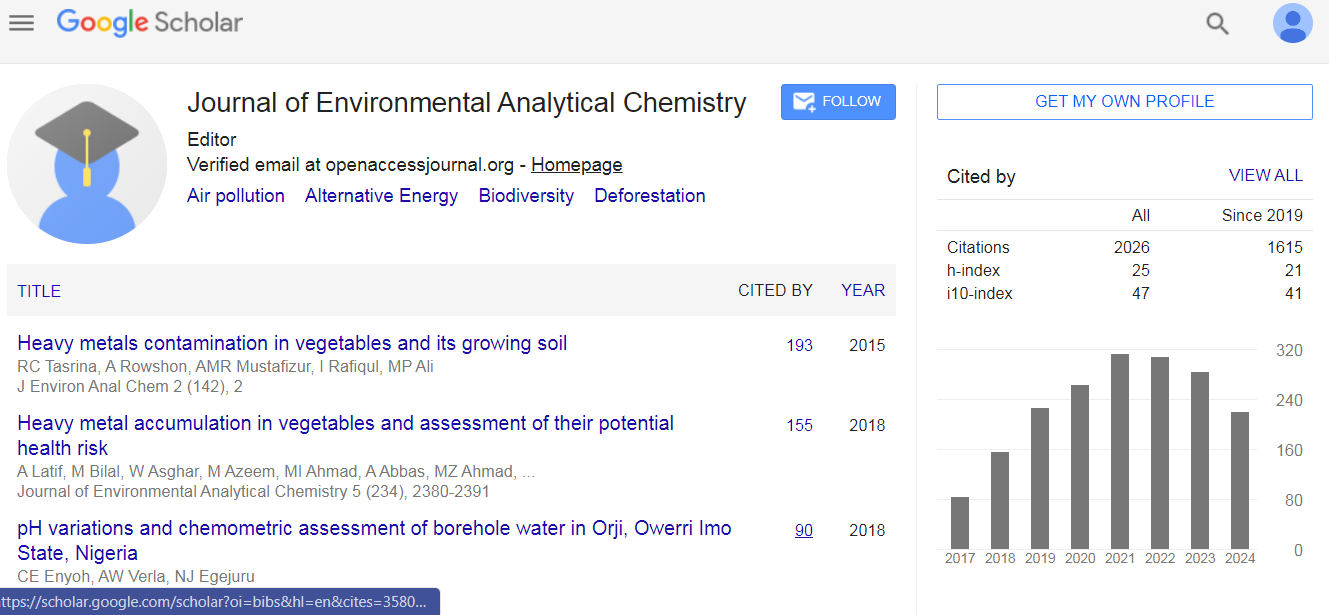
Journal of Environmental Analytical Chemistry received 1781 citations as per Google Scholar report