Mini Review - (2023) Volume 13, Issue 5
Received: 28-Aug-2023, Manuscript No. jbpbt-23-116659;
Editor assigned: 30-Aug-2023, Pre QC No. P-116659;
Reviewed: 12-Sep-2023, QC No. Q-116659;
Revised: 19-Sep-2023, Manuscript No. R-116659;
Published:
28-Sep-2023
Citation: Wang, Suing. “An Easy Bioprocess for Long-chain
Peptide Catalyst Screening and Optimisation Used in the Asymmetric Aldol
Reaction.” J Bioprocess Biotech 13 (2023): 587.
Copyright: © 2023 Wang S. This is an open-access article distributed under the
terms of the Creative Commons Attribution License, which permits unrestricted
use, distribution, and reproduction in any medium, provided the original author
and source are credited.
The field of organic synthesis has undergone a remarkable transformation in recent years, driven by the desire to develop more efficient and environmentally friendly methods for the construction of complex molecules. One of the key strategies in this quest is the use of asymmetric synthesis, which allows chemists to selectively produce a single enantiomer of a compound, avoiding the formation of unwanted byproducts and reducing waste. The asymmetric aldol reaction is a fundamental transformation in organic chemistry, and its development has been a central focus of research in the field. In recent years, biocatalysis has emerged as a powerful tool for achieving high levels of enantioselectivity in various chemical reactions. Enzymes, as nature's catalysts, are capable of catalyzing complex reactions with high specificity and efficiency. However, the application of enzymes in asymmetric synthesis has often been limited by the availability of suitable catalysts and the challenges associated with their screening and optimization. This article delves into an innovative approach, an easy bioprocess, for the screening and optimization of longchain peptide catalysts used in the asymmetric aldol reaction.
Organic • Byproduct • Aldol
The aldol reaction is a fundamental carbon-carbon bond-forming reaction in organic chemistry. In the asymmetric aldol reaction, the goal is to selectively produce a single enantiomer of the product, making it a valuable tool for the synthesis of chiral compounds. Traditionally, this has been achieved using chiral organic catalysts or metal-based catalysts. While these methods can be effective, they often suffer from limitations, such as the need for high catalyst loadings and the generation of significant waste. Enzymes offer an attractive alternative for catalyzing the asymmetric aldol reaction. Enzymes are naturally occurring catalysts that can be highly selective for specific substrates and reactions. Moreover, they operate under mild conditions, have broad functional group tolerance, and often require lower catalyst loadings. These features make enzymes promising candidates for green and sustainable asymmetric synthesis [1].
The use of enzymes in asymmetric synthesis has faced challenges related to substrate specificity and enantioselectivity. For the asymmetric aldol reaction, in particular, finding suitable enzyme catalysts has proven to be a formidable task. The natural substrate scope of most aldolases is often limited to small molecules, and their enantioselectivity may not be suitable for complex target molecules. To overcome these limitations, researchers have turned to the design and engineering of long-chain peptide catalysts. These catalysts are derived from natural enzymes but are modified to enhance their catalytic properties, substrate scope, and enantioselectivity. They offer the potential to bridge the gap between the limited scope of natural enzymes and the requirements of complex synthesis. Long-chain peptide catalysts are a type of biocatalyst created through protein engineering, a process that involves the modification of natural enzymes to improve their catalytic performance. These catalysts are often designed by introducing mutations or alterations to the enzyme's active site to expand its substrate scope and increase its enantioselectivity [2].
The first step in the bioprocess involves creating a library of long-chain peptide catalysts. These catalysts are designed through protein engineering techniques, often involving site-directed mutagenesis and combinatorial approaches. The goal is to introduce variations in the enzyme's active site, tailoring it to interact with different substrates and facilitate enantioselective aldol reactions. This step is typically achieved using recombinant DNA technology, allowing for the controlled introduction of specific mutations in the enzyme's gene. By systematically varying the amino acid residues at the active site, a diverse library of long-chain peptide catalysts is generated.
With the catalyst library in hand, the next step is to employ high-throughput screening methods to evaluate the catalytic activity and enantioselectivity of each variant. High-throughput screening is a crucial aspect of the bioprocess, as it allows for the rapid assessment of a large number of catalysts. In the case of asymmetric aldol reactions, the high-throughput screening process typically involves the use of a colorimetric or fluorometric assay. This assay is designed to detect the formation of the aldol product and quantify the Enantiomeric Excess (ee). The substrates, including the aldehyde and ketone components, are combined with a potential catalyst variant, and the reaction is monitored for product formation [3].
The data collected from the high-throughput screening are then analyzed to identify promising long-chain peptide catalyst candidates. Catalysts that exhibit high catalytic activity and enantioselectivity are selected for further optimization. The goal is to narrow down the pool of catalysts to those with the most potential for the asymmetric aldol reaction. In this step, the Structure Activity Relationship (SAR) analysis plays a crucial role. By understanding how specific mutations in the long-chain peptide catalysts influence their catalytic performance, researchers can make informed decisions about which variants to prioritize for optimization. The selected long-chain peptide catalysts are subjected to further optimization. This optimization can involve additional rounds of protein engineering, focusing on the most promising catalyst candidates. The aim is to fine-tune the catalysts to improve their catalytic efficiency, enantioselectivity, and substrate scope. The optimization process may also include the modification of reaction conditions, such as pH, temperature, and co-solvents, to enhance the catalytic performance of the long-chain peptide catalysts. Additionally, computational tools and molecular modeling can be employed to gain insights into the catalyst-substrate interactions and guide further modifications [4-6].
Once the long-chain peptide catalysts have been thoroughly screened and optimized, they can be applied to the asymmetric aldol reaction on a larger scale. This transition from laboratory-scale screening to practical application is a critical phase in the development of these biocatalysts for industrial and synthetic purposes. The scale-up process involves adapting the optimized catalysts and reaction conditions to meet the requirements of industrial applications. Factors such as catalyst loading, reaction time, and substrate concentration are carefully considered to achieve high yields and enantioselectivity while minimizing waste and byproduct formation. The easy bioprocess for long-chain peptide catalyst screening and optimization offers several advantages in the context of the asymmetric aldol reaction and beyond. In the context of asymmetric aldol reactions, long-chain peptide catalysts have been developed to catalyze the formation of new carbon-carbon bonds in a highly selective and efficient manner. By modifying the active site and tailoring it to accommodate a broader range of substrates, these catalysts enable the synthesis of complex chiral compounds that were once challenging to access through traditional methods. The development of long-chain peptide catalysts for asymmetric aldol reactions necessitates a robust screening and optimization process. Identifying suitable catalyst candidates and fine-tuning their performance is crucial to harness the full potential of these biocatalysts. To this end, an innovative bioprocess has been developed to facilitate the screening and optimization of long-chain peptide catalysts.
None.
There is no conflict of interest by author.
Google Scholar, Crossref, Indexed at
Google Scholar, Crossref, Indexed at
Google Scholar, Crossref, Indexed at
Google Scholar, Crossref, Indexed at
Google Scholar, Crossref, Indexed at
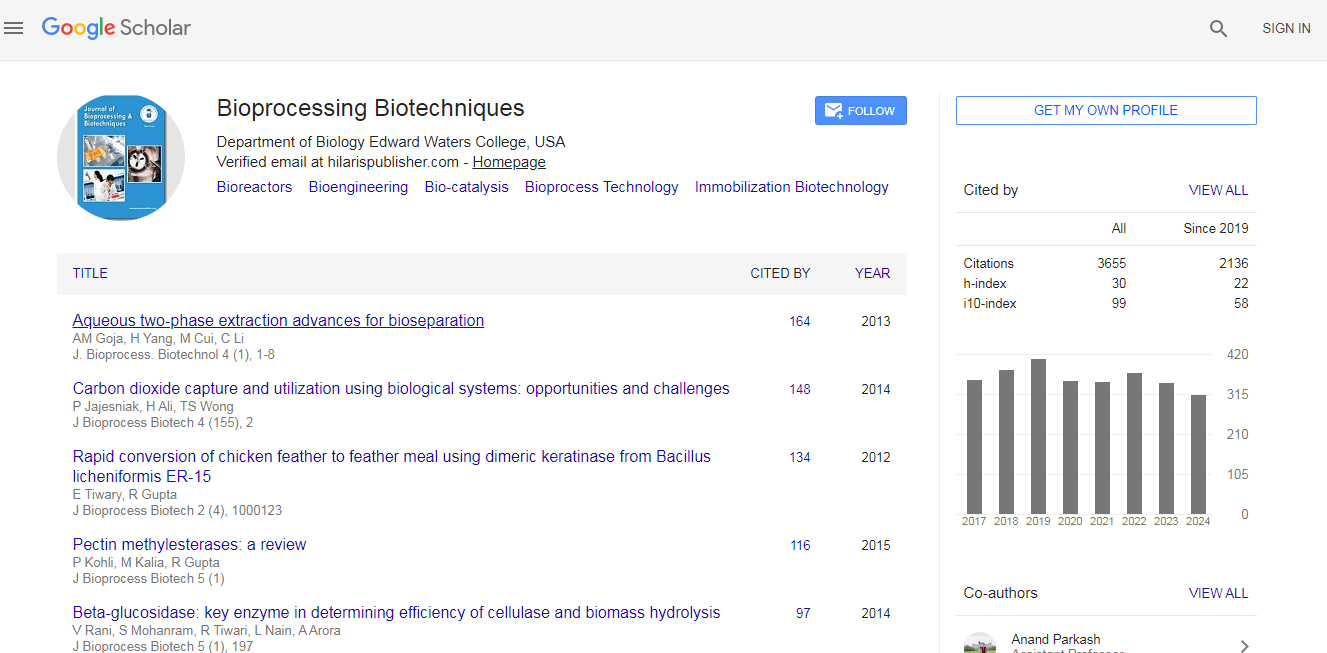
Journal of Bioprocessing & Biotechniques received 3351 citations as per Google Scholar report