Brief Report - (2025) Volume 7, Issue 3
Received: 01-Aug-2025, Manuscript No. jspd-25-174854;
Editor assigned: 04-Aug-2025, Pre QC No. P-174854;
Reviewed: 18-Aug-2025, QC No. Q-174854;
Revised: 22-Aug-2025, Manuscript No. R-174854;
Published:
29-Aug-2025
, DOI: 10.37421/2684-4575.2025.6.022
Citation: Sundaram, Ravi. ”AI-Driven Pathology: Enhancing Diagnostics, Personalizing Care.” J Surg Path Diag 07 (2025):22.
Copyright: © 2025 Sundaram R. This is an open-access article distributed under the terms of the Creative Commons Attribution License, which permits unrestricted use, distribution and reproduction in any medium, provided the original author and source are credited.
The landscape of histopathological evaluation is undergoing a significant transformation, marked by the increasing integration of Artificial Intelligence (AI) and advanced molecular diagnostics across a spectrum of diseases. This evolution promises to enhance diagnostic precision, improve prognostic accuracy, and refine therapeutic strategies. A clear example of this is in lung cancer histopathology, where AI is proving to be a transformative force. It is not only improving diagnostic accuracy and efficiency but also playing a crucial role in classifying tumors, grading, and predicting patient outcomes, making the entire diagnostic process inherently more objective and consistent [1].
This pivotal role of AI extends to prostate cancer, where systematic reviews confirm its robust potential to improve diagnostic accuracy and efficiency in grading and risk stratification. This demonstrates a clear pathway for AI's seamless integration into routine clinical practice, ultimately leading to better patient outcomes [3].
The benefits of AI are also evident in melanoma histopathology, where innovative algorithms are enhancing diagnostic accuracy, markedly reducing inter-observer variability, and significantly assisting in prognosis. The future direction for dermatopathology involves the comprehensive integration of AI into routine practices [6].
Beyond the direct application of AI in specific oncological contexts, the broader field of histopathological evaluation is grappling with its own set of evolving challenges and opportunities. In breast cancer, the focus has shifted towards integrating molecular markers and advanced imaging techniques. These innovations are critical for addressing current diagnostic and prognostic hurdles, thereby shaping more personalized treatment strategies through the adoption of new technologies and multidisciplinary approaches [2].
Similarly, the conventional methods for histopathological evaluation of liver fibrosis are being supplemented and potentially superseded by novel approaches. This includes moving beyond traditional scoring systems to incorporate emerging techniques such as digital pathology and AI, which promise more accurate and reproducible assessments essential for precise staging and informed treatment decisions [4].
For oral squamous cell carcinoma, the detailed understanding of tumor biology is being deepened by carefully linking traditional diagnostic criteria with advanced genetic markers. This combined approach is proving invaluable for early detection, accurate prognostication, and the development of highly targeted therapies [5].
The complexities of histopathological evaluation are not limited to cancers. In kidney disease, its evolving role in diagnosis and management is paramount. The challenges associated with classifying intricate renal pathologies are being met with advancements in molecular diagnostics and digital pathology, leading to improved precision and guiding more personalized treatment strategies [7].
Neurodegenerative diseases are also benefiting from significant progress in histopathological diagnosis. This includes the development of improved staining techniques, the identification of novel biomarkers, and the innovative application of advanced imaging methods. All these advancements collectively contribute to a more accurate understanding of disease progression and facilitate better differential diagnoses [8].
Furthermore, specialized areas require continuous updates to their diagnostic criteria. For gastrointestinal stromal tumors (GISTs), current histopathological criteria are being refined, emphasizing the critical role of immunohistochemistry in distinguishing GISTs from other mesenchymal tumors. Understanding specific prognostic factors remains crucial for guiding optimal treatment decisions [9].
Finally, the histopathological evaluation of response to immunotherapy in solid tumors presents a unique set of complexities. This field requires a nuanced understanding of unique patterns of immune-related adverse events and tumor regression. The pressing need for standardized assessment tools is evident to accurately predict and monitor treatment efficacy in this rapidly advancing therapeutic landscape [10].
The contemporary practice of histopathological evaluation is undergoing a profound transformation, driven by technological advancements and a deeper understanding of disease mechanisms. Artificial Intelligence (AI) emerges as a central theme, revolutionizing diagnostics across various oncological fields. For instance, AI tools are fundamentally improving lung cancer histopathology by enhancing diagnostic accuracy and overall efficiency. These tools are critical for classifying tumors, grading their severity, and predicting patient outcomes, ultimately fostering a more objective and consistent diagnostic process [1]. This transformative potential is equally apparent in prostate cancer, where systematic reviews and meta-analyses consistently confirm AI's ability to improve diagnostic accuracy and efficiency in grading and risk stratification. Such findings highlight a clear path for AI's integration into routine clinical practice, promising superior patient outcomes [3]. The application of AI extends to melanoma histopathology, where sophisticated algorithms are demonstrating improved diagnostic accuracy, a significant reduction in inter-observer variability, and valuable assistance in prognostication. The ongoing developments point towards a future where AI is fully integrated into routine dermatopathology workflows [6].
Beyond the direct application of AI, the field is also benefiting from the integration of molecular markers and advanced imaging techniques, addressing persistent challenges in diagnosis and prognosis. Breast cancer histopathology, for example, is navigating an evolving landscape by focusing on these integrative approaches. The goal is to overcome current hurdles and shape more personalized treatment strategies through the adoption of new technologies and multidisciplinary collaboration [2]. Similarly, liver fibrosis evaluation is seeing a shift from traditional scoring systems to embracing more innovative methods, including digital pathology and AI. These emerging techniques are poised to offer more accurate and reproducible assessments, which are critically important for precise staging and informed treatment decisions [4]. In the context of oral squamous cell carcinoma, a deeper understanding of tumor biology is being achieved by carefully linking traditional diagnostic criteria with genetic markers. This combined approach is instrumental in improving early detection, refining prognostication, and enabling more targeted therapeutic interventions [5].
The evolving role of histopathology is also evident in non-cancerous conditions, where precision and personalized approaches are becoming paramount. In kidney disease, for instance, advancements in molecular diagnostics and digital pathology are improving the precision of histopathological evaluation and guiding personalized treatment strategies, especially for complex renal pathologies. This represents a significant step forward in managing kidney conditions [7]. For neurodegenerative diseases, recent progress in histopathological diagnosis includes not only improved staining techniques but also the identification of novel biomarkers and the application of advanced imaging methods. These collective efforts contribute to a more accurate understanding of disease progression and facilitate better differential diagnoses [8].
Moreover, the nuances of specific disease entities and treatment responses demand specialized histopathological insights. An update on the current histopathological criteria for diagnosing gastrointestinal stromal tumors (GISTs) underscores the critical role of immunohistochemistry in distinguishing GISTs from other mesenchymal tumors. Identifying and understanding prognostic factors remains crucial for guiding appropriate treatment decisions [9]. Lastly, the complex task of histopathologically evaluating response to immunotherapy in solid tumors is a burgeoning area. This requires careful consideration of the unique patterns of immune-related adverse events and tumor regression. The pressing need for standardized assessment tools is highlighted to accurately predict and monitor treatment efficacy in this rapidly advancing therapeutic landscape [10]. This comprehensive approach underscores a collective effort to refine diagnostic accuracy, enhance prognostic capabilities, and optimize treatment strategies across a broad spectrum of medical conditions.
Histopathological evaluation is undergoing significant modernization across numerous medical fields, particularly in oncology and broader disease management. A key development is the widespread integration of Artificial Intelligence (AI), which is transforming diagnostics by enhancing accuracy and efficiency in areas like lung, prostate, and melanoma cancers. AI tools are proving effective in tumor classification, grading, risk stratification, and reducing inter-observer variability, paving the way for more objective and consistent diagnostic processes. These advancements signify a shift towards a more precise and data-driven approach in pathology. Beyond AI, the field is actively leveraging advanced molecular markers, digital pathology, and sophisticated imaging techniques. These innovations are critical for addressing existing diagnostic and prognostic challenges in conditions such as breast cancer, liver fibrosis, and oral squamous cell carcinoma, facilitating more personalized and effective treatment strategies. Furthermore, advancements in histopathology are improving the precision of diagnosis and management in complex conditions like kidney disease and neurodegenerative diseases through the identification of novel biomarkers and improved staining methods. The continuous refinement of diagnostic criteria for specific tumors, such as gastrointestinal stromal tumors, and the complex evaluation of immunotherapy responses in solid tumors underscore the critical and ongoing need for standardized assessment tools and integrative approaches. These efforts aim to optimize patient care and improve clinical outcomes across a broad spectrum of medical conditions.
None
None
Yuwei L, Xiaoxiao K, Hong L. "Artificial intelligence in histopathological evaluation of lung cancer: a systematic review".Pathol Res Pract 242 (2023):154341.
Indexed at, Google Scholar, Crossref
Francesca C, Sara M, Francesco S. "Current challenges and future perspectives of histopathological evaluation in breast cancer".Front Med (Lausanne) 10 (2023):1111624.
Indexed at, Google Scholar, Crossref
Shanshan S, Ying W, Meng Z. "Artificial intelligence for histopathological evaluation of prostate cancer: a systematic review and meta-analysis".Prostate Cancer Prostatic Dis 27 (2024):1-13.
Indexed at, Google Scholar, Crossref
Valeria C, Luca MSG, Elisa V. "Histopathological evaluation of liver fibrosis: Current methods and emerging approaches".World J Gastroenterol 28 (2022):2115-2130.
Indexed at, Google Scholar, Crossref
Aftab AK, Preeti LS, Vasanth KK. "Molecular and histopathological evaluation of oral squamous cell carcinoma".J Oral Maxillofac Pathol 24 (2020):S38-S44.
Indexed at, Google Scholar, Crossref
Jian L, Jialu Y, Shichuan L. "Artificial intelligence for histopathological evaluation of melanoma: recent advances and future perspectives".Front Oncol 13 (2023):1205307.
Indexed at, Google Scholar, Crossref
Hongyan Z, Mengjiao S, Qiuming L. "Histopathological evaluation of kidney disease: current issues and future perspectives".Ren Fail 44 (2022):111-125.
Indexed at, Google Scholar, Crossref
Sara FH, Masoud R, Maryam G. "Recent advances in histopathological evaluation of neurodegenerative diseases".J Neurol Sci 429 (2021):117621.
Indexed at, Google Scholar, Crossref
Maria RG, Angela D, Luigi I. "Histopathological evaluation of gastrointestinal stromal tumors: an update".Pathologica 112 (2020):228-235.
Indexed at, Google Scholar, Crossref
Francesca M, Umberto M, Gabriella DP. "Histopathological evaluation of response to immunotherapy in solid tumors: current challenges and future directions".Semin Cancer Biol 86 (2022):641-654.
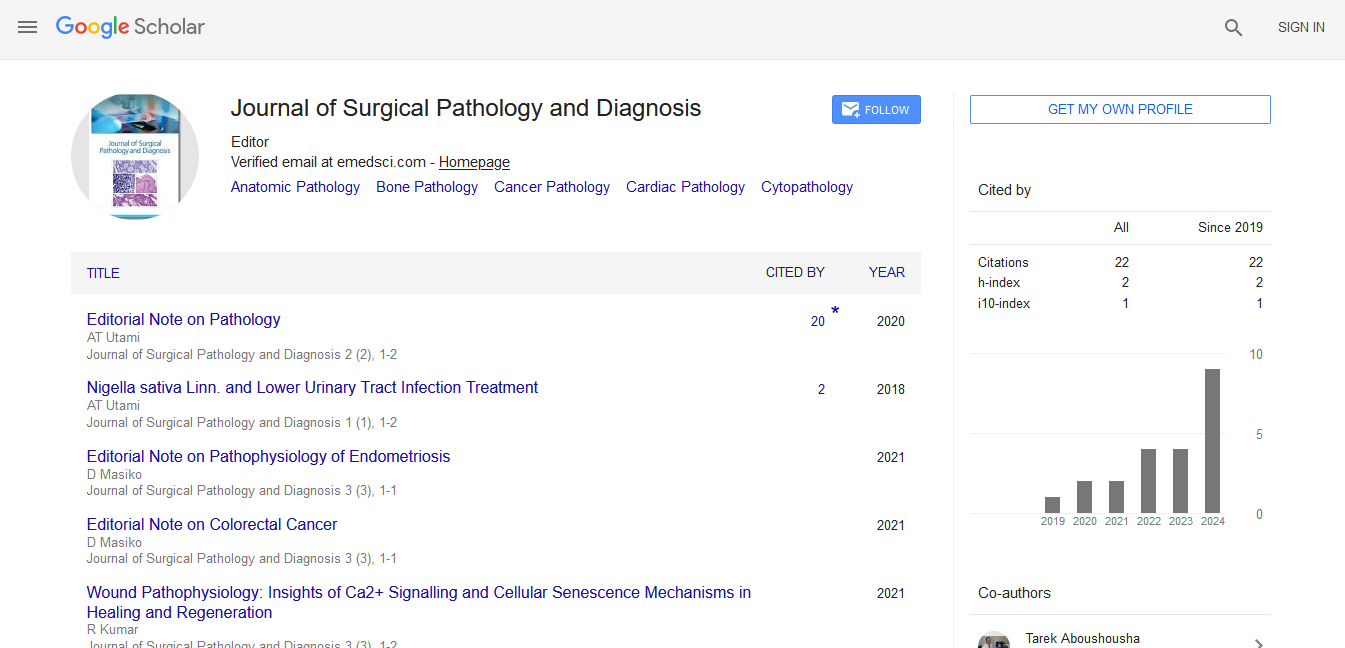
Journal of Surgical Pathology and Diagnosis received 15 citations as per Google Scholar report