Brief Report - (2025) Volume 13, Issue 6
Received: 01-Dec-2025, Manuscript No. jcdd-25-177689;
Editor assigned: 03-Dec-2025, Pre QC No. P-177689;
Reviewed: 17-Dec-2025, QC No. Q-177689;
Revised: 22-Dec-2025, Manuscript No. R-177689;
Published:
29-Dec-2025
, DOI: 10.37421/2329-9517.2025.13.699
Citation: Lebo Mokoena. ”AI Transforms Cardiology: Diagnosis
to Personalized Care.” J Cardiovasc Dis Diagn 13 (2025):699.
Copyright: © 2025 M. Lebo This is an open-access article distributed under the terms of the Creative Commons Attribution License, which permits unrestricted use, distribution
and reproduction in any medium, provided the original author and source are credited.
One key systematic review and meta-analysis explores how deep learning models are used in diagnosing cardiovascular diseases. It critically highlights the effectiveness of these AI approaches in various diagnostic tasks, demonstrating their potential to improve accuracy and efficiency in identifying heart conditions early. The review particularly emphasizes the need for standardized methodologies and larger, diverse datasets to further validate and integrate these tools into clinical practice. This underscores deep learning's vital role in advancing early and precise diagnostic capabilities within cardiology[1].
A recent article discusses the broad applications of Artificial Intelligence (AI) in cardiac imaging, covering everything from improving image acquisition techniques to assisting in complex clinical decision-making. It meticulously outlines how AI algorithms can enhance image quality, automate measurements, detect subtle anomalies, and ultimately support cardiologists in making more informed diagnoses and treatment plans. The key takeaway, in essence, is AI's transformative role across the entire cardiac imaging pipeline. Ultimately, AI's comprehensive influence spans the entire cardiac imaging pipeline, promising significant advancements[2].
Another systematic review and meta-analysis evaluates the performance of various machine learning models in predicting future heart failure events. It pinpoints promising algorithms that can leverage diverse patient data, like electronic health records and imaging, to stratify risk and forecast adverse outcomes. The compelling findings suggest that machine learning holds significant potential to enhance personalized management strategies and improve patient prognosis in heart failure. This work underscores the potential for more effective, personalized patient management in heart failure[3].
This paper provides a comprehensive overview of the current state and future prospects of Artificial Intelligence in interpreting electrocardiograms (ECGs). It further delves into how AI can automate the detection of arrhythmias, predict cardiac events, and assist in diagnosing complex heart conditions from ECG data. The discussion strongly points to AI's ability to significantly enhance the speed and accuracy of ECG analysis, making it a valuable tool for both general practitioners and specialists. This shows AI can significantly boost the efficiency and accuracy of ECG analysis for various medical professionals[4].
This article carefully examines the journey of Artificial Intelligence in precision cardiology, from its foundational research to its clinical application. It eloquently illustrates how AI contributes to personalized medicine by tailoring diagnostic and therapeutic strategies based on individual patient characteristics. The paper distinctly highlights the potential for AI to optimize treatment outcomes by providing precise insights into disease mechanisms and patient responses. Ultimately, this drives the optimization of treatment outcomes through personalized insights into patient responses[5].
A significant paper reviews the current evidence and outlines future directions for Artificial Intelligence in cardiovascular risk stratification. It convincingly demonstrates how AI algorithms can integrate diverse datasets, including genetic, clinical, and lifestyle factors, to more accurately predict an individual's risk of developing cardiovascular disease. The core idea here is that AI can move beyond traditional risk calculators to offer more nuanced and personalized risk assessments, allowing for earlier and more targeted preventive interventions. This enables more targeted and proactive preventive interventions against cardiovascular disease[6].
This article offers an in-depth overview of AI's current and prospective uses in cardiac electrophysiology. It specifically details how AI is being applied to improve arrhythmia detection, guide ablation procedures, and personalize treatment for complex heart rhythm disorders. The discussion strongly emphasizes AI's capacity to process vast amounts of electrophysiological data, leading to more precise diagnostics and optimized therapeutic strategies. The insights gained lead to more precise diagnostics and optimized therapeutic strategies for complex heart rhythm disorders[7].
This paper meticulously explores the opportunities and challenges of integrating Artificial Intelligence into cardiovascular drug discovery and development. It particularly highlights how AI can accelerate various stages, from identifying novel drug targets and designing potent molecules to predicting drug efficacy and potential side effects. The central message conveyed is that AI promises to streamline the traditionally lengthy and costly process of bringing new cardiovascular medications to patients. This promises to accelerate the traditionally slow and expensive process of developing new cardiovascular medications[8].
This article deeply delves into the ethical considerations surrounding the increasing adoption of Artificial Intelligence in cardiology. It carefully addresses critical issues such as data privacy, algorithmic bias, informed consent, and accountability in AI-driven clinical decisions. The paper profoundly stresses the importance of developing robust ethical frameworks and guidelines to ensure that AI integration benefits all patients equitably and upholds professional medical standards. This is crucial to ensure Artificial Intelligence benefits all patients equitably while upholding medical standards[9].
Finally, a comprehensive review highlights the crucial role of Artificial Intelligence in advancing personalized cardiovascular medicine, ranging from refined risk prediction to optimized treatment strategies. It vividly shows how AI can analyze vast patient data to create individual profiles, enabling clinicians to predict disease onset more accurately and tailor interventions to maximize effectiveness for each patient. The article prominently emphasizes AI's potential to transform cardiology into a more proactive and patient-centric field. The ultimate goal is to transform cardiology into a more proactive and patient-centric field[10].
Artificial Intelligence (AI) and machine learning models are fundamentally reshaping the landscape of cardiovascular medicine, particularly in diagnostics. One systematic review highlights how deep learning models effectively diagnose cardiovascular diseases, emphasizing their potential for enhanced accuracy and efficiency through standardized methodologies and diverse datasets[1]. This is complemented by the broad applications of AI in cardiac imaging, which improves image acquisition, automates measurements, and detects subtle anomalies, thus empowering cardiologists with more informed diagnostic capabilities and treatment plans across the entire imaging pipeline[2]. Similarly, AI is transforming electrocardiogram (ECG) interpretation by automating arrhythmia detection, predicting cardiac events, and assisting in diagnosing complex heart conditions from ECG data. This significantly boosts the speed and accuracy of ECG analysis, making it an invaluable tool for both general practitioners and specialists alike[4].
Beyond initial diagnosis, AI demonstrates remarkable capabilities in predicting future cardiovascular events and refining risk stratification. Machine learning models, for instance, have shown promise in forecasting heart failure events by effectively leveraging diverse patient data such as electronic health records and imaging information. These findings indicate a significant potential to enhance personalized management strategies and improve patient prognosis in heart failure[3]. Furthermore, AI algorithms are pivotal for cardiovascular risk stratification, integrating various complex datasetsâ??including genetic, clinical, and lifestyle factorsâ??to more precisely predict an individual's susceptibility to developing cardiovascular disease. This advancement moves beyond conventional risk calculators, providing nuanced and personalized risk assessments that enable earlier and more targeted preventive interventions[6].
The application of Artificial Intelligence extends crucially into precision cardiology and the optimization of treatment strategies. AI's journey from basic research to clinical implementation showcases its role in personalized medicine, allowing for diagnostic and therapeutic approaches to be tailored based on individual patient characteristics. This means AI can optimize treatment outcomes by offering precise insights into disease mechanisms and patient-specific responses[5]. In cardiac electrophysiology, AI is currently being applied to enhance arrhythmia detection, precisely guide ablation procedures, and personalize treatment plans for complex heart rhythm disorders. Its unparalleled ability to process vast amounts of electrophysiological data leads to more accurate diagnostics and greatly optimized therapeutic strategies, truly enhancing patient care[7].
The overarching goal of AI in cardiology points towards a future of highly personalized and proactive cardiovascular medicine. AI achieves this by analyzing extensive patient data to construct individual profiles, which empowers clinicians to predict disease onset with greater accuracy and customize interventions to maximize their effectiveness for each unique patient. This profound capability emphasizes AIâ??s potential to fundamentally transform cardiology into a more proactive and patient-centric field, shifting the focus from reactive treatment to preventative and tailored care[10].
Moreover, AI presents significant opportunities in cardiovascular drug discovery and development, while simultaneously raising critical ethical questions that demand careful consideration. AI has the capacity to accelerate multiple stages of drug development, from identifying novel drug targets and designing potent molecules to accurately predicting drug efficacy and potential side effects. This innovation promises to streamline the traditionally lengthy and resource-intensive process of bringing new cardiovascular medications to patients faster and more efficiently[8]. However, the increasing integration of AI in cardiology also brings forth important ethical considerations, including ensuring data privacy, addressing potential algorithmic bias, securing informed consent, and establishing accountability for AI-driven clinical decisions. It is therefore crucial to develop robust ethical frameworks and clear guidelines to ensure that AI integration genuinely benefits all patients equitably and consistently upholds the highest professional medical standards[9].
This systematic review explores how deep learning models diagnose cardiovascular diseases, highlighting their effectiveness in improving accuracy and efficiency. It emphasizes the need for standardized methodologies and diverse datasets for clinical integration. A recent article discusses Artificial Intelligence's broad applications in cardiac imaging, from improving acquisition to assisting in clinical decision-making. AI algorithms enhance image quality, automate measurements, and detect anomalies, supporting cardiologists in informed diagnoses and treatment plans. Another review evaluates machine learning models for predicting heart failure events, identifying promising algorithms that leverage patient data to stratify risk and forecast outcomes. The findings suggest machine learning can significantly enhance personalized management and prognosis. A separate paper offers an overview of AI in interpreting electrocardiograms (ECGs), detailing its ability to automate arrhythmia detection, predict cardiac events, and aid in diagnosing complex heart conditions. This greatly enhances the speed and accuracy of ECG analysis. This article examines AI's journey in precision cardiology, showing how it tailors diagnostic and therapeutic strategies based on individual patient characteristics to optimize treatment outcomes. A paper reviews AI's role in cardiovascular risk stratification, demonstrating how algorithms integrate diverse datasets to accurately predict disease risk. This provides more nuanced, personalized assessments for targeted preventive interventions. Another article provides a comprehensive overview of AI's uses in cardiac electrophysiology, detailing its application in arrhythmia detection, guiding ablation procedures, and personalizing treatment for heart rhythm disorders. This leads to more precise diagnostics. A different paper explores opportunities and challenges of AI in cardiovascular drug discovery, highlighting its potential to accelerate identifying targets, designing molecules, and predicting efficacy. This promises to streamline drug development. This article delves into ethical considerations of AI in cardiology, addressing data privacy, algorithmic bias, and informed consent. It stresses the importance of robust ethical frameworks. Lastly, a review highlights AI's role in advancing personalized cardiovascular medicine, from refined risk prediction to optimized treatment strategies. This shows how AI can transform cardiology into a proactive and patient-centric field.
Indexed at, Google Scholar, Crossref
Indexed at, Google Scholar, Crossref
Indexed at, Google Scholar, Crossref
Indexed at, Google Scholar, Crossref
Indexed at, Google Scholar, Crossref
Indexed at, Google Scholar, Crossref
Indexed at, Google Scholar, Crossref
Indexed at, Google Scholar, Crossref
Indexed at, Google Scholar, Crossref
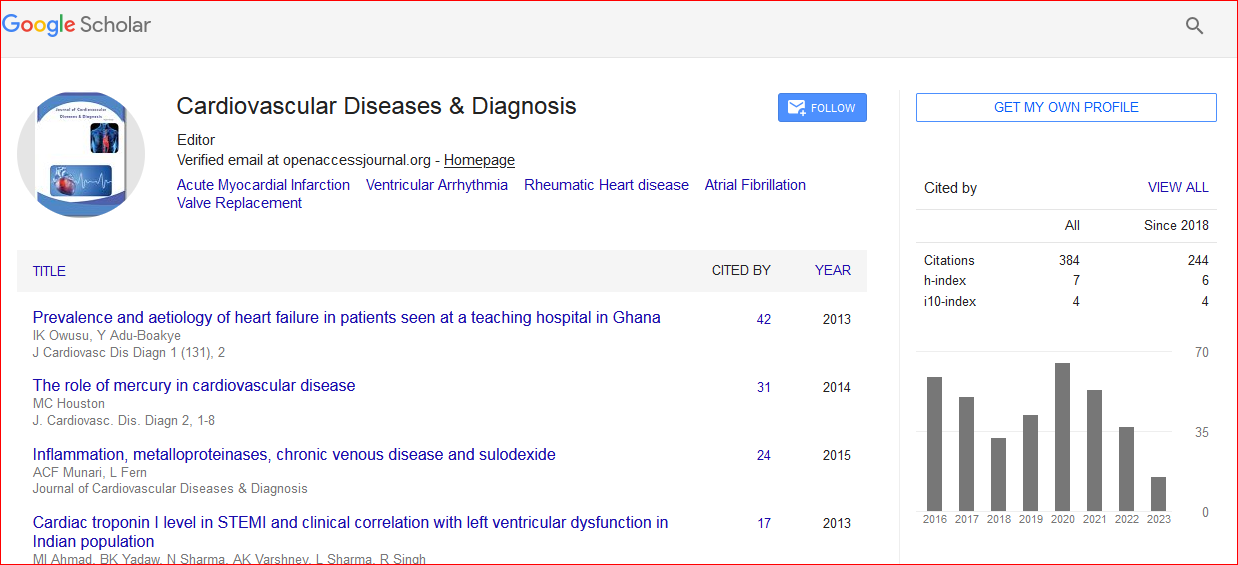
Cardiovascular Diseases & Diagnosis received 427 citations as per Google Scholar report