Brief Report - (2025) Volume 17, Issue 4
Received: 01-Aug-2025, Manuscript No. jbabm-26-182345;
Editor assigned: 03-Aug-2025, Pre QC No. P-182345;
Reviewed: 17-Aug-2025, QC No. Q-182345;
Revised: 24-Aug-2025, Manuscript No. R-182345;
Published:
31-Aug-2025
, DOI: 10.37421/1948-593X.2025.17.503
Citation: Youssef, Amina Ben. ”AI: Transforming Bioanalytical Data Interpretation for Discovery.” J Bioanal Biomed 17 (2025):503.
Copyright: © 2025 Y oussefB. Amina This is an open-access article distributed under the terms of the Creative Commons Attribution License, which permits unrestricted use, distribution and reproduction in any medium, provided the original author and source are credited.
Artificial intelligence (AI) is fundamentally transforming the landscape of bioanalytical data interpretation, offering unparalleled advancements in speed, accuracy, and the depth of insights that can be gleaned from complex biological datasets [1].
Machine learning algorithms, a core component of AI, excel at discerning intricate patterns within these large datasets. This capability is directly contributing to significant improvements in critical areas such as biomarker discovery, enabling researchers to identify novel indicators of disease or treatment response more effectively. Furthermore, AI is enhancing the prediction of drug efficacy, allowing for a more precise understanding of how a particular therapeutic might perform in different patient populations. Patient stratification, the process of dividing patients into subgroups for tailored treatment approaches, is also being revolutionized by AI's ability to identify subtle differences that correlate with treatment outcomes. Beyond analytical prowess, AI also addresses the practical challenges of bioanalytical research by automating laborious and time-consuming tasks. This automation frees up valuable researcher time, allowing them to concentrate on higher-level analytical thinking and the generation of novel hypotheses. The ultimate consequence of these advancements is an accelerated pace of biomedical research, facilitating a more rapid translation of laboratory findings into tangible clinical applications and improved patient care [1].
Deep learning models, a specialized subset of machine learning, are demonstrating exceptional power in the analysis of highly complex bioanalytical data, including intricate datasets generated from mass spectrometry and comprehensive genomic sequences [2].
These advanced models possess the remarkable ability to automatically learn hierarchical features directly from the raw data. This automatic feature extraction is crucial because it allows for the improved identification of subtle signals and patterns that might easily be overlooked or missed by traditional statistical methods. Consequently, the accuracy of numerous critical bioanalytical tasks is significantly enhanced. This includes more precise protein identification from complex mixtures, a more thorough and accurate metabolite profiling for understanding cellular processes, and a more robust calling of genetic variations for disease association studies. The power of deep learning lies in its capacity to uncover hidden complexities within biological data, leading to a deeper and more accurate understanding of biological systems [2].
The integration of AI into the field of metabolomics is yielding substantial advantages for the interpretation of inherently complex metabolic profiles [3].
AI-driven approaches are proving particularly effective in deconvolving the intricate chromatographic and spectral data that are characteristic of metabolomic analyses. This deconvolution allows for a more accurate identification of individual metabolites and their relative abundances. Beyond identification, AI is instrumental in uncovering novel metabolic pathways, illuminating previously unknown biochemical routes within organisms. Moreover, these AI tools can predict how metabolic profiles might change in response to various stimuli, such as environmental factors or pharmacological interventions, and how they are altered in different disease states. This predictive capability is absolutely crucial for gaining a comprehensive understanding of the underlying mechanisms of diseases and for the development of precisely targeted therapeutic interventions that address specific metabolic dysregulations [3].
In the domain of proteomics, AI algorithms are making significant contributions to enhancing both the accuracy and the overall efficiency of protein identification and quantification from mass spectrometry data [4].
Proteomic datasets are notoriously variable and complex, presenting considerable challenges for traditional analytical methods. Machine learning algorithms are particularly well-suited to handle this inherent variability and complexity, leading to more reliable and reproducible results. This improved reliability directly translates into more effective biomarker discovery, enabling the identification of proteins that can serve as indicators of disease or treatment efficacy. Furthermore, AI assists in achieving a better understanding of intricate protein-protein interactions, which are fundamental to cellular function and disease processes. By streamlining the analysis of proteomic data, AI accelerates the critical transition of research findings from the laboratory bench to practical clinical applications, ultimately benefiting patient diagnosis and treatment [4].
The application of AI in the analysis of genomic and transcriptomic data is profoundly transforming our understanding of fundamental biological processes, particularly gene regulation and the complex interplay of genetics in disease pathogenesis [5].
AI algorithms possess the remarkable ability to identify complex genomic signatures that are strongly associated with various diseases, providing new avenues for diagnosis and risk assessment. Furthermore, these algorithms can predict the functional roles of genes with a high degree of accuracy and analyze gene expression patterns at an unprecedented speed. This capability is vital for advancing the field of precision medicine. By enabling a detailed understanding of an individual's unique genetic makeup, AI facilitates the development of personalized treatment strategies that are tailored to their specific genetic profile, leading to more effective and targeted therapies [5].
The persistent challenge of data standardization and integration across diverse bioanalytical sources and platforms is a significant hurdle in advancing research and diagnostics. Fortunately, AI is emerging as a powerful solution to address this issue [6].
Machine learning algorithms have demonstrated a remarkable capacity to harmonize data obtained from various sources, experimental conditions, and analytical platforms. This harmonization is essential for conducting robust meta-analyses, which combine findings from multiple studies to derive more statistically powerful conclusions. Furthermore, standardized and integrated data are fundamental for the development of more comprehensive and predictive models. Such models are indispensable for accelerating drug discovery pipelines and for improving the accuracy and reliability of clinical diagnostics, ultimately leading to better healthcare outcomes [6].
AI is playing a crucial role in the development of sophisticated predictive models designed to forecast drug response and potential toxicity in patients [7].
By meticulously analyzing large-scale bioanalytical datasets, which encompass a wide array of patient and drug-related information, AI algorithms can identify subtle, often non-obvious, patterns. These patterns are instrumental in predicting how an individual patient is likely to respond to a particular drug. This predictive capability is a cornerstone of personalized medicine, enabling healthcare providers to select the most effective treatments for individual patients while minimizing the risk of adverse drug reactions. Consequently, therapeutic strategies become more effective, safer, and better tailored to the unique biological characteristics of each patient, leading to improved treatment outcomes and enhanced patient safety [7].
The interpretation of complex imaging data within the field of bioanalysis, encompassing modalities such as microscopy and various forms of medical imaging, is being significantly enhanced by the application of AI [8].
Deep learning models, in particular, are proving exceptionally adept at automatically detecting and quantifying subtle features within these images. They can precisely segment regions of interest, which are critical for targeted analysis, and even predict disease progression or patient outcomes directly from visual data. This advanced analytical capability provides invaluable support for disease diagnosis, aids in the meticulous planning of treatment strategies, and contributes to a deeper understanding of the underlying mechanisms and progression of diseases. The integration of AI into image analysis promises to revolutionize diagnostic accuracy and therapeutic intervention planning [8].
AI is proving instrumental in elevating the quality and interpretability of bioanalytical data through its ability to automate critical quality control processes and sophisticated outlier detection [9].
Machine learning algorithms can systematically scan experimental data to identify anomalies, inconsistencies, and potential systematic errors that might compromise the validity of downstream analyses. By flagging and addressing these issues early on, AI ensures the reliability and reproducibility of research findings. This meticulous attention to data quality is vital for reducing the risk of drawing incorrect or misleading conclusions, which can have significant implications in both research and clinical settings. The assurance of data integrity provided by AI is fundamental to the advancement of reproducible and trustworthy scientific endeavors [9].
The future trajectory of bioanalytical data interpretation is inextricably linked with the continued advancement and integration of AI technologies [10].
As AI models become progressively more sophisticated and the volume and complexity of bioanalytical data generated by cutting-edge techniques continue to expand exponentially, AI will undoubtedly become indispensable. Its role will be critical in the extraction of meaningful and actionable biological insights from these vast datasets. AI will serve as a powerful engine driving scientific discovery across numerous biological disciplines. Moreover, it will significantly accelerate the crucial translation of research breakthroughs into tangible clinical practices and therapeutic innovations. The ongoing development and refinement of explainable AI (XAI) methodologies are anticipated to further bolster trust and facilitate broader adoption of AI tools within the bioanalytical community, paving the way for a new era of data-driven biological understanding and medical progress [10].
Artificial intelligence (AI) is revolutionizing bioanalytical data interpretation by enabling faster, more accurate, and deeper insights. Machine learning algorithms can identify complex patterns in large datasets, leading to improved biomarker discovery, drug efficacy prediction, and patient stratification. AI also automates laborious tasks, freeing up researchers to focus on higher-level analysis and hypothesis generation, ultimately accelerating the pace of biomedical research and clinical translation [1].
Deep learning models, particularly convolutional neural networks (CNNs) and recurrent neural networks (RNNs), are proving exceptionally powerful for analyzing complex bioanalytical data like mass spectrometry and genomic sequences. These models can automatically learn hierarchical features, improving the identification of subtle signals that might be missed by traditional statistical methods. This leads to enhanced accuracy in tasks such as protein identification, metabolite profiling, and genetic variation calling [2].
The integration of AI in metabolomics offers significant advantages for interpreting complex metabolic profiles. AI-driven approaches can effectively deconvolve chromatographic and spectral data, identify novel metabolic pathways, and predict metabolic responses to various stimuli or disease states. This capability is crucial for understanding disease mechanisms and developing targeted therapeutic interventions [3].
In proteomics, AI algorithms are enhancing the accuracy and efficiency of protein identification and quantification from mass spectrometry data. Machine learning can handle the inherent variability and complexity of proteomic datasets, leading to more reliable biomarker discovery and a better understanding of protein-protein interactions. This accelerates the transition from research findings to clinical applications [4].
AI's application in genomic and transcriptomic data analysis is transforming our understanding of gene regulation and disease. Algorithms can identify complex genomic signatures associated with diseases, predict gene function, and analyze gene expression patterns with unprecedented speed and accuracy. This facilitates precision medicine by enabling personalized treatment strategies based on an individual's genetic makeup [5].
The challenge of data standardization and integration in bioanalysis is being addressed by AI. Machine learning can harmonize data from diverse sources and platforms, facilitating meta-analyses and the development of more comprehensive models. This is essential for building robust predictive models for drug discovery and clinical diagnostics [6].
AI plays a crucial role in the development of predictive models for drug response and toxicity. By analyzing large-scale bioanalytical datasets, AI can identify subtle patterns that predict how an individual will respond to a particular drug, enabling personalized medicine and reducing adverse drug reactions. This leads to more effective and safer therapeutic strategies [7].
The interpretation of complex imaging data in bioanalysis, such as microscopy and medical imaging, is significantly enhanced by AI. Deep learning models can automatically detect and quantify features, segment regions of interest, and even predict disease progression from images. This aids in diagnosis, treatment planning, and understanding disease mechanisms [8].
AI is instrumental in improving the quality and interpretability of bioanalytical data by enabling automated quality control and outlier detection. Machine learning algorithms can identify anomalies and systematic errors in experimental data, ensuring the reliability of downstream analyses and reducing the risk of drawing incorrect conclusions. This is vital for reproducible research [9].
The future of bioanalytical data interpretation is deeply intertwined with AI. As AI models become more sophisticated and bioanalytical techniques generate ever-larger datasets, AI will be indispensable for extracting meaningful biological insights, driving scientific discovery, and accelerating the translation of research into clinical practice. Continued development in explainable AI (XAI) will further enhance trust and adoption [10].
Artificial intelligence (AI) is a transformative force in bioanalytical data interpretation, offering enhanced speed, accuracy, and depth of insights. Machine learning and deep learning algorithms excel at pattern recognition in large datasets, leading to improvements in biomarker discovery, drug efficacy prediction, and patient stratification. AI automates routine tasks, allowing researchers to focus on higher-level analysis and accelerating biomedical research and clinical translation. Specific applications include advanced analysis of mass spectrometry, genomic, and transcriptomic data, as well as metabolomics and imaging. AI also addresses data standardization, integration, quality control, and the development of predictive models for drug response and toxicity. The future of bioanalytical data interpretation is closely tied to AI advancements, promising continued scientific discovery and clinical application.
None
None
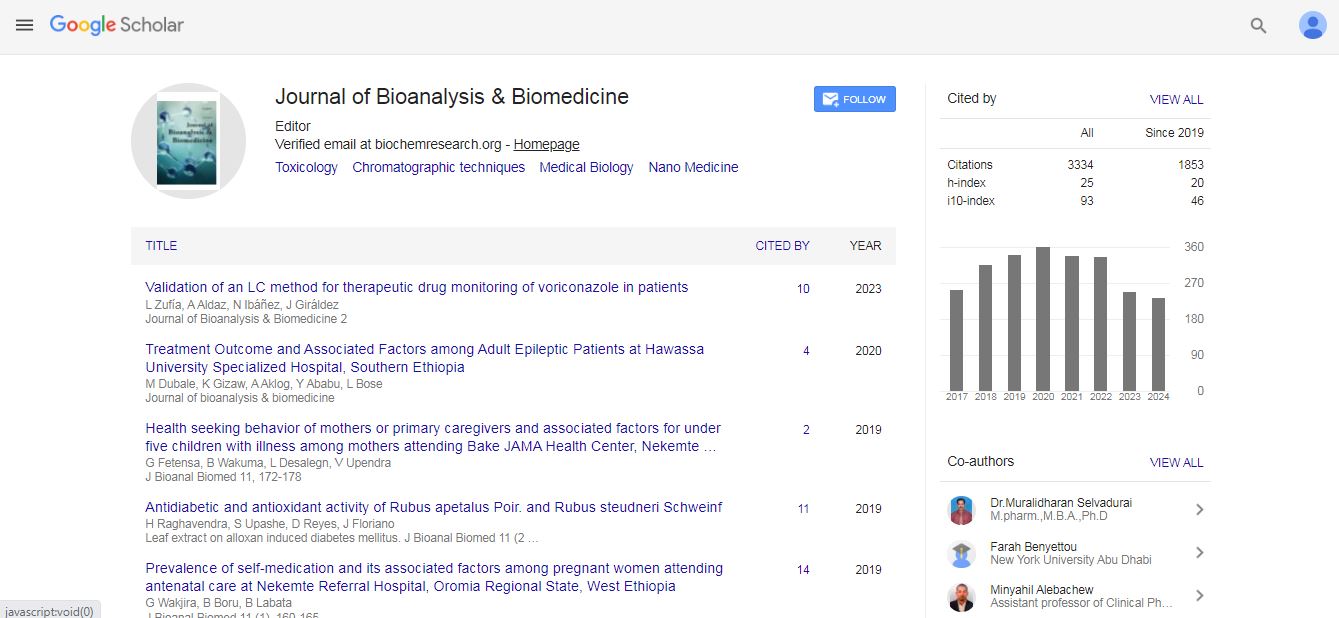
Journal of Bioanalysis & Biomedicine received 3099 citations as per Google Scholar report