Brief Report - (2025) Volume 14, Issue 2
Received: 02-Jun-2025, Manuscript No. ara-25-175562;
Editor assigned: 04-Jun-2025, Pre QC No. P-175562;
Reviewed: 18-Jun-2025, QC No. Q-175562;
Revised: 23-Jun-2025, Manuscript No. R-175562;
Published:
30-Jun-2025
, DOI: 10.37421/2168-9695.2025.14.323
Citation: Moravec, Elena. ”AI \& Robotics: Global Transformation, Ethical Integration.” Adv Robot Autom 14 (2025):323.
Copyright: © 2025 Moravec E. This is an open-access article distributed under the terms of the Creative Commons Attribution License, which permits unrestricted use, distribution and reproduction in any medium, provided the original author and source are credited.
This article explores the transformative impact of robotics and artificial intelligence on medical practices. It highlights how these technologies are enhancing diagnostic precision, enabling minimally invasive surgical procedures, and revolutionizing patient care through automation and intelligent systems. The discussion also covers the ethical implications and the need for robust regulatory frameworks to ensure safe and effective integration [1].
This paper delves into the evolution of human-robot collaboration in manufacturing, emphasizing the shift towards human-centered designs. It discusses new robotic capabilities that allow for safe and efficient co-working environments, leading to increased productivity and adaptability in industrial settings. The insights reveal critical advancements in interaction interfaces and safety protocols [2].
This review provides an overview of bio-inspired soft robotics, highlighting the latest breakthroughs and their diverse applications. It details how the mimicry of biological systems, like muscle or skin, allows for the creation of robots with inherent compliance, adaptability, and safe interaction capabilities, particularly in fields such as healthcare and exploration [3].
This article addresses the complex ethical landscape surrounding the development and deployment of robotics and artificial intelligence. It emphasizes the need for thoughtful design and implementation to mitigate risks such as bias, accountability, and job displacement, advocating for a proactive approach to ensure these technologies serve humanity responsibly [4].
This review summarizes recent applications and future trends of robotics in agriculture, focusing on areas like precision farming, automated harvesting, and disease detection. It highlights how robotics is improving efficiency, reducing labor costs, and promoting sustainable agricultural practices, pointing towards a future of smart, autonomous farms [5].
This article discusses the current state of robotics education, outlining its challenges, emerging opportunities, and future trajectories. It emphasizes the need for interdisciplinary curricula, hands-on learning, and updated teaching methodologies to prepare students for the evolving demands of the robotics industry and research [6].
This survey paper presents a comprehensive review of recent advancements in autonomous robot navigation. It covers key areas such as localization, mapping, path planning, and obstacle avoidance, discussing various algorithms and sensor fusion techniques that enable robots to operate independently in complex and dynamic environments [7].
This review examines the latest developments in robotic dexterous manipulation, focusing on how robots are achieving human-like grasping and object handling capabilities. It discusses innovations in end-effectors, control strategies, and tactile sensing, which are crucial for applications in manufacturing, service robotics, and surgical procedures [8].
This article highlights recent progress and ongoing challenges in underwater robotics. It covers advancements in propulsion systems, sensor technologies, and autonomous control for exploring marine environments, mapping seabeds, and monitoring aquatic life. The discussion also touches upon the persistent hurdles related to communication and power in submerged operations [9].
This systematic review examines the evolving role of robotics in personalized medicine, illustrating how robotic systems are tailored to individual patient needs for diagnosis, treatment, and rehabilitation. It highlights how these systems enhance precision and efficacy, setting the stage for future perspectives in highly customized healthcare solutions [10].
The transformative impact of robotics and Artificial Intelligence (AI) is particularly evident in medical practices. These advanced technologies are not merely supplementary but are fundamentally enhancing diagnostic precision and enabling increasingly minimally invasive surgical procedures. Through automation and sophisticated intelligent systems, robotics is revolutionizing various aspects of patient care. Alongside these advancements, there's a crucial discussion surrounding the ethical implications of such powerful tools, necessitating the development of robust regulatory frameworks to ensure their safe, equitable, and effective integration into healthcare systems [1]. In a related vein, the evolving role of robotics in personalized medicine signifies a significant shift. Robotic systems are now being carefully tailored to individual patient needs, spanning diagnosis, specific treatment protocols, and rehabilitation. This customization significantly enhances both the precision and efficacy of medical interventions, thereby setting the stage for future perspectives in highly customized healthcare solutions [10].
Beyond healthcare, human-robot collaboration in manufacturing is undergoing a significant evolution, moving towards designs that prioritize human involvement and safety. This involves new robotic capabilities specifically engineered to allow for safe and efficient co-working environments. The result is often increased productivity and greater adaptability within diverse industrial settings. Key to these advancements are innovative interaction interfaces and refined safety protocols that facilitate more harmonious integration between humans and machines [2]. Furthermore, the development of robotic dexterous manipulation is pushing boundaries, aiming for robots to achieve human-like grasping and object handling capabilities. This progress relies on innovations in end-effectors, sophisticated control strategies, and advanced tactile sensing, which are indispensable for high-precision applications not just in manufacturing, but also in broader service robotics and complex surgical procedures [8].
Another fascinating area of development lies in bio-inspired soft robotics. This field centers on mimicking biological systems, such as muscle or skin, to create robots with inherent compliance and adaptability. These characteristics allow for safer interaction capabilities, particularly vital for delicate applications in healthcare and complex exploration scenarios [3]. Meanwhile, robotics is also making profound contributions to agriculture. Recent applications and future trends in this sector include precision farming, automated harvesting techniques, and advanced disease detection systems. These robotic integrations are proving instrumental in improving overall efficiency, substantially reducing labor costs, and promoting more sustainable agricultural practices, ultimately pointing towards a future dominated by smart, autonomous farms [5].
The ability of robots to operate independently is highlighted by significant advancements in autonomous robot navigation. Comprehensive reviews of this field cover critical areas such as precise localization, effective mapping, intelligent path planning, and sophisticated obstacle avoidance. Various algorithms, combined with advanced sensor fusion techniques, are enabling robots to operate truly independently within complex and dynamic environments [7]. However, specialized domains present unique challenges. Underwater robotics, for instance, has seen notable progress in propulsion systems, sensor technologies, and autonomous control, crucial for exploring vast marine environments, mapping seabeds, and monitoring aquatic life. Despite these strides, persistent hurdles related to reliable communication and power supply in submerged operations continue to be a focus of ongoing research and development [9].
Underpinning all these technological advancements is the critical field of robotics education. This area currently grapples with its own set of challenges while simultaneously presenting numerous emerging opportunities and defining future trajectories. There is a strong emphasis on the necessity for interdisciplinary curricula, providing ample hands-on learning experiences, and continuously updating teaching methodologies. Such educational frameworks are essential to adequately prepare the next generation of students for the evolving and demanding landscape of the robotics industry and associated research sectors [6].
Robotics and Artificial Intelligence (AI) are fundamentally reshaping various sectors, from healthcare to manufacturing and agriculture. In medicine, these technologies significantly enhance diagnostic precision, enable advanced surgical procedures, and automate patient care, with a strong emphasis on personalized solutions. The integration of AI in medical practices also necessitates robust ethical and regulatory frameworks to ensure safe and responsible use. In industrial settings, the evolution towards human-centered designs in robotics fosters safe and efficient human-robot collaboration, boosting productivity and adaptability. Beyond traditional industrial uses, bio-inspired soft robotics offers inherent compliance and adaptability, useful in healthcare and exploration. Advancements also extend to agriculture, where robotics improves efficiency, reduces labor costs, and supports sustainable practices through precision farming and automated harvesting. Crucially, the field is advancing in autonomous capabilities, including sophisticated navigation, mapping, and obstacle avoidance for independent operation in complex environments. Dexterous manipulation for human-like grasping and object handling is also a key area of development, with implications for manufacturing and surgery. Challenges persist in specialized areas like underwater robotics, particularly concerning communication and power, even as propulsion and sensor technologies advance for marine exploration. Addressing the educational needs of this evolving field is vital, requiring interdisciplinary curricula and hands-on learning to prepare future professionals. Overall, the trajectory points towards increasingly intelligent, adaptive, and ethically integrated robotic systems across diverse applications.
None
None
George SK, James MB, Mark WT. "Robotics and artificial intelligence in medicine".Seminars in Cancer Biology 73 (2021):189-199.
Indexed at, Google Scholar, Crossref
Giacomo C, Andrea GB, Claudio SM. "Robots for human-centered manufacturing: The next generation of human-robot collaboration".Journal of Manufacturing Systems 53 (2019):1-13.
Indexed at, Google Scholar, Crossref
Ali MA, Omar FA, Raed SA. "Bio-inspired soft robotics: A review of recent advancements and applications".Robotics and Autonomous Systems 133 (2020):103565.
Indexed at, Google Scholar, Crossref
Raja BC, Ronald CA, Joanna JB. "Ethical Considerations in Robotics and Artificial Intelligence".Science and Engineering Ethics 26 (2020):1461-1479.
Indexed at, Google Scholar, Crossref
Juan MH, Pedro LS, Jose AF. "Robotics in agriculture: A review of recent applications and future trends".Computers and Electronics in Agriculture 177 (2020):105574.
Indexed at, Google Scholar, Crossref
Fen HL, Jian BW, Yong DL. "Robotics education: Challenges, opportunities, and future directions".Education and Information Technologies 25 (2020):227-248.
Indexed at, Google Scholar, Crossref
Wei SZ, Liang JC, Xin YW. "Advances in robot autonomous navigation: A survey".Robotics and Autonomous Systems 144 (2021):103750.
Indexed at, Google Scholar, Crossref
Haoran SS, Zong XL, Chen GW. "Recent advances in robotic dexterous manipulation: A review".Robotics and Autonomous Systems 153 (2022):103980.
Indexed at, Google Scholar, Crossref
Mingwei SL, Bo BZ, Kai GW. "Underwater robotics: Recent advances and challenges".Ocean Engineering 284 (2023):111450.
Indexed at, Google Scholar, Crossref
Mariam JA, Omar KA, Sara RA. "The role of robotics in personalized medicine: A systematic review and future perspectives".Journal of Innovation and Modern Medicine 2 (2024):100523.
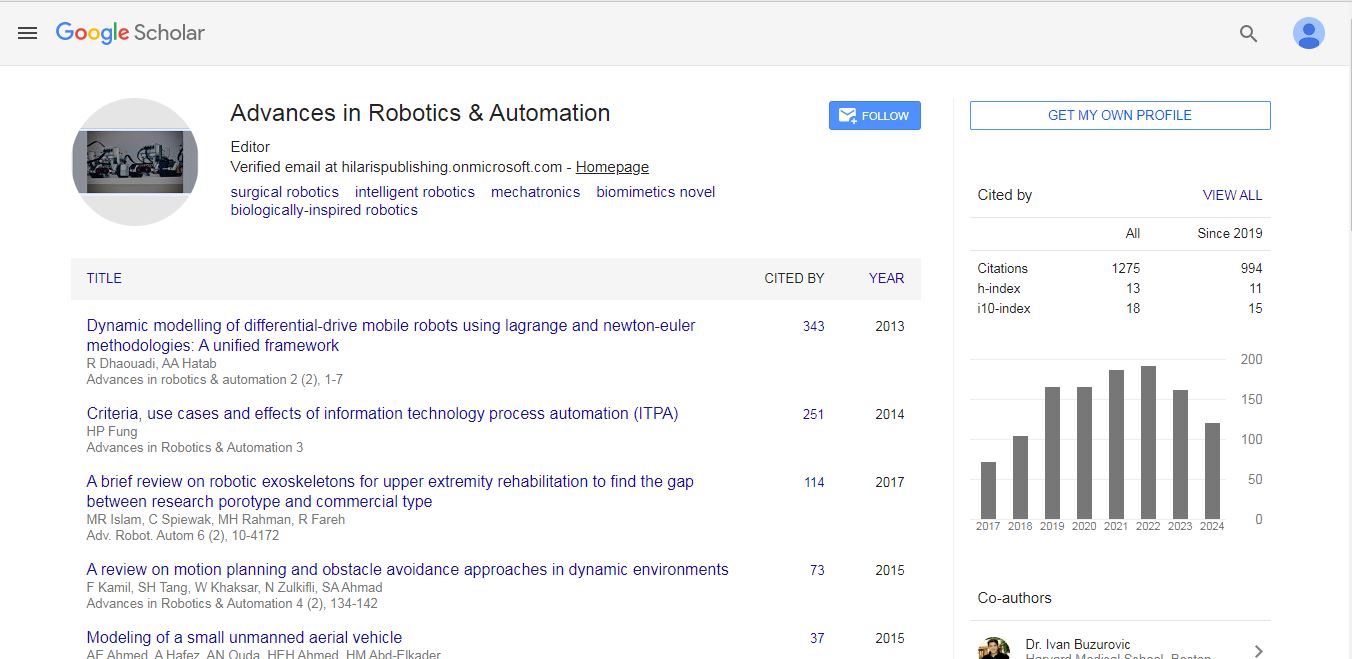
Advances in Robotics & Automation received 1275 citations as per Google Scholar report