Brief Report - (2025) Volume 14, Issue 4
Received: 03-Aug-2025, Manuscript No. jsp-26-182261;
Editor assigned: 05-Aug-2025, Pre QC No. P-182261;
Reviewed: 19-Aug-2025, QC No. Q-182261;
Revised: 21-Aug-2025, Manuscript No. R-182261;
Published:
30-Aug-2025
, DOI: 10.37421/2165-7939.2025.14.730
Citation: Conti, Isabella R.. ”AI Revolutionizing Spine Care: Diagnosis to Treatment.” J Spine 14 (2025):730.
Copyright: © 2025 Conti R. Isabella This is an open-access article distributed under the terms of the Creative Commons Attribution License, which permits unrestricted use, distribution and reproduction in any medium, provided the original author and source are credited.
Artificial intelligence (AI) is profoundly reshaping the landscape of spinal imaging and surgical planning, significantly enhancing diagnostic precision, optimizing the interpretation of medical images, and facilitating the development of highly personalized treatment strategies for spinal conditions [1].
The sophisticated algorithms developed within AI are capable of automating the detection of subtle abnormalities, precisely quantifying the extent of spinal deformities, and offering predictive insights into surgical outcomes. This capability directly translates to more accurate and efficient surgical interventions, ultimately benefiting patient care [1].
This integration of AI into spinal healthcare promises improved visualization of intricate anatomical structures and supports the creation of patient-specific surgical blueprints, with the overarching goal of elevating patient safety and achieving superior clinical results [1].
Machine learning models have demonstrated considerable promise in their ability to predict the success of spinal fusion procedures by meticulously analyzing preoperative imaging features [2].
These advanced models possess the capacity to discern subtle radiographic patterns that may evade the notice of human experts. By doing so, they offer invaluable support for surgical decision-making processes and refine the selection of appropriate candidates for spinal fusion operations [2].
Deep learning techniques are increasingly being employed for the crucial task of segmenting spinal structures within medical images, leading to more accurate assessments of spinal alignment and the identification of deformities [3].
This automated segmentation methodology not only reduces the inherent variability among different observers but also substantially accelerates the analytical process for complex spinal pathologies [3].
AI-powered tools are progressively emerging for the intricate process of virtual surgical planning, particularly in cases involving complex spinal pathologies such as spinal tumors and severe deformities [4].
These advanced tools facilitate the creation of patient-specific three-dimensional models and allow for the simulation of various surgical approaches, thereby enabling surgeons to proactively identify potential challenges and optimize their operative strategies before entering the operating room [4].
The incorporation of AI into the radiomics analysis of spine MRI scans holds significant potential for the early detection and precise characterization of spinal tumors [5].
By extracting detailed features from MRI data, these AI applications can establish correlations with tumor aggressiveness and predict treatment response, thereby offering a non-invasive avenue for effective disease management [5].
AI algorithms are proving to be invaluable in the quantitative assessment of spinal instability across a spectrum of imaging modalities, providing crucial support for the evaluation of patients experiencing degenerative or traumatic spinal conditions [6].
This quantitative analysis plays a vital role in guiding the critical decision-making process between surgical and non-surgical management options [6].
The application of AI in predicting potential complications following spine surgery, including infections or hardware failures, represents a rapidly evolving area of research [7].
By rigorously analyzing both preoperative patient data and intraoperative factors, AI systems can effectively identify individuals at heightened risk, thus enabling the implementation of targeted preventive interventions [7].
AI-driven techniques for image registration and fusion are significantly enhancing the precision of intraoperative navigation during spine surgery [8].
These sophisticated technologies provide real-time guidance, thereby augmenting the accuracy and safety of complex surgical procedures [8].
The development of AI-powered tools designed for the automated detection of vertebral fractures on CT scans promises to substantially improve both diagnostic efficiency and consistency, especially within the demanding environment of emergency care settings [9].
Such advancements can lead to quicker and more reliable diagnoses for patients [9].
Artificial intelligence is currently being explored for its capacity to personalize surgical planning for scoliosis correction procedures [10].
This includes predicting the most effective rod placement and accurately estimating the risk of neurological injury based on an individual patient's unique anatomy and the specific characteristics of their spinal deformity [10].
Artificial intelligence (AI) is revolutionizing spine imaging and surgical planning by elevating diagnostic accuracy, refining image interpretation, and enabling tailored treatment strategies [1].
AI algorithms offer automated detection of abnormalities, precise quantification of spinal deformities, and predictive capabilities for surgical outcomes, leading to enhanced precision and efficiency in interventions [1].
This integration fosters superior visualization of complex spinal anatomy and aids in developing patient-specific surgical plans, ultimately aiming to improve patient safety and clinical results [1].
Machine learning models are showing considerable promise in predicting the success of spinal fusion outcomes by leveraging preoperative imaging features [2].
These models can analyze subtle radiographic patterns that might be imperceptible to human observation, thus informing surgical decision-making and optimizing patient selection for fusion procedures [2].
Deep learning techniques are being effectively applied to the segmentation of spinal structures from medical images, which results in more accurate measurements of spinal alignment and deformity [3].
This automated segmentation process is crucial for reducing inter-observer variability and expediting the analysis of complex spinal conditions [3].
AI-powered tools are emerging as critical assets for virtual surgical planning in complex spinal pathologies, including spinal tumors and severe deformities [4].
These tools enable the creation of patient-specific 3D models and allow for the simulation of surgical approaches, empowering surgeons to anticipate challenges and refine their operative strategies [4].
The integration of AI into radiomics analysis of spine MRI can substantially aid in the early detection and characterization of spinal tumors [5].
Features extracted from MRI scans can be correlated with tumor aggressiveness and treatment response, providing a non-invasive method for managing spinal tumors [5].
AI algorithms are instrumental in quantifying spinal instability from various imaging modalities, which is vital for assessing patients with degenerative or traumatic spinal conditions [6].
This quantitative assessment directly supports decision-making regarding surgical versus non-surgical management strategies [6].
The use of AI in predicting postoperative complications after spine surgery, such as infections or hardware failure, is an active and critical area of research [7].
By analyzing preoperative patient data and intraoperative factors, AI can identify high-risk individuals, facilitating targeted preventive measures and improving patient outcomes [7].
AI-driven image registration and fusion techniques are significantly advancing the accuracy of intraoperative navigation in spine surgery [8].
These technologies provide real-time guidance, thereby increasing precision during complex and delicate surgical procedures [8].
AI-powered tools for the automated detection of vertebral fractures on CT scans are poised to significantly enhance diagnostic efficiency and consistency, particularly in high-pressure emergency settings [9].
This automation can lead to faster and more reliable diagnoses, especially in time-sensitive situations [9].
AI is being explored for its capability to personalize surgical planning for scoliosis correction [10].
This involves predicting optimal rod placement and assessing the risk of neurological injury based on individual patient anatomy and deformity characteristics, allowing for highly tailored surgical approaches [10].
Artificial intelligence (AI) is revolutionizing spine care by improving diagnostic accuracy, optimizing surgical planning, and personalizing treatment strategies. AI algorithms enhance image interpretation, automate abnormality detection, and quantify spinal deformities. Machine learning predicts surgical outcomes and fusion success by analyzing imaging features. Deep learning aids in accurate segmentation of spinal structures, reducing variability and speeding up analysis. AI-powered tools facilitate virtual surgical planning for complex pathologies, allowing for simulation and strategy optimization. Radiomics analysis using AI helps in early tumor detection and characterization. AI quantifies spinal instability, guiding treatment decisions, and predicts postoperative complications to enable preventive measures. AI also enhances intraoperative navigation accuracy and automates vertebral fracture detection. Finally, AI personalizes scoliosis surgery planning by predicting optimal rod placement and assessing neurological injury risk.
None
None
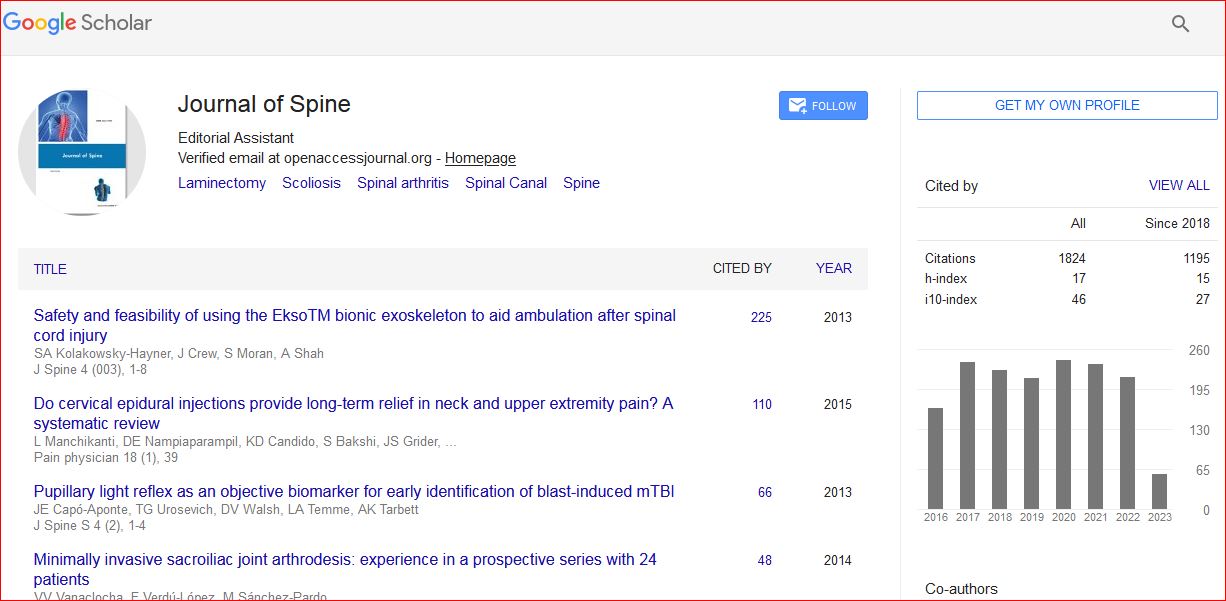
Journal of Spine received 2022 citations as per Google Scholar report