Opinion - (2025) Volume 9, Issue 6
Received: 01-Nov-2025, Manuscript No. fsb-26-189973;
Editor assigned: 03-Nov-2025, Pre QC No. P-189973;
Reviewed: 17-Nov-2025, QC No. Q-189973;
Revised: 24-Nov-2025, Manuscript No. R-189973;
Published:
29-Nov-2025
, DOI: 10.37421/2577-0543.2025.9.259
Citation: Rossi, Isabella. ”AI Revolutionizing Pharmaceutical Formulation: Efficiency, Safety, Innovation.” J. Formul. Sci. Bioavailability 09 (2025):259.
Copyright: © 2025 Rossi I. This is an open-access article distributed under the terms of the Creative Commons Attribution License, which permits unrestricted use, distribution and reproduction in any medium, provided the original author and source are credited.
Artificial intelligence (AI) is increasingly transforming pharmaceutical formulation, offering powerful tools to predict drug-excipient interactions, optimize solubility and dissolution profiles, and enhance bioavailability. Machine learning algorithms can analyze vast datasets to identify optimal formulations more efficiently than traditional methods, leading to reduced development timelines and costs [1].
The application of deep learning models in predicting drug solubility and dissolution rate represents a significant advancement in formulation science. These models, trained on extensive physicochemical and formulation data, can accurately forecast how different excipients and manufacturing processes will impact drug release and absorption [2].
Machine learning algorithms are proving invaluable in understanding and optimizing drug-excipient compatibility. By analyzing spectroscopic data, thermal analysis, and other physicochemical parameters, AI can identify potential adverse interactions that might compromise drug stability and efficacy [3].
AI-driven modeling of pharmacokinetic and pharmacodynamic (PK/PD) properties can significantly guide formulation development towards improved bioavailability. By simulating drug absorption, distribution, metabolism, and excretion (ADME) profiles based on formulation characteristics, AI can predict in vivo performance [4].
The use of generative adversarial networks (GANs) in drug formulation presents an exciting avenue for designing novel drug delivery systems with specific release characteristics. GANs can learn the complex relationships between formulation components and desired performance metrics, enabling the creation of entirely new formulation strategies [5].
AI-powered high-throughput screening (HTS) and in silico formulation design can drastically reduce the time and resources needed for early-stage drug development. By predicting the success of various formulations without extensive wet-lab experiments, AI accelerates the identification of lead candidates and optimizes their characteristics from the outset [6].
The integration of AI in process analytical technology (PAT) allows for real-time monitoring and control of manufacturing processes, ensuring consistent formulation quality and performance. AI algorithms can analyze sensor data to detect deviations and predict potential issues, enabling proactive adjustments to maintain optimal process parameters [7].
AI is instrumental in designing personalized drug formulations tailored to individual patient needs, such as specific genetic profiles or disease states. By analyzing patient data and predicting their response to different formulations, AI can guide the development of customized drug delivery strategies that maximize therapeutic efficacy and minimize side effects [8].
The development of AI-based platforms for predictive toxicology in formulation design is crucial for patient safety. These systems can forecast potential toxicity issues associated with specific excipients or formulation combinations early in the development process, thus avoiding costly late-stage failures and ensuring the safety of the final drug product [9].
Reinforcement learning (RL) offers a novel approach to optimize complex formulation processes, such as controlled drug release. By learning through trial and error in simulated environments, RL agents can discover optimal strategies for controlling particle size, drug loading, and other parameters to achieve desired release kinetics, leading to highly sophisticated drug delivery systems [10].
Artificial intelligence (AI) is revolutionizing pharmaceutical formulation by providing advanced analytical capabilities for predicting crucial drug properties. These tools are essential for forecasting drug-excipient interactions, optimizing solubility and dissolution profiles, and ultimately enhancing bioavailability. The power of machine learning algorithms lies in their ability to process immense datasets, identifying optimal formulations far more efficiently than conventional methods, which directly translates to shortened development timelines and reduced costs [1].
Deep learning models have emerged as a significant advancement in formulation science, particularly in their capacity to predict drug solubility and dissolution rates. Trained on comprehensive physicochemical and formulation data, these models demonstrate high accuracy in forecasting the impact of various excipients and manufacturing techniques on drug release and absorption characteristics [2].
Machine learning algorithms are proving to be indispensable for understanding and improving drug-excipient compatibility. Through the analysis of data from spectroscopic techniques, thermal analysis, and other physicochemical measurements, AI can accurately identify potential detrimental interactions that could compromise the stability and effectiveness of a drug formulation [3].
AI-driven modeling offers a powerful approach to predict pharmacokinetic and pharmacodynamic (PK/PD) properties, which is vital for enhancing formulation development and improving bioavailability. By simulating ADME profiles based on formulation attributes, AI can reliably predict how a drug will perform in vivo, facilitating the rational design of formulations that achieve targeted therapeutic concentrations with minimal patient-to-patient variability [4].
The application of generative adversarial networks (GANs) in drug formulation is opening new frontiers for the creation of novel drug delivery systems designed with specific release profiles. GANs excel at understanding intricate relationships between formulation components and desired performance outcomes, paving the way for the conceptualization of entirely innovative formulation strategies [5].
AI-driven high-throughput screening (HTS) and in silico formulation design represent a paradigm shift in accelerating early-stage drug development, significantly cutting down on time and resources. By accurately predicting the likelihood of success for various formulations without the need for extensive laboratory experimentation, AI expedites the identification of promising lead candidates and their characteristics from the initial stages [6].
The incorporation of AI into process analytical technology (PAT) enables real-time monitoring and precise control over pharmaceutical manufacturing processes, thereby guaranteeing the uniformity of formulation quality and performance. AI algorithms can scrutinize sensor data to detect anomalies and anticipate prospective problems, allowing for timely, proactive adjustments to maintain optimal operational parameters [7].
AI plays a pivotal role in the design of personalized drug formulations that are specifically adapted to individual patient requirements, including genetic makeup or specific disease conditions. By analyzing patient data and predicting individual responses to diverse formulations, AI provides guidance for developing customized drug delivery approaches aimed at maximizing therapeutic benefits while minimizing adverse effects [8].
The creation of AI-based platforms for predictive toxicology within the context of formulation design is fundamentally important for ensuring patient safety. These intelligent systems are capable of forecasting potential toxicological concerns linked to particular excipients or formulation combinations early in the development lifecycle, thereby averting expensive failures in later stages and safeguarding the integrity of the final drug product [9].
Reinforcement learning (RL) introduces a sophisticated new methodology for refining intricate formulation processes, such as those involved in controlled drug release. Through a process of iterative learning in simulated environments, RL agents can identify the most effective strategies for managing variables like particle size and drug loading to achieve precise release kinetics, ultimately yielding highly advanced drug delivery systems [10].
Artificial intelligence (AI) is profoundly impacting pharmaceutical formulation by enabling more efficient and predictive development processes. Machine learning and deep learning algorithms analyze vast datasets to optimize drug-excipient interactions, solubility, dissolution, and bioavailability, reducing development timelines and costs. AI is crucial for predicting drug stability and compatibility, ensuring formulation robustness. Furthermore, AI models predict pharmacokinetic and pharmacodynamic profiles, guiding the rational design of drug delivery systems for improved therapeutic outcomes. Novel approaches like generative adversarial networks and reinforcement learning are paving the way for innovative drug delivery systems and optimized manufacturing processes. AI also enhances patient safety through predictive toxicology and enables personalized drug formulations tailored to individual needs. The integration of AI in process analytical technology ensures consistent quality and performance in pharmaceutical manufacturing. Overall, AI is accelerating drug development, improving efficacy, and enhancing safety.
None
None
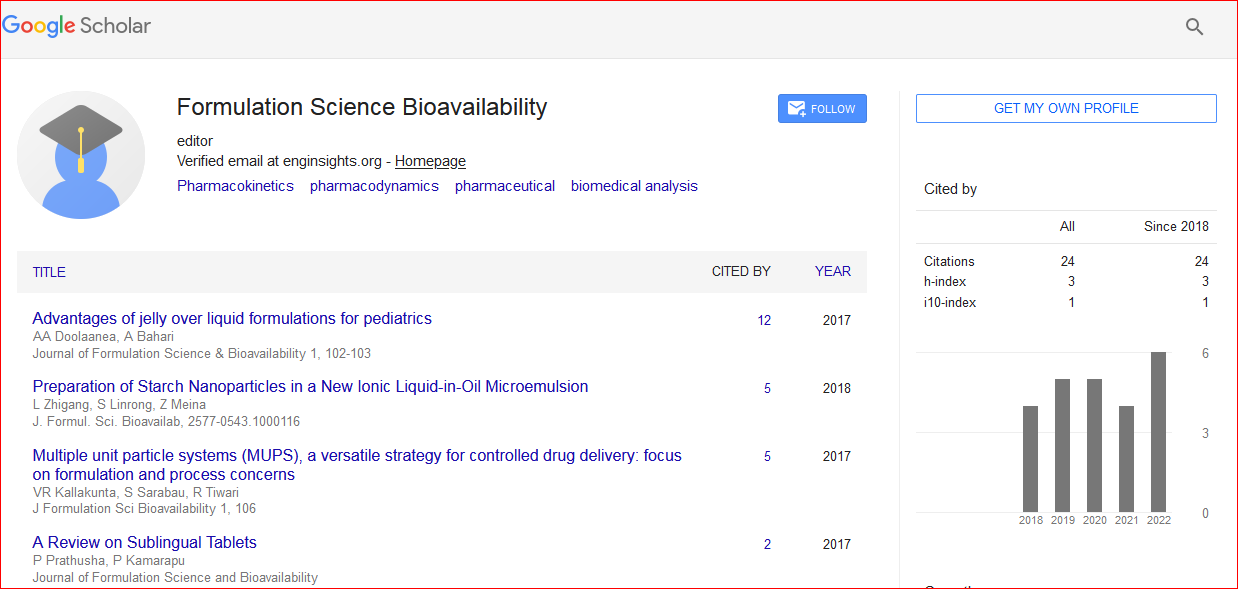
Journal of Formulation Science & Bioavailability received 23 citations as per Google Scholar report