Brief Report - (2025) Volume 16, Issue 2
Received: 01-Apr-2025, Manuscript No. jfr-26-184090;
Editor assigned: 03-Apr-2025, Pre QC No. P-184090;
Reviewed: 17-Apr-2025, QC No. Q-184090;
Revised: 22-Apr-2025, Manuscript No. R-184090;
Published:
29-Apr-2025
, DOI: 10.37421/2157-7145.2025.16.651
Citation: Takamura, Hiroshi. ”AI Revolutionizes Digital Forensics:
Speed, Accuracy, Security.” J Forensic Res 16 (2025):651.
Copyright: © 2025 Takamura H. This is an open-access article distributed under the terms of the Creative Commons Attribution License, which permits unrestricted use,
distribution and reproduction in any medium, provided the original author and source are credited.
Artificial intelligence (AI) is profoundly transforming the field of digital forensics by automating laborious tasks, thereby enhancing the efficiency and effectiveness of evidence analysis. This technological integration allows for a more systematic and rapid examination of digital artifacts, crucial in addressing the escalating volume of data encountered in modern investigations [1].
The capabilities extend to sophisticated pattern recognition, which is essential for identifying subtle indicators of malicious activity or data manipulation that might otherwise be overlooked by human analysts [1].
Deep learning models, a subset of AI, are demonstrating considerable potential in the accurate classification and identification of diverse digital evidence. This includes complex data types like images and videos, aiding investigators in swiftly triaging large datasets and pinpointing incriminating content with remarkable precision [2].
Their ability to learn intricate features from raw data makes them invaluable for handling the nuanced challenges of forensic media analysis [2].
Furthermore, the application of natural language processing (NLP) is becoming indispensable for dissecting unstructured textual data. Emails, chat logs, and social media communications, often rich with critical information, can be systematically analyzed by AI-powered NLP tools to extract relevant details, gauge sentiment, and detect patterns suggestive of criminal conduct [3].
This capability streamlines the review process for massive textual datasets [3].
AI algorithms are also proving instrumental in accelerating the detection and analysis of malware within digital forensic contexts. By leveraging extensive datasets of known malicious software, AI can effectively identify new and evolving threats, often outperforming traditional signature-based detection methods in terms of speed and scope [4].
This proactive approach is vital in combating rapidly advancing cyber threats [4].
In the realm of network forensics, AI excels at anomaly detection, meticulously identifying unusual patterns or deviations from established normal behavior. Such deviations can signal unauthorized access or ongoing intrusions, enabling a more responsive and proactive incident response strategy that mitigates potential damage [5].
This continuous monitoring capability is a significant advancement for network security [5].
The convergence of AI with blockchain technology presents a novel paradigm for enhancing the security and integrity of digital forensic data. Blockchain's inherent immutability provides a trustworthy ledger for recording the provenance and chain of custody of evidence, while AI facilitates the subsequent analysis of this secured data, ensuring its authenticity and reliability [6].
This integration addresses critical concerns regarding evidence tampering [6].
AI-driven data recovery techniques are continuously advancing, significantly improving the chances of retrieving damaged or deleted information from a wide array of storage media. This capability is particularly critical in scenarios involving accidental data loss or deliberate attempts at data wiping, offering a higher success rate for data reconstruction [7].
The sophistication of these methods is crucial for recovering vital evidence [7].
AI's capacity to identify intricate patterns within vast quantities of digital evidence, such as user behavior analytics, is a powerful tool for detecting insider threats or instances of unauthorized access. This proactive capability allows organizations to bolster their defenses and conduct more thorough investigations into security breaches by understanding the subtle indicators of compromise [8].
This foresight is key to preventing breaches [8].
Despite its transformative potential, the ethical and legal ramifications of employing AI in digital forensics demand careful consideration. Ensuring fairness, transparency, and accountability in AI-driven investigations is paramount to upholding the integrity of the justice system and maintaining public trust in forensic processes [9].
These ethical dimensions are critical for responsible deployment [9].
The development of explainable AI (XAI) is a crucial step towards fostering trust and ensuring that AI-generated insights in digital forensics are comprehensible and legally defensible. XAI endeavors to demystify the decision-making processes of AI, making them transparent and readily understandable for legal proceedings and expert testimony [10].
This transparency is essential for judicial acceptance [10].
Artificial intelligence (AI) is fundamentally reshaping the landscape of digital forensics through its ability to automate repetitive tasks, thereby enhancing the speed and accuracy of evidence analysis. This technological integration is vital for managing the ever-increasing volume of digital evidence encountered in contemporary investigations [1].
The enhanced pattern recognition capabilities offered by AI allow for the identification of subtle anomalies and malicious code, contributing to more thorough and efficient forensic examinations [1].
Deep learning models, a sophisticated branch of AI, are proving highly effective in classifying and identifying various digital artifacts, including images and videos. This capability significantly aids in the rapid triage of large datasets, allowing forensic investigators to quickly identify incriminating content and focus their resources more effectively [2].
The nuanced understanding of complex data structures by these models is a major asset in forensic media analysis [2].
Natural language processing (NLP) techniques, powered by AI, are crucial for analyzing textual data such as emails, chat logs, and social media posts. AI-driven NLP can efficiently extract relevant information, discern sentiment, and detect patterns indicative of criminal activity, streamlining the review of vast amounts of textual evidence [3].
This automated text analysis offers substantial time savings and improved accuracy [3].
AI algorithms are accelerating the process of identifying and analyzing malware in digital forensics. By training on extensive datasets of known malware, AI can detect novel and emerging threats with greater efficiency than traditional methods. This enhanced capability is essential for staying ahead of sophisticated cyber threats [4].
The ability to identify zero-day threats is particularly valuable [4].
In network forensics, AI plays a pivotal role in anomaly detection. It helps identify unusual patterns or deviations from normal network behavior that could signify an intrusion or malicious activity. This proactive approach significantly improves incident response capabilities and enhances overall network security [5].
Continuous monitoring and rapid detection are key benefits [5].
The integration of AI with blockchain technology promises enhanced security and integrity for digital forensic data. Blockchain's immutable ledger can meticulously record the provenance and chain of custody of digital evidence, while AI can be employed for its subsequent analysis. This combination ensures the trustworthiness and auditability of forensic findings [6].
The immutability of blockchain adds a critical layer of security [6].
AI-driven data recovery techniques are becoming increasingly sophisticated, leading to higher success rates in retrieving damaged or deleted data from various storage media. This is particularly useful in cases of accidental data loss or intentional data wiping, ensuring that crucial evidence is not lost permanently [7].
The ability to recover data from severely compromised media is a significant advantage [7].
AI can assist in identifying patterns within large volumes of digital evidence, such as through user behavior analytics, to detect insider threats or unauthorized access. This proactive strategy aids in preventing and investigating security breaches by recognizing subtle behavioral anomalies that might indicate malicious intent [8].
Early detection of insider threats is a critical application [8].
The ethical considerations and legal implications associated with using AI in digital forensics are of paramount importance. Ensuring fairness, transparency, and accountability in AI-driven investigations is essential for maintaining the integrity of the justice system and the credibility of forensic science [9].
Addressing these ethical challenges is crucial for responsible AI adoption [9].
The development of explainable AI (XAI) is vital for digital forensics to build trust and ensure that AI-generated insights are understandable and defensible in legal contexts. XAI aims to make AI decision-making processes transparent, allowing for scrutiny and validation of the analytical outcomes [10].
This transparency is necessary for the acceptance of AI evidence in court [10].
Artificial intelligence (AI) is revolutionizing digital forensics by automating tasks, enhancing pattern recognition, and improving evidence analysis speed and accuracy. Machine learning algorithms assist in identifying malicious code, detecting network anomalies, and recovering deleted data, which is crucial for managing increasing evidence volumes. Deep learning models excel at classifying digital artifacts like images and videos, aiding in rapid data triage. Natural language processing (NLP) powered by AI is essential for analyzing textual data such as emails and chat logs, extracting relevant information and identifying criminal patterns. AI algorithms significantly accelerate malware detection by learning from vast datasets, outperforming traditional methods. In network forensics, AI enables proactive anomaly detection to identify intrusions. The integration of AI with blockchain enhances data security and integrity by providing an immutable record of evidence provenance. AI-driven data recovery techniques improve the retrieval of damaged or deleted data. User behavior analytics powered by AI helps detect insider threats. Ethical considerations and the development of explainable AI (XAI) are paramount for ensuring fairness, transparency, and defensibility in AI-driven forensic investigations.
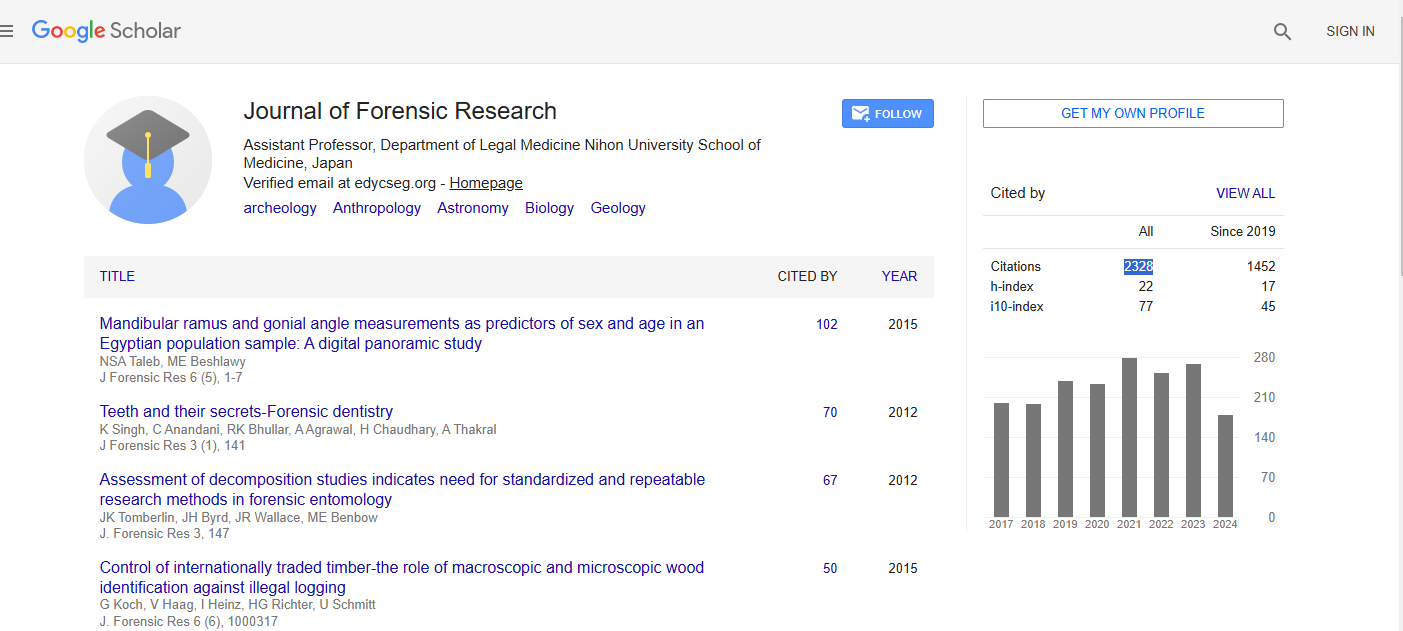
Journal of Forensic Research received 2328 citations as per Google Scholar report