Opinion - (127) Volume 16, Issue 3
Received: 01-May-2025, Manuscript No. jch-26-178759;
Editor assigned: 05-May-2025, Pre QC No. P-178759;
Reviewed: 19-May-2025, QC No. Q-178759;
Revised: 24-May-2025, Manuscript No. R-178759;
Published:
29-May-2025
, DOI: 10.37421/2157-7099.2025.16.797
Citation: Alvarez, Diego M.. ”AI Revolutionizes Cytology: Accuracy, Efficiency, Precision.” J Cytol Histol 16 (2025):797.
Copyright: © 2025 Alvarez M. Diego This is an open-access article distributed under the terms of the Creative Commons Attribution License, which permits unrestricted use, distribution and reproduction in any medium, provided the original author and source are credited.
The field of cytological diagnosis is undergoing a significant transformation, driven by advancements in artificial intelligence and machine learning. These technologies are poised to enhance the accuracy, efficiency, and objectivity of pathological assessments, thereby improving patient care. Image analysis, in particular, is at the forefront of this revolution, offering powerful tools for the interpretation of cytological samples. Machine learning and deep learning algorithms can automate critical tasks such as cell segmentation, classification, and feature extraction, providing valuable assistance to pathologists. This automation is instrumental in detecting subtle abnormalities that might otherwise be missed, leading to earlier and more precise disease identification, especially in the context of various cancers. The integration of these AI-driven approaches holds the promise of reducing inter-observer variability, a persistent challenge in subjective diagnostic fields, leading to more consistent and reliable diagnoses across different practitioners and institutions. Deep learning models have demonstrated remarkable capabilities in analyzing the intricate details of cytological images. These models are particularly adept at the automated detection and grading of precancerous lesions, such as those found in cervical screening. Convolutional Neural Networks (CNNs), a prominent type of deep learning architecture, can learn hierarchical features directly from raw pixel data. This process effectively mimics the visual interpretation process employed by expert cytopathologists, enabling a level of analytical depth previously unattainable through manual methods. Consequently, these advanced computational techniques offer a highly promising avenue for improving the effectiveness and accessibility of screening programs, especially in regions with limited resources where specialized expertise may be scarce. The application of machine learning within the domain of fine-needle aspiration (FNA) cytology is significantly enhancing diagnostic accuracy for a range of malignancies, including those affecting the thyroid and breast. These algorithms possess the ability to quantify subtle cellular features that are indicative of disease. Furthermore, they can identify atypical cells with high precision and even predict the likelihood of malignancy based on complex patterns of cellular characteristics. This analytical power provides pathologists with crucial information, enabling them to make more informed decisions regarding patient management and potentially reducing the necessity for more invasive diagnostic procedures, thereby improving patient comfort and reducing healthcare costs. Quantitative image analysis represents a cornerstone in the objective assessment of cytological specimens. This approach plays a crucial role in evaluating both tumor morphology and individual cellular characteristics. By employing sophisticated algorithms, parameters such as nuclear size, shape, texture, and chromatin patterns can be measured with a high degree of objectivity. These quantitative metrics can then be correlated with patient prognosis and their likely response to different treatment regimens. This provides valuable complementary information that enhances the traditional morphological assessment performed by pathologists, leading to a more comprehensive understanding of the disease. Computational pathology, encompassing AI-driven image analysis, is extending its reach to the characterization of inflammatory and infectious agents within cytological samples. These advanced computational tools are designed to facilitate the rapid and accurate identification of various microorganisms and the recognition of distinct inflammatory patterns. This capability significantly contributes to expediting the diagnostic process for infectious diseases, allowing for quicker initiation of appropriate treatment and potentially improving patient outcomes. The ability to swiftly identify pathogens is critical in managing outbreaks and treating severe infections. For the reliable implementation of AI technologies in cytological diagnosis, standardization of image acquisition and analysis protocols is of paramount importance. Establishing consistent procedures for capturing and processing images ensures that algorithms are trained on representative data and can perform consistently across different settings. The development of robust and generalizable AI algorithms necessitates the availability of large, well-annotated datasets. These datasets are critical for training models that can effectively handle variations in sample preparation, staining techniques, and imaging equipment found in different laboratories worldwide. AI-powered image analysis tools are proving to be invaluable assistants in identifying rare cytological findings and subtle cellular changes. These subtle alterations in cell morphology can sometimes be easily overlooked during manual microscopic examination. By highlighting these anomalies, AI tools can significantly improve the sensitivity of cytological screening for a wide array of conditions, ensuring that potential pathologies are not missed. This enhancement in sensitivity can lead to earlier detection of diseases, which is often critical for successful treatment and improved prognosis. The prognostic implications associated with specific cytological features can be further elucidated through the application of advanced image analysis techniques. Machine learning algorithms are capable of integrating multiple quantitative features derived from cellular images. This integration allows for the prediction of patient outcomes with greater accuracy and can provide guidance for therapeutic decisions. Such capabilities are essential for moving towards a more personalized approach to medicine, where treatment strategies are tailored to the specific characteristics of an individual patient's disease as revealed through detailed cytological analysis. A critical aspect for the successful clinical adoption of AI in cytopathology is the development of interpretability methods for these complex models. Building trust among pathologists and clinicians requires an understanding of how AI algorithms arrive at their diagnostic conclusions. Explainable AI (XAI) techniques are essential for validation purposes, allowing researchers and practitioners to scrutinize the decision-making process of the AI. Furthermore, interpretability is crucial for identifying potential biases that may exist within the algorithms or the data they were trained on, ensuring fairness and equity in diagnostic outcomes. It is crucial to emphasize that the ultimate role of image analysis and AI in cytological diagnosis is not to replace skilled pathologists but rather to augment their capabilities. These technologies are designed to function as valuable second readers, assisting in the review of cases and optimizing the overall diagnostic workflow. By enhancing efficiency and accuracy, the integration of AI ultimately aims to improve patient care through the provision of more precise, timely, and accessible diagnostic services. The synergy between human expertise and artificial intelligence promises to elevate the standard of cytological practice.
Image analysis, especially when powered by machine learning and deep learning techniques, is fundamentally reshaping the landscape of cytological diagnosis. These advanced computational methods are instrumental in improving diagnostic accuracy, increasing the efficiency of the analysis process, and bringing a higher degree of objectivity to interpretations. Key applications include the automated segmentation of cells, their precise classification, and the extraction of relevant features, all of which serve to support pathologists in their identification of subtle abnormalities. This is particularly impactful in the examination of Pap smears, fine-needle aspirates, and other cytological samples, facilitating earlier and more accurate disease detection, especially for various forms of cancer, and mitigating the inherent variability that can arise from multiple human observers. Deep learning models are demonstrating exceptional proficiency in handling the complexity of cytological images, enabling the automated detection and grading of cervical precancerous lesions. Convolutional Neural Networks (CNNs) are particularly effective, as they can automatically learn intricate, hierarchical features directly from the raw pixel data of an image. This ability closely mimics the complex visual interpretation process undertaken by expert cytopathologists. Consequently, deep learning presents a highly promising pathway for enhancing the effectiveness of cervical cancer screening programs, offering a scalable solution that can benefit even settings with limited resources. The integration of machine learning into the practice of fine-needle aspiration (FNA) cytology is significantly boosting diagnostic accuracy for several types of cancers, notably those originating in the thyroid and breast. These intelligent algorithms are capable of precisely quantifying various cellular features that are critical for diagnosis. They can also identify atypical cells with remarkable sensitivity and even provide predictive assessments of malignancy risk. This advanced analytical support empowers pathologists to make more informed and confident decisions, potentially reducing the need for more invasive diagnostic procedures and improving patient comfort. Quantitative image analysis plays an indispensable role in the detailed assessment of tumor morphology and cellular characteristics observed in cytological specimens. This methodology allows for the objective measurement of critical parameters, including nuclear size, shape, texture, and the patterns of chromatin. These quantified features can then be correlated with factors such as patient prognosis and the expected response to treatment. Such objective data provides valuable supplementary information that enhances the traditional morphological evaluation performed by pathologists, leading to a more nuanced understanding of the disease. The scope of computational pathology, which prominently features AI-driven image analysis, is expanding to include the detailed characterization of inflammatory and infectious agents found within cytological samples. These sophisticated computational tools are designed to expedite the process of accurately identifying a wide range of microorganisms and recognizing characteristic inflammatory patterns. This capability significantly contributes to faster diagnosis and more effective management of infectious diseases, which is crucial for timely intervention and improved patient outcomes. A critical prerequisite for the successful and reliable deployment of AI in cytological diagnosis is the establishment of standardized protocols for both image acquisition and subsequent analysis. Developing algorithms that are robust and dependable requires access to extensive, meticulously annotated datasets. These datasets are vital for ensuring that the trained algorithms possess the generalizability needed to perform accurately across diverse laboratory environments and various imaging platforms, overcoming technical variations. AI-powered image analysis tools are proving to be highly effective in assisting with the identification of rare cytological findings and subtle cellular changes that might be easily overlooked during conventional manual examination. By drawing attention to these potentially significant details, these AI tools enhance the sensitivity of cytological screening for numerous conditions. This improved sensitivity can lead to the earlier detection of diseases, which is often a critical factor in achieving successful treatment outcomes. The prognostic value of specific cytological features can be more deeply understood and leveraged through the application of advanced image analysis techniques. Machine learning algorithms have the capacity to integrate a multitude of quantitative features extracted from cellular images. This comprehensive analysis enables more accurate predictions of patient outcomes and provides valuable guidance for therapeutic decision-making, pushing cytological practice towards a more personalized medicine paradigm. The development of methods that enhance the interpretability of AI models used in cytopathology is fundamental to fostering trust and facilitating their widespread clinical adoption. Clinicians need to understand the rationale behind an AI's diagnostic suggestions. Explainable AI (XAI) techniques are essential for validating the reliability of these models and for identifying any potential biases that may be present, ensuring equitable diagnostic performance. It is essential to reiterate that the role of AI-driven image analysis in cytological diagnosis is primarily that of an augmentation to, rather than a replacement for, the expertise of human pathologists. These tools serve as valuable second readers and contribute to optimizing the workflow. Ultimately, the overarching objective is to elevate the quality of patient care through the provision of diagnostic services that are more accurate, efficient, and broadly accessible, creating a synergy between human insight and computational power.
Artificial intelligence, particularly machine learning and deep learning applied to image analysis, is revolutionizing cytological diagnosis by enhancing accuracy, efficiency, and objectivity. These techniques automate cell segmentation, classification, and feature extraction, aiding pathologists in detecting subtle abnormalities and leading to earlier, more precise disease identification. Deep learning models, such as CNNs, excel at analyzing complex images for tasks like cervical precancerous lesion detection. Machine learning improves diagnostic accuracy in FNA cytology for cancers like thyroid and breast. Quantitative image analysis objectively measures cellular features for prognostic correlation. AI also aids in identifying inflammatory and infectious agents and rare cytological findings. Standardization of protocols and large datasets are crucial for reliable AI implementation. Interpretability of AI models is key for clinical trust and adoption. AI tools augment pathologist capabilities, aiming to improve patient care through more accurate and efficient diagnostics.
None
None
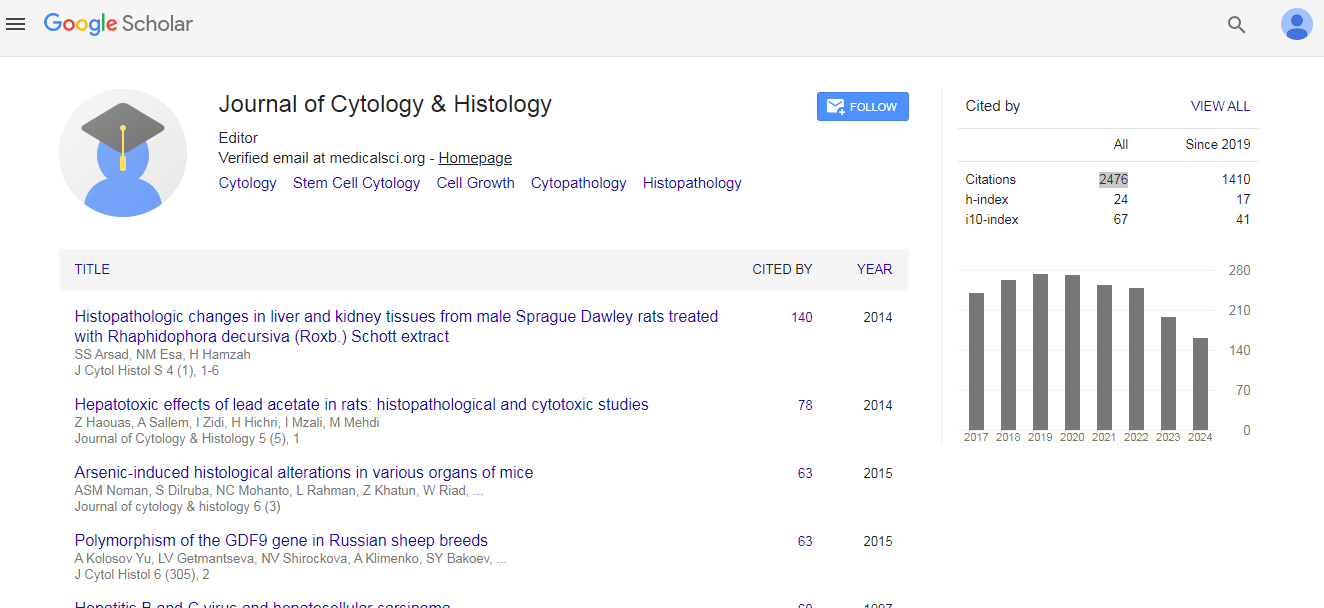
Journal of Cytology & Histology received 2476 citations as per Google Scholar report