Short Communication - (2025) Volume 16, Issue 2
Received: 01-Mar-2025, Manuscript No. jhmi-26-178810;
Editor assigned: 03-Mar-2025, Pre QC No. P-178810;
Reviewed: 17-Mar-2025, QC No. Q-178810;
Revised: 24-Mar-2025, Manuscript No. R-178810;
Published:
31-Mar-2025
, DOI: 10.37421/2157-7420.2025.16.577
Citation: Turner, Michael A.. ”AI Revolutionizes Clinical Decision Support for Better Outcomes.” J Health Med Informat 16 (2025):577.
Copyright: © 2025 Turner A. Michael This is an open-access article distributed under the terms of the Creative Commons Attribution License, which permits unrestricted use, distribution and reproduction in any medium, provided the original author and source are credited.
Artificial Intelligence (AI) is rapidly transforming clinical decision support (CDS) by enhancing diagnostic accuracy, personalizing treatment plans, and improving patient outcomes across various medical fields [1].
Current AI applications are already demonstrating their value, including AI-powered image analysis for radiology and pathology, predictive analytics for disease risk stratification, and natural language processing (NLP) for extracting insights from extensive clinical notes, all contributing to a more informed and precise approach to patient care [1].
The promise of AI extends to augmenting the capabilities of human clinicians by analyzing vast datasets to identify subtle patterns often missed by human observation, leading to earlier and more accurate diagnoses and reducing diagnostic errors [2].
Furthermore, the integration of AI into CDS tools aims to streamline healthcare workflows, allowing medical professionals to dedicate more time to complex patient interactions and direct care [2].
Machine learning (ML), a subset of AI, is proving instrumental in CDS across diverse medical domains such as oncology and cardiology, where ML models can predict patient responses to therapies, identify high-risk individuals, and suggest optimal treatment pathways based on personalized characteristics and real-world evidence [3].
This personalized approach is a significant driver for the increasing adoption of AI in clinical settings, promising a future of more tailored and effective medical interventions [3].
Natural Language Processing (NLP) plays a critical role in unlocking the potential of unstructured clinical text, including physician notes and discharge summaries, enabling AI-driven CDS systems to interpret a broader spectrum of patient information for more comprehensive decision support [4].
By accessing and interpreting this wealth of data, NLP contributes to a better understanding of a patient's history and current status, enriching the diagnostic and treatment planning process [4].
Looking ahead, the future of AI in CDS envisions systems that move beyond mere diagnostic aids to become proactive partners in patient care, facilitating continuous monitoring through wearables and sensors for early detection of health changes and personalized interventions [5].
This proactive stance aims to shift the paradigm of healthcare from reactive treatment to preventative and preemptive strategies, significantly impacting patient well-being [5].
The widespread adoption of AI in CDS is intrinsically linked to addressing ethical considerations and establishing robust regulatory frameworks, with a focus on ensuring data privacy, algorithmic transparency, and fairness, while also mitigating potential biases [6].
The development of clear ethical guidelines is paramount to fostering trust among both clinicians and patients and will undoubtedly shape the responsible evolution of AI in healthcare [6].
AI-powered CDS tools are showing remarkable efficacy in enhancing diagnostic imaging interpretation, capable of identifying abnormalities with high sensitivity and specificity across modalities like radiography, CT scans, and MRIs, aiding in the early detection of conditions such as cancer and cardiovascular diseases [7].
This capability not only improves diagnostic speed but also significantly boosts accuracy in interpreting complex medical images [7].
The seamless integration of AI with electronic health records (EHRs) is a vital step towards realizing real-time CDS, as AI can analyze the extensive data within EHRs to provide clinicians with timely alerts, risk assessments, and treatment recommendations directly within their existing workflows, enhancing actionability and efficiency [8].
This integration ensures that AI-driven insights are readily accessible and actionable at the point of care [8].
AI's potential in drug discovery and development is also a significant area of advancement, capable of accelerating the traditionally slow and expensive process by analyzing biological data, predicting molecular interactions, and identifying potential drug candidates, offering new hope for novel therapies for complex diseases [9].
This acceleration promises to bring much-needed treatments to market more rapidly [9].
The successful implementation of AI in CDS necessitates a collaborative approach involving a multidisciplinary team of clinicians, informaticians, data scientists, and ethicists, ensuring that AI tools are clinically relevant, user-friendly, and ethically sound, ultimately leading to better patient outcomes and more efficient healthcare systems [10].
This collaborative framework is essential for navigating the complexities of AI integration in healthcare [10].
Artificial Intelligence (AI) is revolutionizing clinical decision support (CDS) by enhancing diagnostic accuracy, personalizing treatment plans, and improving patient outcomes across various medical specialties [1].
Current applications are already making a substantial impact, including AI-powered image analysis for radiology and pathology, predictive analytics for disease risk stratification, and the application of natural language processing (NLP) for extracting valuable insights from clinical notes, all contributing to a more informed and precise approach to patient care [1].
AI algorithms are demonstrating significant promise in augmenting the capabilities of clinicians. By analyzing vast datasets, these systems can identify subtle patterns that might be missed by human observation, leading to earlier and more accurate diagnoses [2].
The integration of AI into CDS tools aims to reduce diagnostic errors and streamline workflows, allowing healthcare professionals to focus more on complex patient interactions and direct care [2].
The application of machine learning (ML) in CDS spans numerous medical domains, from oncology to cardiology. ML models can predict patient responses to different therapies, identify individuals at high risk for specific conditions, and suggest optimal treatment pathways based on individual patient characteristics and real-world evidence, driving a more personalized approach to medicine [3].
This personalized approach is a key driver for the increasing adoption of AI in clinical settings, promising more effective and tailored medical interventions [3].
Natural Language Processing (NLP) is a critical component for extracting structured data from unstructured clinical text, such as physician notes and discharge summaries. This capability allows AI-driven CDS systems to access and interpret a broader spectrum of patient information, leading to more comprehensive decision support and a better understanding of patient history and current status [4].
By enabling AI to understand unstructured text, NLP enhances the depth and breadth of information available for clinical decision-making [4].
The future of AI in CDS envisions systems that are not merely diagnostic aids but also proactive partners in patient care. This includes continuous patient monitoring through wearables and other sensors, enabling early detection of subtle changes in health status and the delivery of personalized interventions before a condition escalates, fundamentally shifting healthcare from reactive to proactive [5].
This prospective view highlights the potential for AI to prevent disease progression and improve overall patient well-being [5].
Ethical considerations and regulatory frameworks are paramount for the widespread adoption of AI in CDS. Ensuring data privacy, algorithmic transparency, and fairness, while also addressing potential biases, is crucial for building trust among clinicians and patients [6].
The development of robust ethical guidelines will shape the responsible evolution of AI in healthcare, ensuring patient safety and trust [6].
AI-powered CDS tools can significantly enhance diagnostic imaging interpretation by identifying abnormalities with high sensitivity and specificity. This applies to various modalities, including radiography, CT scans, and MRIs, aiding radiologists in detecting early signs of diseases like cancer and cardiovascular conditions, thereby improving diagnostic speed and accuracy [7].
The precision offered by AI in image analysis can lead to earlier interventions and better prognoses [7].
The integration of AI with electronic health records (EHRs) is crucial for real-time CDS. AI can analyze the wealth of data within EHRs to provide clinicians with timely alerts, risk assessments, and treatment recommendations directly within their workflow, making the decision support more actionable and efficient [8].
This integration ensures that AI's insights are readily available at the point of care, enhancing clinical workflow and patient management [8].
AI's potential in drug discovery and development is vast. By analyzing biological data, predicting molecular interactions, and identifying potential drug candidates, AI can accelerate the traditionally slow and expensive process of bringing new therapies to market, offering hope for novel treatments for complex diseases [9].
This acceleration in drug development could lead to faster access to life-saving medications [9].
The implementation of AI in CDS requires a multidisciplinary approach, involving clinicians, informaticians, data scientists, and ethicists. Effective collaboration is essential to ensure that AI tools are clinically relevant, user-friendly, and ethically sound, ultimately driving better patient outcomes and more efficient healthcare systems [10].
This collaborative framework is key to successful and responsible AI integration in healthcare [10].
Artificial Intelligence (AI) is significantly advancing clinical decision support (CDS) by improving diagnostic accuracy, personalizing treatments, and enhancing patient outcomes. Current AI applications utilize image analysis, predictive analytics, and natural language processing (NLP) to extract insights from clinical data. Machine learning models predict patient responses and identify high-risk individuals, promoting personalized medicine. NLP unlocks structured data from unstructured clinical text, providing comprehensive patient information. Future AI in CDS aims for proactive patient monitoring and personalized interventions, shifting healthcare towards prevention. Ethical considerations like data privacy and algorithmic fairness are crucial for AI adoption. AI also enhances diagnostic imaging interpretation and integrates with EHRs for real-time support. Furthermore, AI accelerates drug discovery and development. Successful implementation requires multidisciplinary collaboration to ensure clinical relevance, usability, and ethical soundness, ultimately improving patient care and healthcare efficiency.
None
None
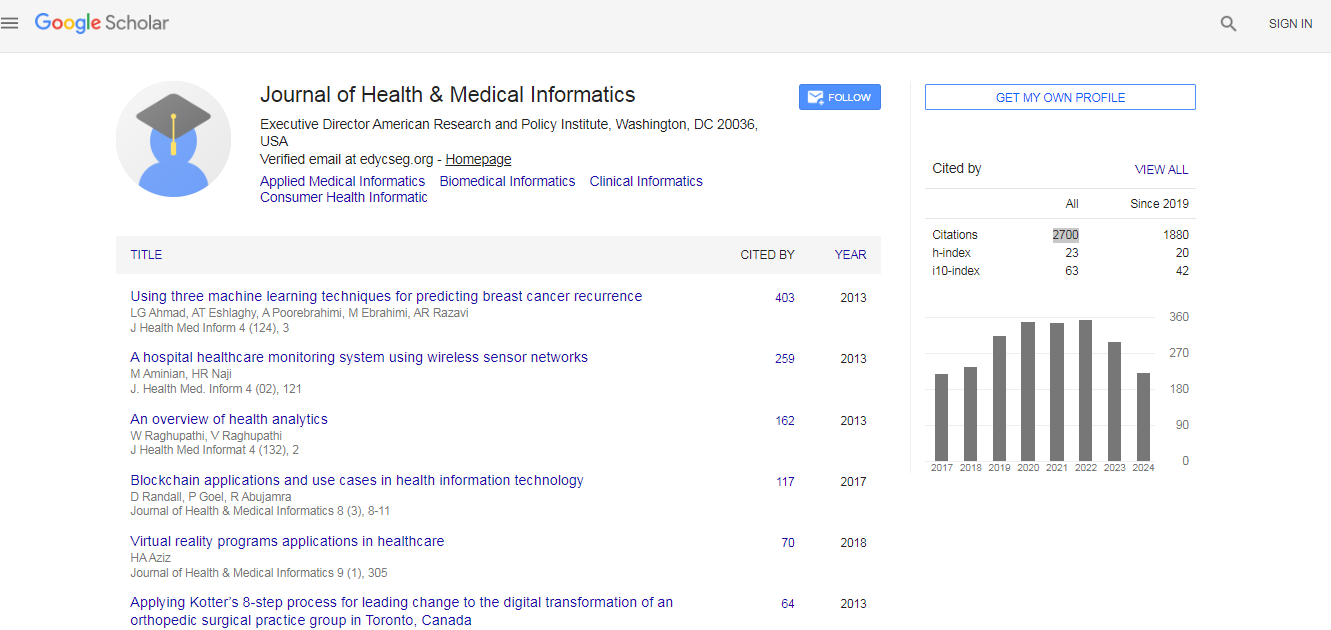
Journal of Health & Medical Informatics received 2700 citations as per Google Scholar report