Short Communication - (2025) Volume 15, Issue 4
Received: 31-Jul-2025, Manuscript No. jmcj-25-176905;
Editor assigned: 04-Aug-2025, Pre QC No. P-176905;
Reviewed: 18-Aug-2025, QC No. Q-176905;
Revised: 21-Aug-2025, Manuscript No. R-176905;
Published:
28-Aug-2025
, DOI: 10.37421/2165-7912.2025.15.636
Citation: Crawford, Benjamin H..AI Reshapes Media: Opportunities, Challenges, Ethics. J Mass Communicat Journalism 15(2025):636.
Copyright: © 2025 Crawford H. Benjamin This is an open-access article distributed under the terms of the Creative Commons Attribution License, which permits unrestricted
use, distribution and reproduction in any medium, provided the original author and source are credited.
Artificial Intelligence is profoundly transforming the media industry, reshaping everything from content creation to audience interaction and ethical considerations. The integration of Artificial Intelligence presents a paradigm shift, offering immense opportunities for innovation alongside significant challenges. This collection of research examines the multifaceted impact of Artificial Intelligence across various media domains. Artificial Intelligence plays a crucial role in media production and management, automating tasks, personalizing content, and optimizing workflows. However, this also brings forth challenges related to data privacy, ethical implications, and the need for new skill sets, emphasizing human oversight and Artificial Intelligence collaboration for responsible innovation [1].
In journalism, ethical challenges are paramount, encompassing algorithmic bias, transparency, accountability, and the threat of deepfakes. Developing robust ethical guidelines is essential to ensure responsible Artificial Intelligence deployment and maintain public trust and journalistic integrity [2].
Personalized content delivery is another revolutionary application, with Artificial Intelligence and machine learning algorithms enhancing user engagement through techniques like collaborative filtering and content-based recommendations. This raises important considerations for data privacy and algorithmic transparency [3].
Similarly, Artificial Intelligence boosts audience engagement in digital media by analyzing user behavior and delivering personalized, interactive experiences, though data privacy remains a key challenge [10].
The impact extends to film and video production, where Artificial Intelligence streamlines processes from script analysis to visual effects and sound design. While unlocking creative possibilities, it also raises concerns about job displacement and the ethical implications of synthetic media [4].
Artificial Intelligence also augments human creativity across creative industries, generating artistic compositions and assisting storytelling. This sparks debates on originality, authorship, and the future role of human artists [7].
Algorithmic journalism highlights how automation reshapes news production, offering speed and efficiency but posing challenges to content credibility, journalistic roles, and the potential for algorithmic bias [5].
Artificial Intelligence also holds a dual role in combating misinformation. It can rapidly detect and debunk false content, improving news trustworthiness. However, ethical pitfalls include the potential for Artificial Intelligence to generate misleading content or exhibit biases that suppress legitimate information [6].
Finally, governing Artificial Intelligence in the media sector presents global challenges due to rapid technological change, jurisdictional complexities, and the need to balance innovation with ethical safeguards. Adaptable, multi-stakeholder governance models are advocated to prioritize transparency, accountability, and fundamental rights [8].
A significant challenge is the deepfake phenomenon, with research detailing creation methods, misuse potential in propaganda, and technical/policy countermeasures to mitigate societal impact [9].
These studies collectively underscore Artificial Intelligence’s transformative presence, highlighting its revolutionary potential and the critical need for thoughtful, ethical, and well-governed integration.
Artificial Intelligence's pervasive influence across the media landscape is undeniable, touching every facet from creation to consumption. The technology’s promise lies in its capacity to automate various tasks, personalize content, and significantly optimize operational workflows, providing a new backbone for media production and management [1]. This efficiency, however, comes with a critical need to address challenges like data privacy, ethical considerations, and the imperative for media professionals to adapt through acquiring new skill sets. The future of media, therefore, increasingly points towards a necessary synergy where human oversight works hand-in-hand with Artificial Intelligence for responsible innovation and sustainable growth.
A core area of transformation is how Artificial Intelligence revolutionizes content delivery and audience engagement. Personalized content, driven by sophisticated machine learning algorithms, is now a cornerstone of modern media platforms. Techniques such as collaborative filtering and content-based recommendations are meticulously employed to enhance user engagement by tailoring experiences directly to individual preferences [3]. This analytical capability extends to digital media, where Artificial Intelligence excels at analyzing user behavior, predicting preferences, and consequently delivering personalized content and interactive experiences. This process strengthens connections between media producers and their audiences, although the persistent challenge of data privacy remains a critical consideration that needs ongoing attention [10].
Beyond personalization, Artificial Intelligence profoundly impacts creative and news production. In film and video, the technology offers transformative solutions across the entire production cycle. From preliminary script analysis and storyboarding to intricate post-production tasks like editing, visual effects, and sound design, Artificial Intelligence streamlines workflows and unlocks unprecedented creative possibilities [4]. The broader relationship between Artificial Intelligence and human creativity is also a compelling subject. Artificial Intelligence can serve as a powerful tool, augmenting creative processes by assisting in generating artistic compositions and aiding in complex storytelling. This dynamic interplay inevitably sparks philosophical and practical discussions regarding originality, authorship, and the evolving role of human artists in a technologically advanced creative ecosystem [7]. In journalism, the rise of algorithmic journalism illustrates how automation reshapes news production and consumption. While offering undeniable benefits in speed and efficiency, it also introduces challenges concerning content credibility, the potential erosion of traditional journalistic roles, and the risk of algorithmic bias subtly influencing public discourse [5].
Ethical dimensions and societal impacts form another critical pillar of Artificial Intelligence’s integration into media. Concerns around algorithmic bias, transparency, and accountability are central to discussions about Artificial Intelligence in journalism. The proliferation of deepfakes, for instance, highlights a significant threat, necessitating the development of robust ethical guidelines and frameworks to ensure responsible Artificial Intelligence deployment and uphold journalistic integrity and public trust [2]. Furthermore, Artificial Intelligence plays a dual, complex role in combating misinformation. It offers powerful capabilities for rapid detection and debunking of false content, which can substantially improve the trustworthiness of news sources. Conversely, there are ethical pitfalls, including the risk of Artificial Intelligence systems inadvertently generating misleading content or exhibiting biases that might unintentionally suppress legitimate information [6]. The deepfake phenomenon itself warrants detailed attention, investigating its emergence, methods of creation, potential for misuse in propaganda and disinformation, and the technical and policy-based countermeasures being developed to detect and mitigate its far-reaching societal impact [9].
Finally, the governance of Artificial Intelligence within the media sector is a global challenge demanding thoughtful consideration. Regulatory approaches face hurdles such as the rapid pace of technological change, complex jurisdictional boundaries, and the delicate balance between fostering innovation and safeguarding ethical principles. The consensus points towards the necessity for adaptable, multi-stakeholder governance models. These models must prioritize transparency, accountability, and the protection of fundamental rights in all Artificial Intelligence deployments within media, ensuring that technological progress serves broader societal well-being [8].
Artificial Intelligence is profoundly reshaping the media landscape, offering significant opportunities alongside complex challenges. It automates production tasks, personalizes content, and optimizes workflows across various platforms, from journalism to film production [1]. In journalism, Artificial Intelligence enhances speed and efficiency in news reporting but raises concerns about content credibility, job displacement, and algorithmic bias [5]. Ethical considerations are paramount, with discussions focusing on algorithmic bias, transparency, accountability, and the rise of deepfakes, demanding robust ethical guidelines [2]. Artificial Intelligence also plays a dual role in combating misinformation, offering tools for rapid detection while also posing risks of generating misleading content [6]. For content delivery, machine learning algorithms are crucial for personalized experiences and user engagement [3, 10]. In film and video, Artificial Intelligence streamlines pre-production and post-production, unlocking creative possibilities but also raising concerns about job displacement and synthetic media [4]. The broader impact on human creativity is explored, viewing Artificial Intelligence as a tool for augmentation in artistic compositions and storytelling, prompting debates on originality and authorship [7]. The governance of Artificial Intelligence in media is a global challenge, requiring adaptable, multi-stakeholder models that prioritize transparency and accountability to balance innovation with fundamental rights [8]. The emergence of deepfake technology, its misuse, and countermeasures are also critical topics [9].
None
None
Norbert G, Petra N, Maximilian S. "AI in Media Production and Management: Promises, Perils, and Prospects".JMBS 19 (2022):177-196.
Indexed at, Google Scholar, Crossref
Chen GHT, Jia TS, Aashish DS. "Ethical Implications of AI in Journalism: An Overview of the Current Landscape".J Media Ethics 38 (2023):169-183.
Indexed at, Google Scholar, Crossref
Muhammad MK, Shahzad SA, Tanveer RA. "Personalized Content Delivery in Media: The Role of Artificial Intelligence and Machine Learning".IJCSNS 21 (2021):247-254.
Indexed at, Google Scholar, Crossref
James DS, Karen LJ, Michael AW. "Artificial Intelligence in Film and Video Production: Challenges and Opportunities".J Visual Commun Image Represent 87 (2022):103632.
Indexed at, Google Scholar, Crossref
Anna AJ, Benjamin TD, Robert MC. "Algorithmic Journalism: Automation and its Impact on News Production and Consumption".Digital Journalism 9 (2021):978-995.
Indexed at, Google Scholar, Crossref
Priya VS, Ananya SG, Devendra KM. "Combating Misinformation with AI: Opportunities and Ethical Challenges for Media Organizations".J Media & Communication Studies 15 (2023):53-62.
Indexed at, Google Scholar, Crossref
Lucy MC, Richard TH, Stephen JD. "Artificial Intelligence and Creativity: Exploring the Impact on Creative Industries".Convergence 26 (2020):1069-1085.
Indexed at, Google Scholar, Crossref
Katherine LG, Steven TW, Jennifer MB. "Governing AI in Media: A Critical Review of Regulatory Approaches and Challenges".Media, Culture & Society 45 (2023):699-715.
Indexed at, Google Scholar, Crossref
Manjesh PS, Rama SD, Vijay KS. "The Deepfake Phenomenon: Societal Impact and Countermeasures in the Digital Media Landscape".J Inf Secur Appl 70 (2022):103328.
Indexed at, Google Scholar, Crossref
John DW, Laura GT, Michael RC. "Leveraging Artificial Intelligence for Enhanced Audience Engagement in Digital Media".Int J Digital Content Technology Appl 15 (2021):47-58.
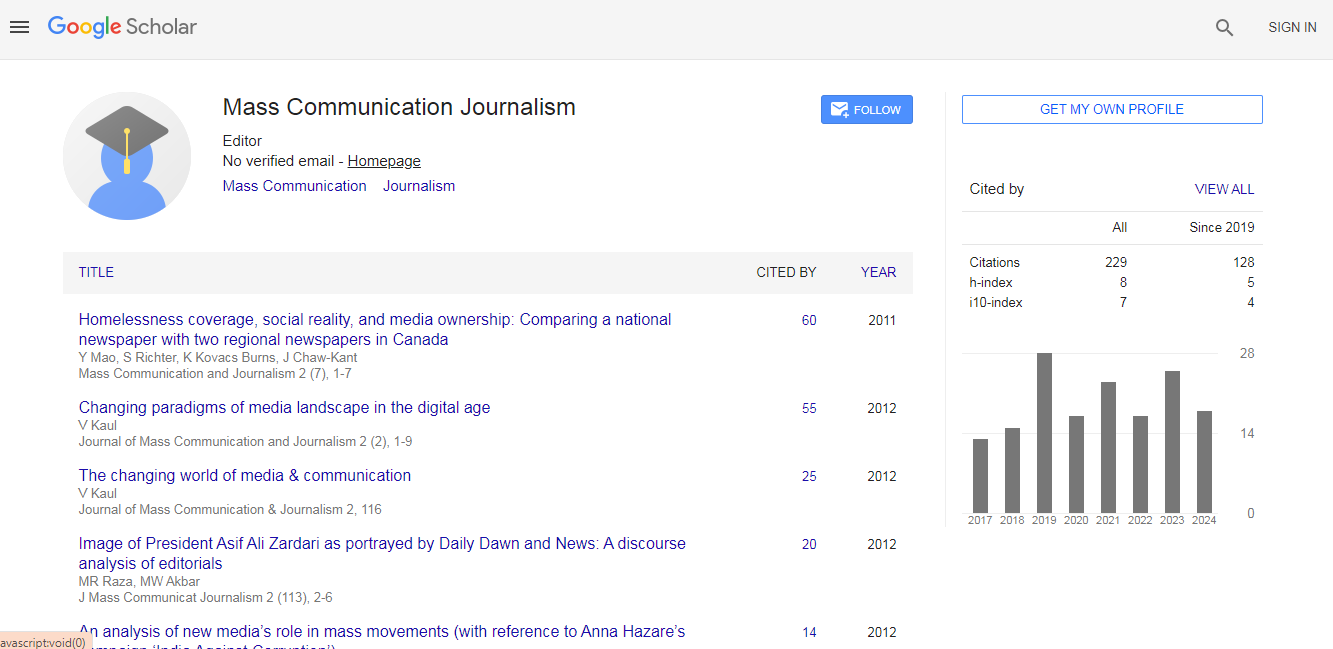
Journal of Mass Communication & Journalism received 205 citations as per Google Scholar report