Brief Report - (2025) Volume 11, Issue 5
Received: 02-Sep-2025, Manuscript No. ohcr-25-174314;
Editor assigned: 04-Sep-2025, Pre QC No. P-174314;
Reviewed: 17-Sep-2025, QC No. Q-174314;
Revised: 23-Sep-2025, Manuscript No. R-174314;
Published:
30-Sep-2025
, DOI: 10.37421/2471-8726.2025.11.213
Citation: Romano, Giulia. ”AI, Advanced Imaging Revolutionize Oral Maxillofacial Radiology.” Oral Health Case Rep 11 (2025):213.
Copyright: © 2025 Romano G. This is an open-access article distributed under the terms of the Creative Commons Attribution License, which permits unrestricted use, distribution and reproduction in any medium, provided the original author and source are credited.
Artificial Intelligence (AI) tools, including machine learning and deep learning, are transforming oral and maxillofacial radiology. These tools aim to enhance diagnostic accuracy, automate pathology detection for issues like dental caries, periodontal bone loss, and periapical lesions, and improve treatment planning from various radiographic images. AI holds promise for standardizing diagnostics and reducing clinician workload [1].
A systematic review and meta-analysis affirms the diagnostic superiority of cone-beam computed tomography (CBCT) over conventional periapical radiography in identifying periapical lesions. CBCT provides significantly higher accuracy in detecting and characterizing these lesions, often missed by traditional 2D imaging due to superimposition. This makes CBCT a valuable asset for endodontic diagnosis and planning [2].
CBCT is a superior imaging modality for evaluating temporomandibular joint (TMJ) degenerative changes. A systematic review confirms its ability to visualize cortical bone changes, erosions, osteophytes, and subchondral cysts, which are indicators of TMJ osteoarthritis. CBCT's detailed structural analysis is key for accurate diagnosis and treatment planning for TMJ disorders [3].
Another systematic review highlights CBCT's diagnostic precision for odontogenic cysts and tumors of the jaws. Its superior three-dimensional visualization enables accurate assessment of lesion characteristics and their relationship to adjacent vital structures. This detailed view is critical for differential diagnosis, surgical planning, and prognostication of complex oral pathologies [4].
CBCT also offers advanced three-dimensional analysis of periodontal bone loss. Its ability to accurately measure bone defect depth, width, and morphology provides a more precise assessment than conventional 2D radiographs. This detailed 3D information is crucial for diagnosing, classifying, and planning effective periodontal treatment, especially for complex cases [5].
For diagnosing dental trauma, CBCT offers a significant advantage over conventional radiographs, particularly for detecting root fractures, alveolar bone fractures, and luxation injuries often obscured in 2D images. A systematic review and meta-analysis shows CBCT's superior 3D visualization leads to more accurate and earlier diagnosis, vital for timely management [6].
Advanced imaging techniques like CBCT, MRI, and PET/CT play a critical role in the diagnosis and staging of oral squamous cell carcinoma (OSCC). These modalities provide detailed information on tumor extent, lymph node involvement, and distant metastases, crucial for accurate staging, treatment planning, and prognostic assessment. Multi-modal imaging improves outcomes for oral cancer patients [7].
In localizing and assessing impacted canines, CBCT demonstrates significantly more precise information than conventional radiography regarding position, root resorption, and proximity to vital structures. A systematic review and meta-analysis indicates this leads to improved surgical planning and reduced complications, especially for complex impactions, ensuring better clinical outcomes [8].
CBCT is highly effective in assessing bone quality and quantity for dental implant placement. A systematic review concludes it provides precise measurements of bone height, width, and density, along with identifying vital anatomical structures. This detailed 3D information is indispensable for pre-surgical planning, optimizing implant positioning, and minimizing risks, supporting higher implant success rates [9].
Finally, CBCT excels in detecting various maxillary sinus pathologies. Its superior three-dimensional visualization allows for precise identification of mucosal thickenings, cysts, foreign bodies, and inflammatory processes. This detailed imaging is crucial for differential diagnosis and surgical planning, particularly when considering dental procedures that might affect the maxillary sinus [10].
AI applications, particularly machine learning and deep learning, are advancing oral and maxillofacial radiology. These tools aim to enhance diagnostic accuracy, automate the detection of pathologies like dental caries, periodontal bone loss, and periapical lesions, and refine treatment planning from various radiographic images. AI's potential lies in standardizing diagnostics and reducing clinician workload [1]. Furthermore, CBCT has emerged as a crucial diagnostic tool, consistently demonstrating superior accuracy over conventional 2D imaging modalities in various contexts.
For instance, CBCT offers significantly higher accuracy in detecting and characterizing periapical lesions, especially where traditional 2D imaging might miss or underestimate their true extent due to superimposition, supporting its role in endodontic diagnosis and treatment planning [2]. It also proves a superior imaging modality for evaluating degenerative changes in the temporomandibular joint (TMJ), effectively visualizing cortical bone changes, erosions, osteophytes, and subchondral cysts indicative of TMJ osteoarthritis. This detailed structural analysis aids in precise diagnosis and treatment planning for TMJ disorders [3].
The diagnostic precision of CBCT extends to odontogenic cysts and tumors of the jaws, providing superior three-dimensional visualization for accurate assessment of lesion size, location, internal structure, and relationship to adjacent vital structures like nerves and teeth. This enhanced detail is crucial for differential diagnosis, surgical planning, and prognostication of these complex oral pathologies [4]. Moreover, CBCT is highly effective for three-dimensional analysis of periodontal bone loss, offering a more precise assessment of bone defect depth, width, and morphology than conventional 2D radiographs. This detailed 3D information is critical for diagnosis, classification, and planning effective periodontal treatment, particularly in complex cases involving furcation defects and angular bone loss [5].
In cases of dental trauma, CBCT offers a significant advantage over conventional radiographs for detecting root fractures, alveolar bone fractures, and luxation injuries often obscured in 2D images. Its superior 3D visualization leads to more accurate and earlier diagnosis, which is crucial for timely and appropriate management [6]. Similarly, when localizing and assessing impacted canines, CBCT provides significantly more precise information regarding exact position, root resorption, and proximity to vital structures compared to conventional radiography. This leads to improved surgical planning and reduced complications, ensuring better clinical outcomes for complex impactions [8].
CBCT is also indispensable for dental implant placement, effectively assessing bone quality and quantity by providing precise measurements of bone height, width, and density, and identifying vital anatomical structures. This detailed information is key for optimal implant positioning and risk minimization, contributing to higher implant success rates [9]. Its diagnostic accuracy extends to detecting various maxillary sinus pathologies, allowing precise identification of mucosal thickenings, cysts, foreign bodies, and inflammatory processes, crucial for differential diagnosis and surgical planning in relation to dental procedures [10]. Beyond CBCT, advanced imaging techniques, including MRI and PET/CT, play a critical role in the diagnosis and staging of oral squamous cell carcinoma (OSCC), providing detailed information on tumor extent, lymph node involvement, and distant metastases, essential for accurate staging, treatment planning, and prognostic assessment, ultimately improving outcomes for oral cancer patients [7].
Advanced imaging techniques and Artificial Intelligence (AI) are fundamentally transforming oral and maxillofacial radiology, greatly enhancing diagnostic accuracy and treatment planning. AI tools, specifically machine learning and deep learning, are being developed to automate the detection of pathologies like dental caries, periodontal bone loss, and periapical lesions, thereby standardizing diagnostics and easing clinician workload. Cone-Beam Computed Tomography (CBCT) consistently demonstrates superior three-dimensional visualization compared to conventional two-dimensional radiography across a spectrum of conditions. It offers higher accuracy in identifying periapical lesions, evaluating degenerative changes in the temporomandibular joint, and precisely assessing odontogenic cysts and tumors by detailing their characteristics and relationship to vital structures. CBCT is also crucial for the accurate three-dimensional analysis of periodontal bone loss, providing precise measurements essential for effective treatment planning. Furthermore, its efficacy is evident in diagnosing dental trauma, localizing impacted canines with greater precision for improved surgical outcomes, and comprehensively assessing bone quality and quantity for optimal dental implant placement. CBCT's ability to detect various maxillary sinus pathologies, including mucosal thickenings and cysts, is vital for differential diagnosis and surgical considerations. Complementing CBCT, other advanced modalities like MRI and PET/CT are indispensable for the diagnosis and staging of oral squamous cell carcinoma, offering critical information for prognostic assessment and treatment strategies. These collective advancements underscore a shift towards more precise, comprehensive, and efficient patient care in oral and maxillofacial radiology.
None
None
1. Mostafa A, Mohamed A, Abdul RA. "Artificial Intelligence Applications in Oral and Maxillofacial Radiology: A Scoping Review".Sensors (Basel) 23 (2023):6867.
Indexed at, Google Scholar, Crossref
2. Lucas GD, Carolina F, Camila ACV. "Diagnostic accuracy of cone-beam computed tomography compared to periapical radiography for detecting periapical lesions: A systematic review and meta-analysis".J Endod 48 (2022):433-444.e5.
Indexed at, Google Scholar, Crossref
3. Kuan-Pin S, Te-Yu W, Chien-Ting C. "Cone-beam computed tomography for the assessment of temporomandibular joint degenerative changes: A systematic review".J Formos Med Assoc 119 (2020):404-413.
Indexed at, Google Scholar, Crossref
4. VÃtor DdM, Leonardo dSM, Bárbara RG. "Diagnostic Accuracy of Cone-Beam Computed Tomography in the Assessment of Odontogenic Cysts and Tumors of the Jaws: A Systematic Review".J Oral Maxillofac Surg 79 (2021):153-162.
Indexed at, Google Scholar, Crossref
5. Abdulaziz SA, Omar A, Fahad HA. "Three-Dimensional Analysis of Periodontal Bone Loss Using Cone-Beam Computed Tomography: A Systematic Review".J Clin Med 12 (2023):4099.
Indexed at, Google Scholar, Crossref
6. NÃcollas GdA, Marcos ALdC, Luciana MSR. "Cone-beam computed tomography for the diagnosis of dental trauma: A systematic review and meta-analysis".Dent Traumatol 36 (2020):371-381.
Indexed at, Google Scholar, Crossref
7. Paraskevi EZ, Vasileios IP, Christina GN. "Role of Advanced Imaging Techniques in Oral Squamous Cell Carcinoma: A Systematic Review".Cancers (Basel) 15 (2023):3222.
Indexed at, Google Scholar, Crossref
8. Ana CCeS, André FL, Carlos AdRB. "Diagnostic accuracy of cone-beam computed tomography compared with conventional radiography for impacted canine detection: A systematic review and meta-analysis".Oral Surg Oral Med Oral Pathol Oral Radiol 131 (2021):e211-e222.
Indexed at, Google Scholar, Crossref
9. Ahmed E, Islam RE, Hany ME. "Diagnostic Accuracy of Cone-Beam Computed Tomography in the Assessment of Bone Quality and Quantity for Dental Implant Placement: A Systematic Review".Clin Implant Dent Relat Res 25 (2023):541-550.
Indexed at, Google Scholar, Crossref
10. Thássia BG, Paulo RMdC, Thiago dSS. "Diagnostic accuracy of cone-beam computed tomography for maxillary sinus pathologies: A systematic review".Oral Radiol 38 (2022):440-452.
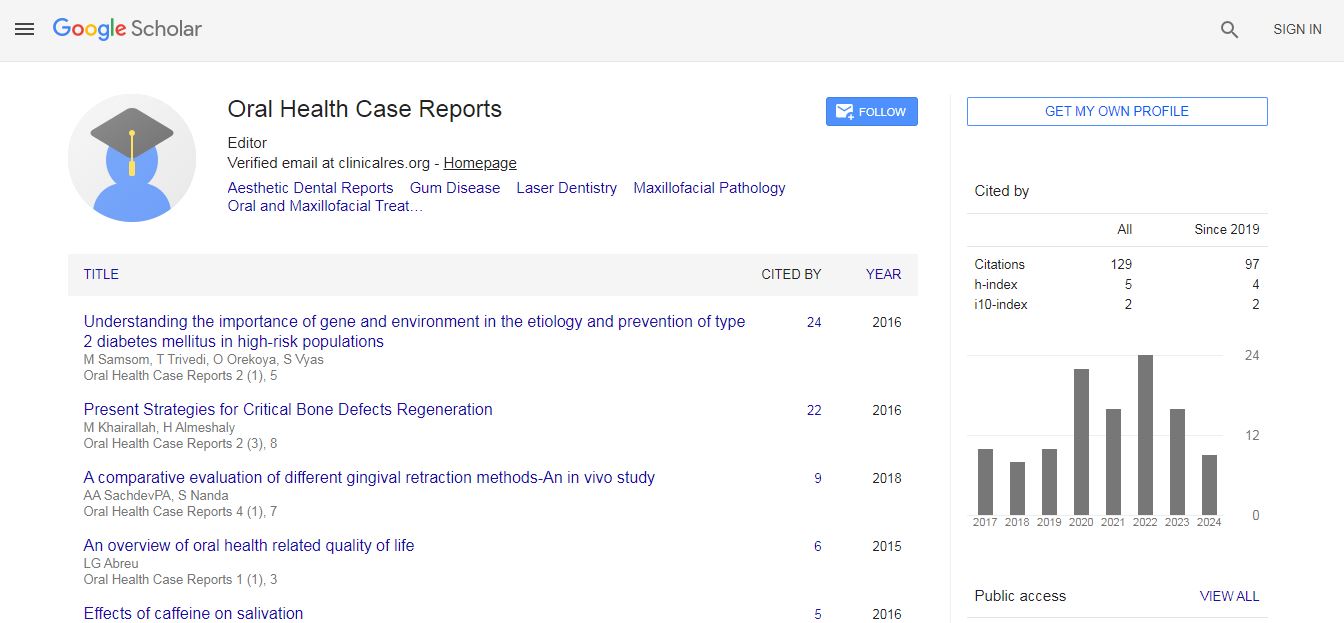
Oral Health Case Reports received 120 citations as per Google Scholar report