Opinion - (2025) Volume 14, Issue 3
Received: 01-Jun-2025, Manuscript No. idse-26-182812;
Editor assigned: 03-Jun-2025, Pre QC No. P-182812;
Reviewed: 17-Jun-2025, QC No. Q-182812;
Revised: 23-Jun-2025, Manuscript No. R-182812;
Published:
30-Jun-2025
, DOI: 10.37421/2168-9768.2025.14.492
Citation: O’Connor, Daniel. ”Agricultural Water Management:
Innovations and Environmental Sustainability.” Irrigat Drainage Sys Eng 14
(2025):492.
Copyright: © 2025 O’Connor D. This is an open-access article distributed under the terms of the Creative Commons Attribution License, which permits unrestricted use,
distribution and reproduction in any medium, provided the original author and source are credited.
The field of agricultural water management is undergoing significant advancements, driven by the need for enhanced efficiency and sustainability. Modern irrigation and drainage systems are increasingly sophisticated, incorporating principles from hydraulics and hydrology to optimize water use and mitigate environmental impacts. These innovations aim to improve agricultural productivity while conserving precious water resources and safeguarding ecosystems [1].
The profound and pervasive influence of climate change necessitates a re-evaluation of our water management strategies. Shifting precipitation patterns and rising temperatures directly impact hydrological regimes, leading to increased variability in water availability for agriculture. Research is focusing on modeling these changes to predict future water stress and develop adaptive measures for irrigation infrastructure and scheduling [2].
The integration of cutting-edge technologies, such as remote sensing and Geographic Information Systems (GIS), is revolutionizing the monitoring and management of irrigation networks. These tools provide unprecedented capabilities for spatial analysis, enabling precise assessment of crop water requirements, identification of inefficiencies, and optimization of water distribution across agricultural landscapes [3].
Subsurface drainage systems play a critical role in maintaining soil health and preventing waterlogging and salinity, which can severely impair crop yields. Hydrological modeling of these systems is essential for understanding soil moisture dynamics and designing effective drainage solutions that promote optimal growing conditions and agricultural productivity [4].
Pressurized irrigation systems, including drip and sprinkler technologies, are at the forefront of efficient water application. Optimizing their design and operation, with a focus on hydraulic principles, is key to minimizing energy consumption and water loss. This focus ensures uniform water delivery, thereby enhancing the sustainability of modern agricultural irrigation infrastructure [5].
The intricate interplay between surface water and groundwater resources is a central concern in agricultural catchments. Understanding these interactions through hydrological modeling is vital for developing integrated water resource management strategies that balance the needs of irrigation and drainage while preserving water quality and quantity for both agricultural and ecological purposes [6].
Effective irrigation scheduling is paramount for maximizing water use efficiency and crop productivity. The development and evaluation of on-farm tools that integrate hydrological data and crop water use models are crucial. These data-driven approaches empower farmers to make informed decisions about irrigation timing and volume, leading to significant water savings [7].
The environmental consequences of agricultural drainage practices, particularly on downstream water bodies, require careful consideration. Research is examining the hydrological impacts, including sediment and nutrient loads, to promote best management practices that mitigate negative effects and ensure the ecological health of connected aquatic ecosystems [8].
Advanced computational techniques, such as Computational Fluid Dynamics (CFD), are proving invaluable for modeling water flow within complex irrigation and drainage networks. These simulations provide deep insights into flow patterns, head losses, and sediment transport, enabling optimization of hydraulic structures and improved system performance [9].
Soil hydrology is a fundamental determinant of the performance of various irrigation methods. Understanding soil water dynamics, infiltration rates, and their relationship with water use efficiency under different irrigation scenarios is crucial. This knowledge guides the selection of appropriate irrigation techniques tailored to specific soil properties and water availability, ensuring optimal agricultural outcomes [10].
The evolution of irrigation and drainage engineering is intrinsically linked to the application of advanced hydraulic and hydrological principles. This discipline focuses on optimizing agricultural water management by exploring innovative techniques for water conservation, flood mitigation, and soil health. Recent research highlights practical engineering solutions designed to boost water use efficiency in agriculture and minimize detrimental environmental footprints [1].
In the context of a changing global climate, the impact on hydrological systems and subsequent water availability for irrigation is a critical research area. Sophisticated modeling techniques are being employed to anticipate future water scarcity scenarios and to devise adaptive strategies for irrigation system design and water allocation. The imperative for resilient water management practices is underscored by fluctuating precipitation and increased evaporation rates [2].
Remote sensing and GIS technologies are emerging as powerful instruments for the precise monitoring and management of extensive irrigation networks. Their application facilitates the accurate assessment of crop water needs, the identification of areas with suboptimal water distribution, and the overall optimization of water resource allocation within precision agriculture frameworks [3].
Subsurface drainage systems are engineered to manage soil moisture and prevent the deleterious effects of waterlogging and salinization. The hydrological processes governing these systems are subject to detailed analysis, with research examining how various design parameters influence soil water dynamics and, consequently, crop productivity. This leads to improved strategies for designing and managing effective subsurface drainage for agricultural lands [4].
The design and operational efficiency of pressurized irrigation systems, such as drip and sprinkler methods, are key areas of focus. Hydraulic principles are applied to minimize energy requirements and water losses while ensuring uniform water application to crops. The research aims to enhance the overall efficiency and long-term sustainability of contemporary irrigation infrastructure [5].
Agricultural catchments are characterized by complex interactions between surface water and groundwater, which have significant implications for irrigation and drainage strategies. Hydrological modeling plays a vital role in elucidating water balance and nutrient transport mechanisms, thereby supporting the development of integrated water resource management plans that sustain both water quality and quantity for agricultural purposes [6].
On-farm irrigation scheduling tools are being developed and refined, leveraging hydrological data and crop water use models. The efficacy of these tools in optimizing irrigation timing and volume is evaluated to achieve substantial water savings and improve crop yields. The growing emphasis is on adopting data-driven methodologies for effective irrigation management [7].
The environmental ramifications of agricultural drainage on downstream water bodies are a significant concern, particularly regarding sediment and nutrient loads. Studies are analyzing various drainage practices and their ecological impacts, proposing best management strategies to mitigate adverse effects. The importance of considering watershed-scale consequences of drainage engineering is increasingly recognized [8].
Computational Fluid Dynamics (CFD) is being utilized to model water flow within irrigation channels and drainage networks. This advanced numerical simulation approach allows for detailed analysis of flow characteristics, energy losses, and sediment movement, contributing to the optimization of hydraulic structures and overall system performance [9].
The role of soil hydrology in the performance of different irrigation methods, including surface, sprinkler, and micro-irrigation, is thoroughly investigated. Research examines the intricate soil water dynamics, infiltration processes, and their direct impact on water use efficiency under diverse irrigation scenarios, providing essential guidance for selecting the most appropriate irrigation techniques based on site-specific conditions [10].
This collection of research explores various facets of agricultural water management. Advancements in irrigation and drainage engineering focus on optimizing water use through hydraulic and hydrological principles, addressing environmental concerns [1].
The impact of climate change on water availability and the need for adaptive strategies are highlighted, employing modeling techniques for future water stress prediction [2].
Technologies like remote sensing and GIS are revolutionizing irrigation network management by enabling precise spatial analysis of crop water needs and water distribution [3].
Subsurface drainage systems are crucial for soil health, with hydrological modeling guiding their design to improve soil moisture dynamics and crop yields [4].
Pressurized irrigation systems are optimized using hydraulic principles to minimize energy and water loss, enhancing efficiency and sustainability [5].
The interaction between surface and groundwater in agricultural catchments is studied through hydrological modeling to improve integrated water resource management [6].
On-farm irrigation scheduling tools, utilizing hydrological data and crop models, are developed to optimize water application, leading to water savings and improved yields [7].
The environmental impacts of agricultural drainage on downstream water quality, including sediment and nutrient loads, are assessed to propose best management practices [8].
Computational Fluid Dynamics (CFD) is employed to model water flow in irrigation and drainage channels, optimizing hydraulic structures [9].
Finally, the influence of soil hydrology on the performance of different irrigation methods is examined to guide the selection of appropriate techniques based on soil properties and water availability [10].
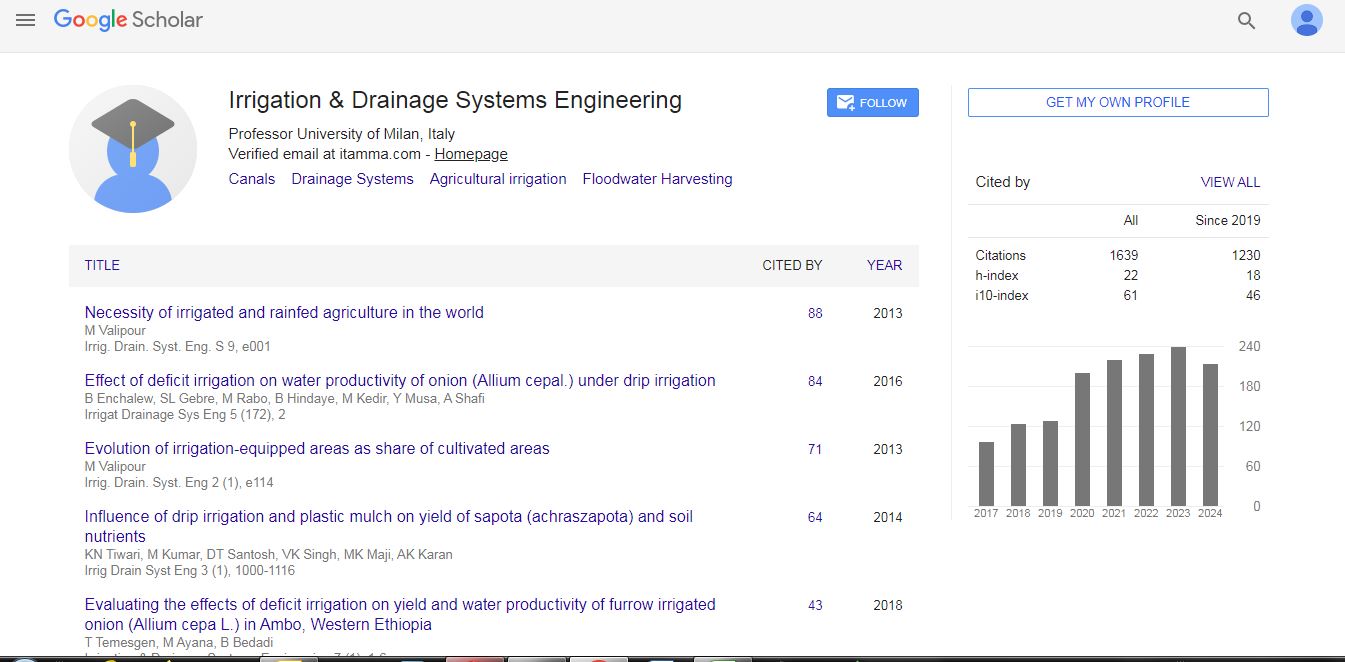
Irrigation & Drainage Systems Engineering received 835 citations as per Google Scholar report