Commentary - (2025) Volume 14, Issue 6
Received: 01-Dec-2025, Manuscript No. idse-26-183632;
Editor assigned: 03-Dec-2025, Pre QC No. P-183632;
Reviewed: 17-Dec-2025, QC No. Q-183632;
Revised: 22-Dec-2025, Manuscript No. R-183632;
Published:
29-Dec-2025
, DOI: 10.37421/2168-9768.2025.14.519
Citation: Karimi, Mohsen. ”Agricultural Water Management: Efficiency
and Sustainability Research.” Irrigat Drainage Sys Eng 14 (2025):519.
Copyright: © 2025 Karimi M. This is an open-access article distributed under the terms of the Creative Commons Attribution License, which permits unrestricted use,
distribution and reproduction in any medium, provided the original author and source are credited.
The advancement of agricultural practices is intrinsically linked to efficient water management, a critical factor in ensuring global food security and environmental sustainability. The optimization of irrigation systems has emerged as a paramount concern, particularly in regions facing increasing water scarcity and the challenges posed by climate change. Research in this domain seeks to enhance water use efficiency, minimize energy consumption, and maintain or improve crop yields. The foundational principles of hydraulic performance in irrigation systems are being continuously refined through detailed investigation and technological innovation. Understanding how water pressure and emitter characteristics interact is vital for maximizing the effectiveness of water delivery to crops, ensuring uniformity and preventing wastage. This involves intricate analysis of flow dynamics within the irrigation network, aiming to achieve a balance between adequate water supply and resource conservation. The continuous pursuit of improved irrigation methodologies underscores the global commitment to sustainable agriculture and the responsible stewardship of water resources. The development of advanced irrigation technologies and management strategies is essential for adapting to the evolving environmental landscape and meeting the demands of a growing population. Consequently, a comprehensive understanding of the underlying hydraulic principles and their practical application is indispensable for agricultural practitioners and researchers alike. This forms the bedrock upon which future innovations in irrigation science and technology will be built, fostering resilience and productivity in agricultural systems worldwide [1].
The evolution of irrigation techniques has seen a significant shift towards methods that minimize water loss and enhance nutrient uptake. Subsurface drip irrigation (SDI) represents a notable advancement in this regard, offering a promising alternative to traditional surface irrigation. By delivering water directly to the root zone, SDI effectively reduces water losses associated with evaporation and deep percolation, thereby improving overall water use efficiency. This method also has profound implications for nutrient management, as it can significantly influence the distribution of essential elements within the soil profile. The careful management of SDI systems can lead to substantial gains in crop productivity while simultaneously mitigating the environmental impact of agricultural runoff. The potential for SDI to revolutionize water management in arid and semi-arid regions is substantial, offering a pathway to more sustainable and productive agricultural practices. Its ability to precisely deliver water and nutrients to the root zone makes it an attractive option for farmers seeking to optimize resource utilization. The ongoing research into SDI technologies and their application further highlights the dynamic nature of agricultural innovation. As water resources become increasingly constrained, the importance of such efficient irrigation methods will only grow. This focus on in-situ water delivery is a testament to the ongoing efforts to enhance agricultural resilience in the face of environmental challenges. The continued development and adoption of SDI technologies are crucial for achieving long-term sustainability in agriculture [2].
Agricultural drainage networks play a crucial role in managing excess water within agricultural lands, but they can also contribute to environmental challenges if not properly managed. The movement of water through these networks can lead to the transport of pollutants, impacting the quality of receiving water bodies. The development of sophisticated modeling tools has become essential for understanding and mitigating these impacts. Numerical simulation approaches allow researchers to accurately predict the flow and solute transport characteristics within open drainage channels. By validating these models against real-world field data, their reliability and predictive power can be significantly enhanced. These models serve as invaluable instruments for assessing the influence of various factors, such as channel geometry and flow velocity, on the dispersion of pollutants. The ability to simulate these complex processes provides a scientific basis for developing effective strategies to manage water quality in agricultural drainage systems. Such advancements are critical for protecting aquatic ecosystems and ensuring the sustainable use of water resources. The integration of modeling techniques into drainage management practices represents a significant step forward in agricultural environmental management. This scientific approach offers a proactive means of addressing potential pollution issues before they cause irreversible damage. The continuous refinement of these simulation tools will further strengthen our capacity to safeguard water quality for future generations [3].
Effective irrigation scheduling is fundamental to maximizing water productivity and crop yield, especially under water-limited conditions. Wheat, as a staple crop, is particularly sensitive to the timing and amount of water applied during its growth cycle. Research into optimizing irrigation schedules involves a detailed analysis of the intricate interplay between irrigation parameters, environmental factors, and crop physiological responses. By identifying the most effective irrigation timings and volumes, agriculturalists can significantly enhance water use efficiency. The goal is to deliver the precise amount of water required by the crop at the most critical stages of its development, thereby minimizing waste and maximizing the conversion of water into biomass. Furthermore, understanding and adapting to climate variability is essential for developing robust irrigation strategies that can withstand unpredictable weather patterns. The insights gained from such studies are crucial for developing resilient agricultural systems capable of producing sufficient food in an era of increasing environmental uncertainty. The adoption of data-driven irrigation scheduling practices is a key component of modern sustainable agriculture. This meticulous approach ensures that water resources are utilized in the most productive and efficient manner possible. The ongoing efforts to refine these strategies will be instrumental in ensuring food security in a changing climate [4].
The integration of smart technologies into irrigation systems represents a transformative step towards achieving greater efficiency and sustainability. Smart irrigation control systems, which leverage real-time data from weather forecasts and soil moisture sensors, offer a highly responsive and adaptive approach to water management. These systems automate irrigation decisions, ensuring that water is applied only when and where it is needed, thereby significantly reducing water waste. The continuous monitoring of soil moisture levels allows for precise adjustments to irrigation schedules, preventing both over-watering and under-watering, which can negatively impact crop health and yield. Validation through field trials has consistently demonstrated the efficacy of these systems in achieving substantial water savings while maintaining optimal soil moisture conditions. The development and widespread adoption of such intelligent irrigation solutions are pivotal for conserving water resources and enhancing the resilience of agricultural production in the face of growing environmental pressures. The proactive management facilitated by these smart systems empowers farmers to make more informed decisions, leading to improved resource utilization and better crop outcomes. This technological advancement is a cornerstone of modern precision agriculture, driving efficiency and sustainability across the agricultural sector [5].
Salinity in irrigation water poses a significant challenge to agricultural productivity, impacting both the performance of irrigation systems and the water uptake capabilities of crops. Studies investigating the effects of salinity are crucial for understanding how different salt concentrations affect the irrigation infrastructure and the physiological health of plants. One of the key concerns is emitter clogging, where salt deposits can obstruct water flow, leading to uneven water distribution. Furthermore, elevated salinity levels can alter soil water potential, making it more difficult for crops to extract water and essential nutrients. The physiological response of plants to saline conditions can include reduced growth rates, wilting, and decreased yields. Therefore, research in this area provides valuable insights into managing irrigation practices in regions where saline water resources are prevalent. Developing strategies to mitigate the negative impacts of salinity, such as proper flushing of irrigation lines or selecting salt-tolerant crop varieties, is essential for maintaining agricultural viability. The knowledge gained from such investigations is vital for ensuring that irrigation can continue to be a viable practice even in challenging environments. This research directly addresses the practical needs of farmers operating in areas where water quality is a significant constraint on production [6].
Soil moisture conservation is a cornerstone of sustainable agriculture, especially in regions prone to drought or with limited water availability. Mulching, the practice of covering the soil surface with a layer of material, has long been recognized as an effective technique for reducing soil evaporation and improving water retention. Different mulching materials, varying in their physical and chemical properties, can have distinct impacts on soil moisture dynamics and consequently on crop water use. Understanding these differences is crucial for optimizing water management strategies. Analyzing the effectiveness of various mulching materials, along with their optimal application rates, allows for the development of tailored recommendations for different agricultural systems. The adoption of appropriate mulching practices can significantly enhance water use efficiency, leading to improved crop performance and yield, particularly in rainfed and irrigated agricultural systems operating under water-scarce conditions. This approach offers a practical and cost-effective means of conserving water resources and building resilience in dryland agriculture. The insights provided by this research empower farmers to make informed decisions about mulching, thereby enhancing their ability to manage water resources effectively and sustainably [7].
The environmental impact of agricultural activities extends beyond the farm gate, with drainage water discharge being a significant concern for the health of aquatic ecosystems. Agricultural drainage systems often collect runoff that contains elevated levels of nutrients, pesticides, and sediments, which can be detrimental when released into rivers, lakes, or other water bodies. An environmental impact assessment of this discharge is therefore critical for understanding the potential consequences for the receiving ecosystem. Analyzing the water quality parameters of the drainage effluent provides a quantitative measure of the pollutants being introduced. This data, coupled with an evaluation of the effects on aquatic life and habitats, helps to identify the extent of the environmental risk. The findings from such assessments underscore the urgent need for effective drainage water treatment and management strategies. Implementing measures to reduce pollutant loads before discharge is essential for mitigating pollution and protecting the integrity of aquatic environments. This research highlights the interconnectedness of agricultural practices and environmental health, emphasizing the importance of responsible water management. The proactive identification and mitigation of pollution sources are key to preserving biodiversity and ecosystem services for the future [8].
The energy efficiency and operational costs associated with pumping systems are significant considerations in the economic viability and sustainability of agricultural irrigation. Different types of pumps, power sources, and operating conditions can lead to substantial variations in energy consumption and overall expenditure. A thorough assessment of these factors is essential for identifying strategies to reduce energy use and enhance the financial feasibility of irrigation. This involves comparing the performance of various pump technologies, evaluating the efficiency of different power sources (such as electricity, diesel, or renewable energy), and analyzing how operational practices influence energy demand. The research provides valuable recommendations for selecting energy-efficient pumps and optimizing their operation to minimize both energy consumption and costs. By adopting these recommendations, farmers can significantly reduce their operational expenses and contribute to broader energy conservation efforts within the agricultural sector. This focus on efficiency is vital for making irrigation more affordable and environmentally friendly. The economic implications of these choices directly impact the long-term sustainability of farming operations, making this research highly relevant [9].
In arid and semi-arid regions, where water availability for irrigation is often a major constraint, water harvesting techniques offer a promising avenue for augmenting water supply. These methods aim to capture and store rainfall or runoff, thereby increasing the amount of water available for agricultural use. Various water harvesting techniques exist, each with its own potential for water conservation and impact on crop water supply. Analyzing the effectiveness of different methods, such as contour bunds, micro-catchments, and farm ponds, allows for a comprehensive understanding of their water conservation potential. By assessing how these techniques influence soil moisture levels and the overall availability of water for crops, valuable insights can be gained. This research provides practical guidance on adapting water harvesting strategies to local conditions, thereby promoting sustainable agriculture in water-scarce environments. The implementation of effective water harvesting practices is a crucial step towards ensuring water security for agriculture and enhancing the resilience of farming communities in these challenging regions. This approach represents a vital component of integrated water resource management [10].
The investigation into the hydraulic performance of drip irrigation systems by Amiri et al. (2023) provides a detailed analysis of how varying water pressure and emitter characteristics influence efficiency. The study emphasizes the optimization of water application uniformity and the minimization of energy consumption. Key findings underscore the significant impact of pressure regulation and emitter design on the overall sustainability of the system and the efficacy of crop water delivery. This research contributes to a deeper understanding of the foundational principles governing the efficiency of modern irrigation technologies [1].
Gholami et al. (2022) evaluated the effectiveness of subsurface drip irrigation (SDI) in reducing water losses, specifically through evaporation and deep percolation. Their study examined the influence of SDI on soil moisture distribution and nutrient leaching patterns. The results clearly indicate that SDI can substantially improve water use efficiency when compared to conventional surface irrigation methods. This enhancement leads to better crop yields and a reduced environmental footprint, highlighting the advantages of targeted water delivery to the root zone [2].
Karimi et al. (2024) presented a numerical modeling approach designed to simulate the complex processes of flow and solute transport within open agricultural drainage channels. The model was rigorously validated against extensive field data, confirming its accuracy and reliability. This validated model serves as a critical tool for assessing how various factors, including channel geometry and flow velocity, affect pollutant dispersion. The findings offer valuable guidance for managing water quality in agricultural drainage networks, a crucial aspect of environmental protection [3].
Karami et al. (2021) conducted a study examining the impact of different irrigation scheduling strategies on water productivity and crop yield, specifically focusing on wheat. By analyzing the intricate relationship between irrigation timing, water application volume, and prevailing environmental conditions, the research successfully identified optimal strategies for maximizing water use efficiency under conditions of water scarcity. The study also offers practical recommendations for adapting irrigation practices to account for climate variability, ensuring more resilient crop production [4].
Mousavi et al. (2023) focused on the development and performance evaluation of a smart irrigation control system. This innovative system integrates real-time weather data with soil moisture sensor readings to automate irrigation decisions. The primary objectives were to reduce water waste and improve crop health. Field trials provided validation for the system's effectiveness, demonstrating significant water savings and the maintenance of stable soil moisture levels, crucial for optimal plant growth [5].
Ebrahimi et al. (2022) investigated the effects of irrigation water salinity on the performance of sprinkler irrigation systems and on crop water uptake. Their research involved applying different salinity levels to assess their impact on emitter clogging, water distribution patterns, and the physiological responses of crops. The findings offer critical insights for managing irrigation practices in areas where water resources are affected by salinity, enabling more informed decision-making for farmers [6].
Nazari et al. (2024) explored the effectiveness of various mulching materials in conserving soil moisture and enhancing water use efficiency within agricultural fields. The study analyzed how different types and application rates of mulch influence soil moisture dynamics and crop water consumption. The research provides practical recommendations for implementing sustainable water management practices, particularly in dryland agriculture, where soil moisture conservation is paramount for successful crop cultivation [7].
Gholami et al. (2021) conducted an environmental impact assessment concerning the discharge of agricultural drainage water into a receiving water body. Their analysis focused on key water quality parameters of the drainage effluent and evaluated its effects on the local aquatic ecosystem. The study strongly emphasizes the necessity of implementing effective drainage water treatment and management strategies to mitigate pollution and protect aquatic environments [8].
Ahmadi et al. (2023) assessed the energy efficiency and operational costs associated with various pumping systems utilized in agricultural irrigation. By comparing different pump types, power sources, and operating conditions, the research identified specific strategies for reducing energy consumption and improving the economic viability of irrigation systems. The analysis includes recommendations for selecting energy-efficient pumps, thereby contributing to cost savings and reduced environmental impact [9].
Mousavi et al. (2022) investigated the effectiveness of different water harvesting techniques aimed at increasing water availability for irrigation in arid and semi-arid regions. The study analyzed the water conservation potential and the impact on crop water supply of various methods, such as contour bunds and micro-catchments. The research offers valuable insights for adapting water harvesting strategies to promote sustainable agriculture in water-scarce environments, crucial for enhancing agricultural resilience [10].
This collection of research explores various facets of agricultural water management, focusing on improving irrigation efficiency and sustainability. Studies examine the hydraulic performance of drip irrigation systems, the benefits of subsurface drip irrigation (SDI) in reducing water loss, and the use of numerical modeling to manage drainage water quality. Optimizing irrigation scheduling for crops like wheat, and developing smart irrigation control systems integrating weather data and soil moisture sensors are highlighted as key strategies. The impact of irrigation water salinity on system performance and crop uptake is investigated, alongside the effectiveness of mulching materials for soil moisture conservation. Furthermore, research assesses the environmental impact of drainage water discharge and analyzes the energy efficiency of pumping systems. Finally, the effectiveness of water harvesting techniques for augmenting water supply in arid regions is explored, providing a comprehensive overview of current research aimed at enhancing water use efficiency in agriculture.
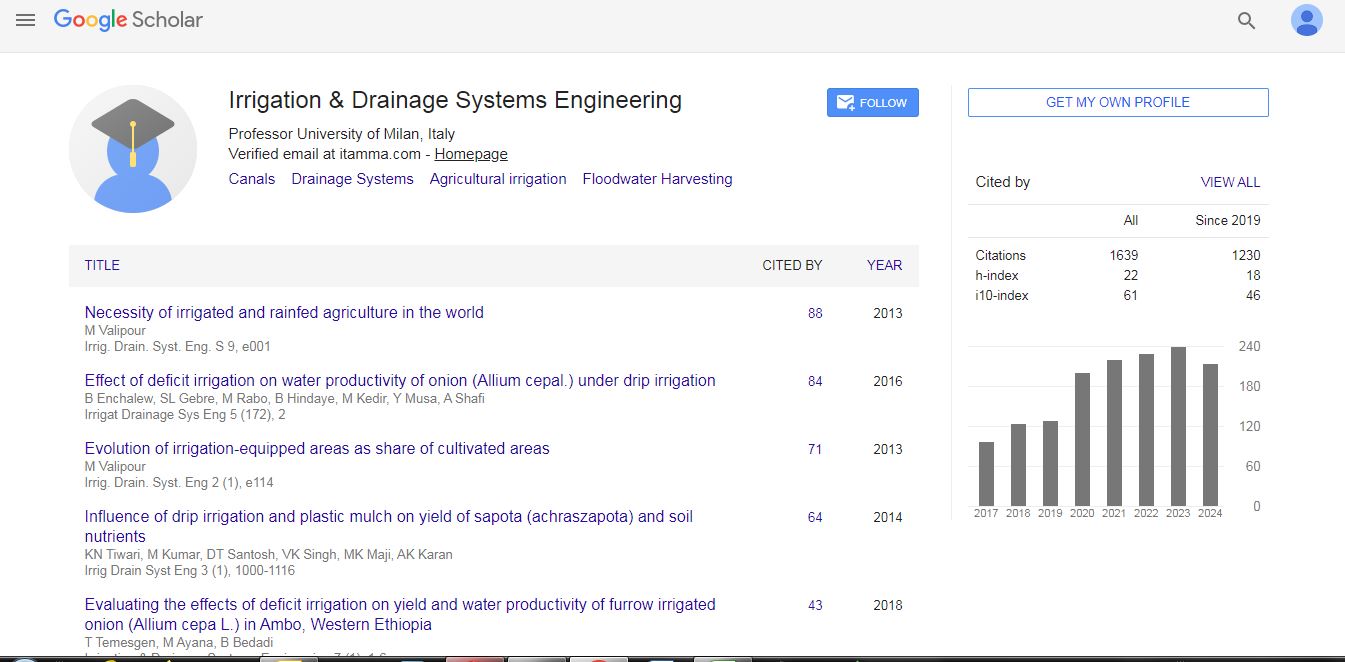
Irrigation & Drainage Systems Engineering received 835 citations as per Google Scholar report