Perspective - (2025) Volume 14, Issue 6
Received: 01-Dec-2025, Manuscript No. idse-26-183637;
Editor assigned: 03-Dec-2025, Pre QC No. P-183637;
Reviewed: 17-Dec-2025, QC No. Q-183637;
Revised: 22-Dec-2025, Manuscript No. R-183637;
Published:
29-Dec-2025
, DOI: 10.37421/2168-9768.2025.14.524
Citation: Khumalo, Zanele. ”Agricultural Drainage Systems:
Yield, Salinity, and Sustainability.” Irrigat Drainage Sys Eng 14 (2025):524.
Copyright: © 2025 Khumalo Z. This is an open-access article distributed under the terms of the Creative Commons Attribution License, which permits unrestricted use,
distribution and reproduction in any medium, provided the original author and source are credited.
Efficient agricultural irrigation drainage systems are paramount for enhancing crop yields and mitigating soil salinization, a critical aspect for sustainable agriculture in water-scarce regions. The optimization of water management within these landscapes relies heavily on robust design principles and analytical methodologies. Proper drainage plays a pivotal role in preventing waterlogging, improving soil aeration, and facilitating the removal of excess salts, all contributing to increased productivity and long-term soil health [1].
The hydrological dynamics of subsurface drainage in irrigated fields are complex and significantly influence crop performance. A simulation-based approach has been presented to predict drainage performance under various soil conditions and rainfall patterns, highlighting the importance of accurate hydrological modeling for effective drainage network design. This modeling ensures the prevention of root zone saturation and promotes optimal plant growth, offering practical guidance for agricultural engineers and agronomists [2].
Evaluating the performance of different agricultural drainage systems, including both surface and subsurface drains, is essential for managing water tables and soil salinity, particularly in arid and semi-arid regions. Integrating field data with computational fluid dynamics (CFD) aids in analyzing flow patterns and salt transport, underscoring the need for a comprehensive design approach that considers both water removal and salt leaching efficiency for sustainable agriculture [3].
The economic and environmental impacts of improved irrigation drainage in agricultural settings are substantial. Well-designed drainage systems can significantly reduce costs associated with waterlogging, salinization, and crop losses, while also contributing to water resource conservation and the protection of downstream ecosystems. This aspect provides a framework for assessing the cost-effectiveness and sustainability of drainage investments [4].
Advanced technologies such as remote sensing and GIS are increasingly vital in the analysis and design of agricultural drainage networks. These tools enable the mapping of soil properties, delineation of catchment areas, and optimization of drainage infrastructure layout. The integration of spatial technologies leads to gains in efficiency and accuracy, resulting in more effective and cost-efficient drainage solutions [5].
Climate change poses significant challenges to agricultural irrigation drainage systems, necessitating adaptation in design requirements. Changes in precipitation patterns, increased evapotranspiration, and potential sea-level rise directly affect water management strategies. Adjustments in drainage system design are crucial to maintain agricultural productivity and prevent land degradation, promoting resilient infrastructure for future climate scenarios [6].
The selection of appropriate pipe drainage materials is a key consideration in agricultural irrigation systems. Comparative analyses focusing on durability, cost, and environmental impact, alongside hydraulic performance and installation challenges, guide farmers and engineers in choosing the most suitable and sustainable materials for their specific needs and local conditions [7].
In large-scale irrigation projects, the design and management of drainage systems are critical for controlling waterlogging and salinity. Principles of drainage component sizing, network layout, and system maintenance are explored to ensure efficient water removal and salt leaching. Practical recommendations aim to optimize drainage performance and prevent land degradation in extensive agricultural schemes [8].
The remediation of waterlogged and salinized soils is a primary function of agricultural drainage systems. Assessing the effectiveness of different drainage techniques in restoring soil quality and agricultural potential involves an in-depth analysis of physical, chemical, and biological soil changes. Well-designed and managed drainage is thus vital for sustainable land use and food security [9].
The integration of intelligent control systems and sensor networks offers a path toward optimizing agricultural irrigation drainage systems. Real-time monitoring of soil moisture, water table depth, and salinity enables adaptive drainage management, enhancing water use efficiency and reducing environmental impacts through smart technologies that improve drainage infrastructure performance and sustainability [10].
The fundamental importance of efficient agricultural irrigation drainage systems cannot be overstated, particularly in their capacity to boost crop yields and counteract the detrimental effects of soil salinization. This is especially relevant in regions where water scarcity is a pressing concern. The intricate design principles and analytical methodologies employed in optimizing water management within agricultural landscapes are central to addressing these challenges. Effective drainage serves multiple functions: it is crucial for preventing waterlogging, which can suffocate plant roots, and for improving soil aeration, thereby creating a healthier environment for root development. Furthermore, it facilitates the essential process of removing excess salts that accumulate in the soil due to irrigation, a process that is detrimental to crop growth and soil fertility. By addressing these issues, proper drainage directly contributes to the adoption of sustainable agricultural practices and a significant increase in overall productivity [1].
Understanding the hydrological dynamics of subsurface drainage within irrigated fields is vital for predicting how drainage systems will perform under diverse environmental conditions. A simulation-based approach allows for accurate forecasting of drainage performance, taking into account variations in soil types and rainfall patterns. This predictive capability is essential for the successful design of effective drainage networks. The primary goal of these networks is to prevent saturation of the root zone, ensuring that plants receive adequate water without being waterlogged, and to promote optimal conditions for healthy plant growth. The insights gained from such studies provide invaluable practical guidance for both agricultural engineers and agronomists, enabling them to tailor drainage solutions precisely to the unique requirements of specific sites [2].
A thorough performance evaluation of various agricultural drainage systems is necessary for effective water table and soil salinity management, particularly in arid and semi-arid environments where these issues are most pronounced. This evaluation often involves comparing different types of drainage, such as surface drains (which remove water from the soil surface) and subsurface drains (which are installed below the ground). To gain a deeper understanding of how these systems function, researchers often integrate field data with advanced computational techniques like computational fluid dynamics (CFD). This integration allows for detailed analysis of water flow patterns and the movement of salts within the soil. Such studies highlight the critical need for a holistic design approach that not only focuses on the efficient removal of excess water but also on the effective leaching of salts from the root zone, which is imperative for maintaining long-term soil health and ensuring the sustainability of agricultural production [3].
Beyond the direct agricultural benefits, the economic and environmental ramifications of implementing improved irrigation drainage systems are significant and far-reaching. Properly designed drainage infrastructure can lead to substantial cost reductions by minimizing losses associated with waterlogging, salinization, and subsequent crop failures. Simultaneously, these systems contribute positively to broader environmental goals, such as the conservation of precious water resources, which might otherwise be wasted or become unusable due to salinity. Furthermore, effective drainage helps protect downstream ecosystems from the negative impacts of agricultural runoff, such as pollution and altered water quality. Consequently, this research provides a valuable framework for decision-makers and stakeholders to conduct thorough assessments of the cost-effectiveness and overall sustainability of investments in agricultural drainage projects [4].
The application of modern spatial technologies, namely remote sensing and Geographic Information Systems (GIS), has revolutionized the processes of analyzing and designing agricultural drainage networks. These powerful tools enable the creation of detailed maps that can depict crucial soil properties, accurately delineate catchment areas that drain into specific systems, and optimize the overall layout of drainage infrastructure for maximum efficiency. By leveraging these technologies, researchers and practitioners can achieve significant improvements in the speed, accuracy, and effectiveness of drainage design. This leads to the development of solutions that are not only more functional but also more economically viable, ensuring that resources are allocated efficiently for optimal results in agricultural water management [5].
The escalating impacts of climate change present a formidable challenge to the established design standards for agricultural irrigation drainage systems. Alterations in precipitation patterns, characterized by increased intensity and variability, coupled with rising global temperatures that drive higher rates of evapotranspiration, are fundamentally changing the hydrological regimes under which these systems operate. Moreover, the projected rise in sea levels poses a threat to coastal agricultural lands, potentially leading to saltwater intrusion and increased salinization. These combined factors necessitate a critical re-evaluation and adjustment of water management strategies and drainage system designs. The objective is to ensure the continued viability of agricultural productivity and to prevent widespread land degradation, thereby building more resilient drainage infrastructure capable of withstanding future climatic uncertainties [6].
Selecting the most appropriate materials for drainage pipes is a crucial aspect of designing effective and durable agricultural irrigation systems. This involves a detailed comparative analysis that considers a range of factors essential for agricultural applications. Key among these are the longevity and resistance to degradation of the materials (durability), the initial cost of procurement and installation (cost), and their overall impact on the environment throughout their lifecycle. Beyond material properties, the hydraulic performance of different pipe typesâ??how efficiently they convey waterâ??and the practical challenges associated with their installation in varying field conditions are also critically examined. This comprehensive research aims to provide farmers and engineers with the necessary information to make informed decisions, selecting materials that are not only technically suitable but also economically sound and environmentally responsible for their specific project requirements and local contexts [7].
The design and effective management of drainage systems are of paramount importance in agricultural areas that are particularly susceptible to problems of waterlogging and soil salinity. This is especially true within the context of extensive, large-scale irrigation projects, which often involve significant investments and complex water distribution networks. The research in this area focuses on establishing and refining the fundamental principles that govern the sizing of individual drainage components, the strategic layout of the entire drainage network to cover the designated area effectively, and the ongoing maintenance required to ensure the system operates at peak performance over time. The ultimate goals are to guarantee efficient removal of excess water from the soil profile and to promote the leaching of accumulated salts, thereby preventing land degradation and preserving the agricultural potential of these vast schemes [8].
Agricultural drainage systems play a vital role in the ecological process of remediating soils that have become waterlogged and salinized. This involves assessing the effectiveness of various drainage techniques in revitalizing the soil's quality and restoring its capacity for agricultural production. The research delves deeply into the complex physical, chemical, and biological changes that occur within the soil environment subsequent to the implementation of drainage measures. This detailed understanding allows for the optimization of drainage strategies. Ultimately, the findings underscore the indispensable role that well-conceived and meticulously managed drainage systems play in achieving sustainable land use practices and ensuring long-term food security for growing populations [9].
Modern advancements in intelligent control systems and the deployment of extensive sensor networks are paving the way for significantly optimizing the operational efficiency of agricultural irrigation drainage systems. By enabling real-time monitoring of critical environmental parametersâ??such as soil moisture content, the depth of the water table, and the concentration of salts in the soil and waterâ??these technologies allow for highly adaptive and responsive drainage management strategies. This adaptive approach leads to substantial improvements in water use efficiency, ensuring that water is used only when and where it is needed, and minimizes the potential for negative environmental impacts, such as nutrient leaching or the discharge of saline water into sensitive ecosystems. The study highlights the transformative potential of integrating smart technologies into existing and future drainage infrastructure to enhance both performance and long-term sustainability [10].
This collection of research explores various facets of agricultural irrigation drainage systems. Key themes include the critical role of drainage in boosting crop yields and managing soil salinization, particularly in water-scarce regions. Studies delve into the design principles, hydrological modeling, and performance evaluation of both surface and subsurface drainage, emphasizing their importance in preventing waterlogging and optimizing plant growth. The economic and environmental benefits of improved drainage, alongside the integration of advanced technologies like remote sensing, GIS, and intelligent control systems, are also highlighted. Furthermore, research addresses the impacts of climate change on drainage design and the comparative analysis of drainage pipe materials. The remediation of degraded soils and the management of drainage in large-scale irrigation projects are also covered, underscoring the contribution of effective drainage to sustainable land use and food security.
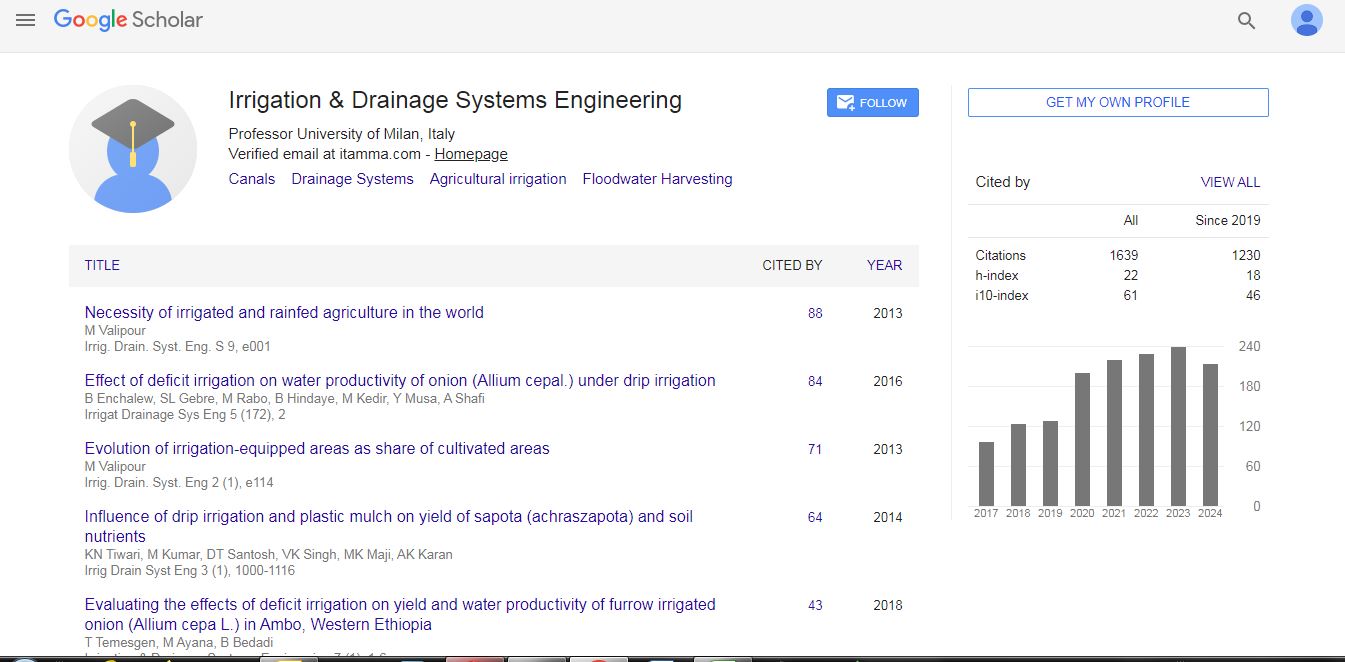
Irrigation & Drainage Systems Engineering received 835 citations as per Google Scholar report