Brief Report - (2025) Volume 13, Issue 4
Received: 01-Jul-2025, Manuscript No. economics-26-186056;
Editor assigned: 03-Jul-2025, Pre QC No. P-186056;
Reviewed: 17-Jul-2025, QC No. Q-186056;
Revised: 22-Jul-2025, Manuscript No. R-186056;
Published:
29-Jul-2025
, DOI: 10.37421/2375-4389.2025.13.532
Citation: Bennett, Olivia. ”Aging Population: Macroeconomic
Challenges and Policy Solutions.” J Glob Econ 13 (2025):532.
Copyright: © 2025 Bennett O. This is an open-access article distributed under the terms of the Creative Commons Attribution License, which permits unrestricted use,
distribution and reproduction in any medium, provided the original author and source are credited.
Aging populations represent a significant global demographic shift, presenting multifaceted challenges and opportunities for economies worldwide. The macroeconomic implications are profound, affecting labor supply, productivity, and government finances. Key insights reveal potential declines in economic growth and increased costs for healthcare and pensions, necessitating strategic policy interventions to ensure fiscal sustainability [1].
The dynamics of labor markets are particularly sensitive to population aging. A shrinking working-age population can lead to wage pressures and a greater demand for automation as businesses seek to maintain output levels. Policies promoting flexible work arrangements and continuous learning are identified as crucial for adapting to these demographic transformations [2].
The fiscal architecture of societies faces substantial pressure from aging populations, primarily through increased public pension and healthcare expenditures. Rising longevity and declining fertility rates contribute to a potential increase in public debt, underscoring the need for reforms that balance intergenerational equity with long-term fiscal stability [3].
Aggregate savings and investment patterns are also influenced by demographic shifts. A larger proportion of retirees who tend to dissave can lead to lower national savings rates and potentially higher interest rates, impacting capital accumulation. Policies that encourage private savings and attract foreign investment can serve as mitigating factors [4].
Innovation and technological adoption are posited as critical tools for counteracting the negative productivity effects associated with an aging workforce. When equipped with appropriate skills and technologies, older workers can maintain high levels of productivity, emphasizing the importance of R&D investment and digital literacy [5].
Shifts in consumption patterns are a direct consequence of aging populations. There is a discernible trend towards goods and services favored by older demographics, such as healthcare, leisure activities, and specialized financial products, requiring adaptation from businesses and policymakers [6].
The potential for economic growth is significantly impacted by population aging. Declining labor force participation and potentially lower productivity growth can lead to a slowdown in GDP growth, highlighting the necessity of pro-growth policies like investments in human capital and infrastructure [7].
Healthcare systems bear a substantial burden from aging populations, characterized by rising demand for services, an increased prevalence of chronic diseases, and strain on public health budgets. Integrated care models, preventive health strategies, and technological advancements in healthcare delivery are deemed essential [8].
Financial markets also experience notable effects from aging populations. A larger cohort of retirees drawing down assets may exert downward pressure on equity valuations and increase demand for fixed-income securities, prompting adjustments in investment strategies [9].
Managing the economic consequences of demographic shifts requires a comprehensive suite of policy responses. These interventions span labor market reforms, pension adjustments, healthcare system modifications, and pro-natalist policies, emphasizing the need for multifaceted and context-specific approaches [10].
Population aging introduces significant macroeconomic challenges and opportunities, impacting labor supply, productivity, savings rates, and government finances. Policymakers must navigate potential declines in economic growth, escalating healthcare and pension costs, and evolving consumption patterns by encouraging later retirement, fostering productivity through technology and education, and reforming social security and healthcare systems for fiscal sustainability [1].
Labor market dynamics are considerably influenced by population aging, affecting employment rates, wage levels, and skill shortages. A shrinking working-age population can result in wage pressures and an increased demand for automation. The adoption of policies that promote flexible work arrangements and lifelong learning is vital for adapting to these demographic shifts [2].
The fiscal implications of aging societies are substantial, particularly concerning public pensions and healthcare expenditures. Increased longevity and lower fertility rates can lead to rising public debt. Therefore, reforms are advocated to balance intergenerational equity with long-term fiscal sustainability, including gradual increases in retirement ages and adjustments to benefit formulas [3].
Aging populations impact aggregate savings and investment. A greater proportion of retirees who tend to dissave can decrease national savings rates and potentially increase interest rates, affecting capital accumulation. Policies encouraging private savings and attracting foreign investment are suggested to mitigate these effects [4].
Innovation and technological adoption are identified as crucial in offsetting the negative productivity impacts of aging. An older workforce, if equipped with relevant skills and technologies, can remain productive, underscoring the importance of investment in research and development and digital literacy for older workers [5].
Consumption patterns are shifting due to aging populations, with increased demand for goods and services favored by older demographics, such as healthcare, leisure, and specialized financial products. Businesses and governments must adapt their offerings and policies to cater to these changing consumer preferences [6].
The potential for economic growth is demonstrably affected by population aging, which can lead to a slowdown in GDP growth due to declining labor force participation and potentially lower productivity. Pro-growth policies, including investments in human capital and infrastructure, are essential to counteract these demographic headwinds [7].
Healthcare systems face specific challenges due to aging populations, including rising demand for services, a higher prevalence of chronic diseases, and strain on public health budgets. Integrated care models, preventive health strategies, and technological innovations in healthcare delivery are crucial for addressing these issues [8].
Population aging has implications for financial markets, affecting asset prices and credit availability. A larger number of retirees drawing down assets may reduce equity valuations and increase demand for fixed-income securities. Institutional investors and pension funds are adapting their strategies accordingly [9].
A wide range of policy responses are available to address the economic consequences of aging populations. These include labor market policies, pension reforms, healthcare system adjustments, and pro-natalist policies, with a strong emphasis on the necessity of multi-faceted and context-specific approaches for effective management [10].
Aging populations present significant macroeconomic challenges and opportunities, impacting labor supply, productivity, savings, and government finances. These demographic shifts necessitate policy interventions to address potential economic growth declines and increased healthcare and pension costs. Labor markets face pressures from a shrinking working-age population, requiring flexible work arrangements and continuous learning. Fiscal sustainability is threatened by rising public debt due to increased longevity and lower fertility. Savings rates may decline as retirees dissave, affecting capital accumulation. Innovation and technology are vital for maintaining worker productivity, while consumption patterns are shifting towards goods and services for older demographics. Economic growth potential can be hampered by reduced labor force participation, necessitating pro-growth policies. Healthcare systems face heightened demand and costs. Financial markets may see shifts in asset prices and credit availability. Effective management requires a multi-faceted policy approach encompassing labor markets, pensions, and healthcare.
None
None
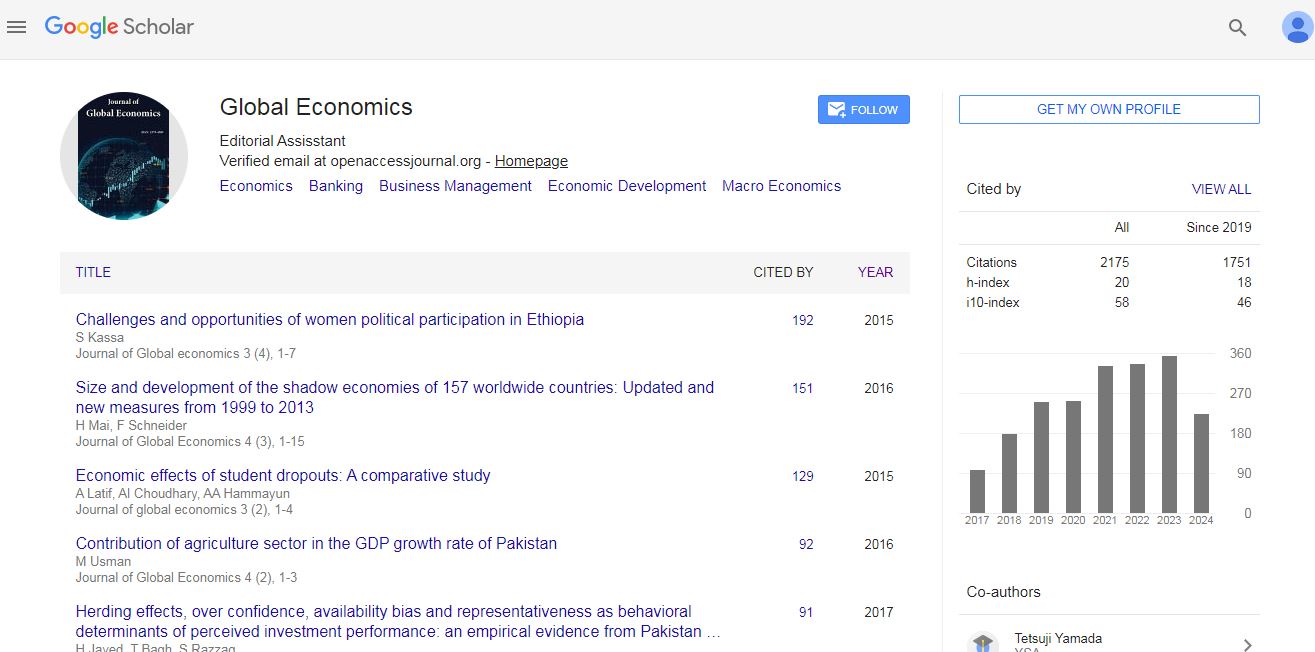
Journal of Global Economics received 2175 citations as per Google Scholar report