Brief Report - (2025) Volume 11, Issue 5
Received: 02-Sep-2025, Manuscript No. ohcr-25-174313;
Editor assigned: 04-Sep-2025, Pre QC No. P-174313;
Reviewed: 17-Sep-2025, QC No. Q-174313;
Revised: 23-Sep-2025, Manuscript No. R-174313;
Published:
30-Sep-2025
, DOI: 10.37421/2471-8726.2025.11.212
Citation: Al-Mansouri, Fatima. ”Aesthetic and Functional Dental Rehabilitation.” Oral Health Case Rep 11 (2025):212.
Copyright: © 2025 Al-Mansouri F. This is an open-access article distributed under the terms of the Creative Commons Attribution License, which permits unrestricted use, distribution and reproduction in any medium, provided the original author and source are credited.
Aesthetic and functional rehabilitation in dentistry often requires a multifaceted approach to address diverse patient needs, ranging from damaged teeth to soft tissue deficiencies and discoloration. Modern dentistry offers a wide array of techniques and materials to restore oral health and enhance smile esthetics. This collection of case reports illustrates the breadth of contemporary practices in cosmetic and restorative dentistry. One report details a successful aesthetic rehabilitation of extensively damaged anterior teeth, integrating direct composite resins and indirect porcelain veneers through a multidisciplinary strategy. This approach achieved excellent esthetic and functional outcomes, underscoring the importance of meticulous planning and precise execution in complex cosmetic cases [1].
Digital Smile Design (DSD) emerges as a significant tool for achieving both white and pink esthetics. A case explores DSD's application, showcasing how digital planning improves communication, predictability, and overall treatment success by visualizing outcomes and guiding precise interventions for ideal gingival and dental contours [2].
Another clinical case report outlines a multidisciplinary strategy for the esthetic and functional rehabilitation of an anterior maxillary dentition. It details the sequence of treatments, including periodontal therapy and prosthetic restorations, highlighting the synergy between different dental specialties for a harmonious and lasting smile transformation [3].
The application of advanced ceramic materials is also critically examined. One report highlights the successful aesthetic rehabilitation of anterior maxillary teeth using a combination of lithium disilicate and zirconia restorations. This case demonstrates the benefits of these materials in terms of strength, esthetics, and biocompatibility, offering predictable solutions for compromised anterior dentition [4].
Beyond hard tissue restoration, soft tissue management is crucial for optimal esthetics. An article describes a case involving root coverage using an innovative acellular dermal matrix. This technique proved effective in achieving predictable root coverage and improving gingival esthetics, offering a viable option for treating recessions [5].
Comprehensive full-mouth rehabilitations are also explored, such as a clinical report illustrating esthetic and functional restoration using IPS e.max Press ceramic restorations. This showcases the successful treatment of severely worn dentition, emphasizing the material's strength, durability, and natural appearance for significant improvements in both esthetics and masticatory function [6].
Immediate implant placement in the esthetic zone represents another advanced technique. A case report outlines this procedure, incorporating a novel approach to socket grafting. It demonstrates how this method can preserve alveolar bone and soft tissue contours, which is vital for optimal esthetic outcomes, reducing treatment time and improving patient satisfaction [7].
For intrinsic and superficial discolorations, a combined approach is often beneficial. One report presents a technique combining in-office bleaching with microabrasion to enhance the esthetics of discolored teeth. This dual strategy effectively addresses enamel stains and discoloration, leading to improvements in tooth shade and surface texture for a brighter smile [8].
Conservative esthetic solutions are also vital. An article focuses on the esthetic closure of a diastema in maxillary anterior teeth using direct composite resin. This illustrates a cost-effective and conservative method to correct spaces, achieving excellent esthetic integration and improving self-confidence in a single visit [9].
Finally, comprehensive esthetic and functional rehabilitation can be achieved using feldspathic ceramic veneers and crowns. A case report outlines this process, demonstrating how these highly esthetic restorations can transform a patient's smile by addressing both cosmetic concerns and functional deficiencies. This emphasizes detailed diagnosis, treatment planning, and skilled execution for successful complex cases [10].
These diverse case reports underscore the intricate nature of modern dental esthetics and functional restoration, highlighting the continuous advancements in materials, techniques, and interdisciplinary collaboration to meet varying patient needs effectively.
Modern dentistry places a significant emphasis on both the aesthetic and functional rehabilitation of the oral cavity, addressing a spectrum of patient concerns from damaged teeth to discolored enamel and gingival issues. The integration of various restorative and periodontal techniques is often crucial for achieving optimal results. For instance, the successful aesthetic rehabilitation of patients with extensively damaged anterior teeth frequently involves a multidisciplinary approach, combining direct composite resins with indirect porcelain veneers. This strategy highlights the necessity for meticulous planning and precise execution to ensure excellent esthetic and functional outcomes in complex cosmetic cases [1]. Similarly, the esthetic and functional rehabilitation of an anterior maxillary dentition can benefit from a comprehensive multidisciplinary strategy that outlines a sequence of treatments, including periodontal therapy and prosthetic restorations, underscoring the synergy between different dental specialties for creating harmonious and lasting smile transformations [3]. When considering full-mouth rehabilitation, techniques utilizing advanced materials like IPS e.max Press ceramic restorations have shown success in restoring severely worn dentition, providing strength, durability, and a natural appearance to dramatically improve both esthetics and masticatory function [6]. Additionally, comprehensive esthetic and functional rehabilitation can be effectively achieved using feldspathic ceramic veneers and crowns, which are chosen for their high esthetic qualities and ability to address both cosmetic concerns and functional deficiencies, emphasizing the critical role of detailed diagnosis, treatment planning, and skilled execution [10].
Digital technology plays an increasingly vital role in modern dental planning and execution. Digital Smile Design (DSD) exemplifies this advancement by facilitating the achievement of both white and pink esthetics. This approach integrates digital planning tools with clinical procedures, thereby enhancing communication, improving predictability, and guiding precise interventions. DSD enables clinicians to visualize outcomes and craft ideal gingival and dental contours, leading to greater treatment success and patient satisfaction [2]. The precision offered by digital tools complements the selection of advanced materials, contributing to predictable and esthetically pleasing results across various restorative scenarios.
The selection of restorative materials is paramount for achieving both strength and beauty. For the aesthetic rehabilitation of anterior maxillary teeth, a combination of lithium disilicate and zirconia restorations has proven highly effective. These advanced ceramic materials offer significant benefits in terms of strength, superior esthetics, and excellent biocompatibility. They represent a predictable solution for restoring severely compromised anterior dentition, leading to excellent long-term outcomes for patients [4]. Such material choices are central to cases requiring robust and visually appealing restorations.
Soft tissue management, particularly root coverage, is another critical aspect of achieving ideal dental esthetics. Innovative techniques such as the use of an acellular dermal matrix have shown significant promise in this area. A clinical case demonstrated the effectiveness of this grafting material in achieving predictable root coverage and subsequently improving gingival esthetics. This approach provides a viable option for treating gingival recessions and significantly enhancing the patient's smile appearance, highlighting the interplay between periodontal health and overall esthetics [5]. Furthermore, in cases requiring tooth replacement, immediate implant placement and provisionalization in the esthetic zone, incorporating novel approaches to socket grafting, are vital. This technique is designed to preserve alveolar bone and soft tissue contours, which is crucial for optimal esthetic outcomes, reducing treatment time and improving patient satisfaction in anterior implant cases [7].
Addressing intrinsic and extrinsic tooth discolorations is also a common esthetic challenge. A technique combining in-office bleaching with microabrasion has been presented as an effective method to enhance the esthetics of discolored teeth. This dual approach efficiently targets superficial enamel stains and intrinsic discoloration, leading to significant improvements in tooth shade and surface texture, and ultimately a brighter, more uniform smile [8]. For more conservative corrections, such as closing spaces between teeth, the esthetic closure of a diastema in maxillary anterior teeth using direct composite resin offers a cost-effective and efficient solution. This approach achieves excellent esthetic integration with the natural dentition and can significantly improve a patient's smile and self-confidence often in a single visit [9]. These varied strategies collectively demonstrate the comprehensive toolkit available to dental professionals for enhancing patient smiles.
The provided data outlines a range of contemporary dental procedures and techniques aimed at aesthetic and functional rehabilitation. It begins with cases demonstrating multidisciplinary approaches for extensively damaged anterior teeth, utilizing combinations of direct composite resins and indirect porcelain veneers to achieve excellent esthetic and functional outcomes through meticulous planning. Digital Smile Design is presented as a crucial tool for integrating digital planning with clinical procedures, enhancing communication, predictability, and guiding precise interventions for ideal gingival and dental contours, ensuring both white and pink esthetics. Further multidisciplinary strategies are explored for anterior maxillary dentition, emphasizing the synergy between periodontal therapy and prosthetic restorations for harmonious smile transformations. The collection also delves into advanced material applications, such as the successful aesthetic rehabilitation of anterior maxillary teeth with lithium disilicate and zirconia restorations, highlighting their strength, esthetics, and biocompatibility. Root coverage using novel acellular dermal matrices is detailed, showing effectiveness in treating gingival recessions and improving esthetics. Full-mouth rehabilitations with IPS e.max Press ceramic restorations illustrate restoration of severely worn dentition with strength, durability, and natural appearance. Immediate implant placement with novel socket grafting in the esthetic zone is presented for preserving bone and soft tissue. Other techniques include in-office bleaching combined with microabrasion for discolored teeth, conservative direct composite closure of diastemas, and comprehensive esthetic and functional rehabilitation using feldspathic ceramic veneers and crowns, all underscoring the importance of detailed diagnosis, planning, and skilled execution for successful patient outcomes.
None
None
1. Thaniya L, Prapasri D, Chanon S. "Multidisciplinary Approach for Aesthetic Rehabilitation with Direct and Indirect Restorations: A Case Report".Case Rep Dent 2022 (2022):9906644.
Indexed at, Google Scholar, Crossref
2. Mihaela I, DÄ?nuÈ? R, Camelia B. "Digital Smile Design and Pink Esthetics: A Clinical Case Report".Healthcare (Basel) 9 (2021):375.
Indexed at, Google Scholar, Crossref
3. Andrea C, Laura C, Antonio C. "Esthetic and Functional Rehabilitation of an Anterior Maxillary Dentition with a Multidisciplinary Approach: A Clinical Case Report".Healthcare (Basel) 11 (2023):432.
Indexed at, Google Scholar, Crossref
4. Balamurugan M, Devan M, Durairaj N. "Aesthetic Rehabilitation of Anterior Maxillary Teeth with Lithium Disilicate and Zirconia Restorations: A Case Report".Case Rep Dent 2023 (2023):5052303.
Indexed at, Google Scholar, Crossref
5. Ã?zkan G, Nalan A, Å?ehriyar A. "Root coverage with a novel acellular dermal matrix: A case report and 1-year follow-up".J Indian Soc Periodontol 26 (2022):377-380.
Indexed at, Google Scholar, Crossref
6. Mohammed A, Saud A, Mohsen A. "Full Mouth Esthetic and Functional Rehabilitation with IPS e.max Press Ceramic Restorations: A Clinical Report".Case Rep Dent 2023 (2023):1026078.
Indexed at, Google Scholar, Crossref
7. Ahmed K, Mohammed A, Mohammad A. "Immediate Implant Placement and Provisionalization in the Esthetic Zone with a Novel Approach to Socket Grafting: A Case Report".J Contemp Dent Pract 24 (2023):747-752.
Indexed at, Google Scholar, Crossref
8. Zohaib K, Syed AM, Saleh A. "In-office bleaching combined with microabrasion for improving esthetics in discolored teeth: A case report".Dent Med Probl 60 (2023):479-484.
Indexed at, Google Scholar, Crossref
9. Ji-Hyun K, Su-Kyung J, Dong-Hyun L. "Esthetic Closure of Diastema with Direct Composite Resin in Maxillary Anterior Teeth: A Case Report".J Korean Acad Dent Health 44 (2020):205-209.
Indexed at, Google Scholar, Crossref
10. Yasser E, Shaymaa E, Ali ME. "Comprehensive Esthetic and Functional Rehabilitation Using Feldspathic Ceramic Veneers and Crowns: A Case Report".Case Rep Dent 2023 (2023):4528994.
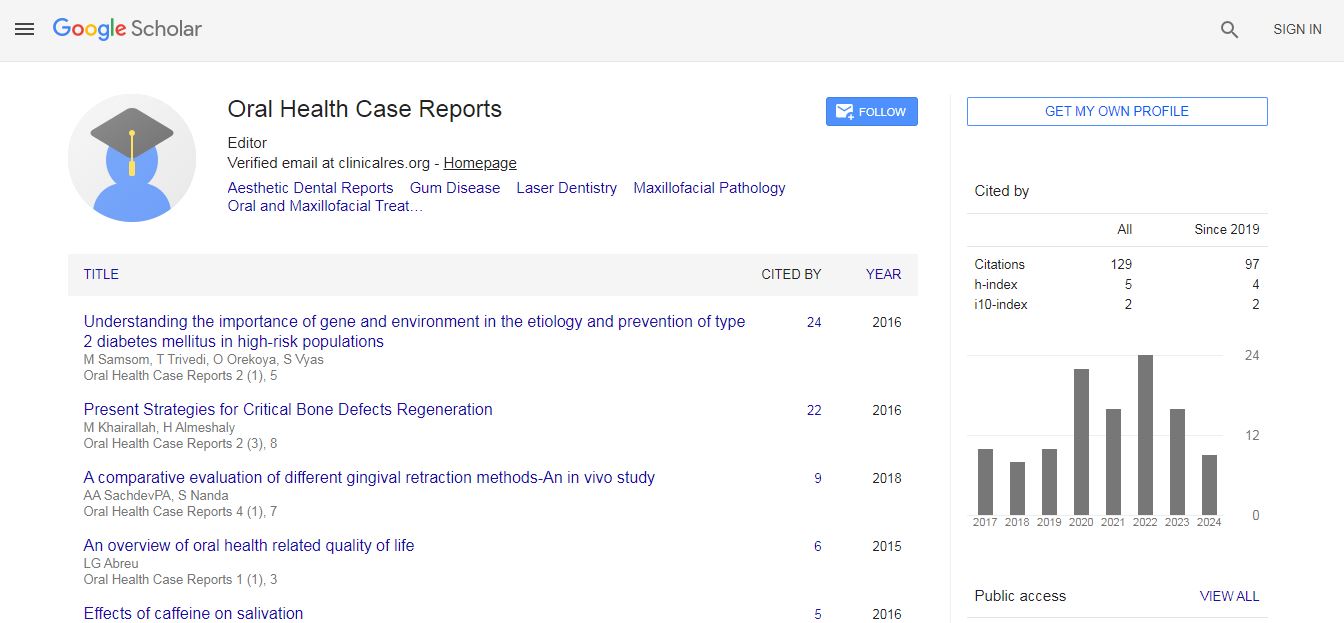
Oral Health Case Reports received 120 citations as per Google Scholar report