Commentary - (2025) Volume 10, Issue 3
Received: 01-May-2025, Manuscript No. apn-26-179085;
Editor assigned: 04-May-2025, Pre QC No. P-179085;
Reviewed: 14-May-2025, QC No. Q-179085;
Revised: 21-May-2025, Manuscript No. R-179085;
Published:
28-May-2025
, DOI: 10.37421/2573-0347.2025.10.429
Citation: Alvarez, Sofia. Advancing Pediatric Oncology Nursing: Best Practices and Innovations.â J Adv Practice Nurs 10 (2025):429.
Copyright: © 2025 Alvarez S. This is an open-access article distributed under the terms of the Creative Commons Attribution License, which permits unrestricted use,
distribution and reproduction in any medium, provided the original author and source are credited.
The landscape of pediatric oncology care is continuously evolving, driven by advancements in treatment modalities and a deepening understanding of the unique needs of young patients and their families. Innovative nursing strategies are at the forefront of enhancing the quality and effectiveness of care provided in this complex field. One significant area of focus is the implementation of patient-centered approaches, which prioritize the individual needs, values, and preferences of the child and their family. This patient-centric philosophy aims to foster a collaborative relationship between healthcare providers and patients, ensuring that care plans are tailored to maximize comfort, minimize distress, and promote optimal outcomes [1].
The integration of technology has also emerged as a critical component in modern pediatric oncology nursing. Telehealth services, for instance, are increasingly being utilized for remote symptom monitoring and to provide ongoing support to families. This allows for more frequent check-ins, timely interventions, and can significantly reduce the burden of travel for families, thereby improving access to care and patient satisfaction [2].
Advanced practice nurses (APNs) play a pivotal role in managing the multifaceted challenges presented by pediatric cancer. Their expertise is crucial in assessing and intervening with complex symptom clusters, leading to better symptom control and a reduction in hospitalizations. The expanded roles of APNs and their collaborative efforts within interprofessional teams are essential for optimizing care delivery and enhancing the quality of life for these young patients [3].
Beyond medical management, the psychosocial well-being of children with cancer is a paramount concern. Interventions such as play therapy have demonstrated significant efficacy in reducing anxiety, fear, and distress associated with the demanding treatment protocols and hospital environments. Nurses are instrumental in facilitating these therapeutic interventions and creating a supportive atmosphere for children [4].
A paradigm shift towards precision nursing is also influencing pediatric oncology. This approach emphasizes tailoring care based on individual patient characteristics, including genetic information and treatment responses. By leveraging such data, nurses can personalize interventions to improve treatment efficacy and minimize adverse effects, necessitating enhanced education in genomics and data interpretation [5].
Family-centered care models remain a cornerstone of pediatric oncology, with nurses playing a crucial role in empowering families as active partners in decision-making and care delivery. Effective communication, comprehensive education, and consistent emotional support are vital for both the child and their caregivers, leading to improved treatment adherence and overall family well-being [6].
Continuous professional development for nurses is essential to meet the demands of this specialized field. Simulation-based training has proven to be a valuable tool, enhancing nurses' competence in managing emergencies, administering complex chemotherapy, and communicating effectively with critically ill children and their families, ultimately improving patient safety [7].
As young patients transition from pediatric to adult cancer care, specialized transition care programs are vital. Nurse-led initiatives are critical for ensuring continuity of care, managing survivorship issues, and supporting adolescents and young adults in navigating the healthcare system, thereby improving outcomes and reducing care gaps [8].
Finally, innovative communication strategies, such as digital storytelling, are being explored to enhance support for pediatric oncology patients and families. Nurses can utilize digital platforms to share educational content, patient experiences, and coping strategies, fostering community and reducing isolation, thereby empowering patients and improving engagement with their care [9].
The comprehensive approach to pediatric oncology nursing involves a multifaceted strategy aimed at improving patient outcomes and quality of life. Innovative nursing strategies are central to this endeavor, encompassing patient-centered care, technological integration, and specialized nursing roles. Patient-centered care, as highlighted by Smith et al. [1], underscores the importance of tailoring interventions to the individual needs and preferences of pediatric oncology patients and their families. This philosophy ensures that care is not only clinically effective but also sensitive to the emotional and psychological impact of cancer and its treatment on young individuals. The adoption of telehealth services by nurses has significantly enhanced access to care and support for pediatric oncology patients. Lee et al. [2] demonstrate how remote symptom monitoring and family support via telehealth can lead to timely interventions, reduced travel burdens, and improved patient satisfaction, underscoring the growing role of technology in bridging geographical and logistical barriers. Advanced practice nurses (APNs) are indispensable in managing the complexities of pediatric oncology. Brown et al. [3] emphasize their expertise in symptom management, patient education, and care coordination. Their ability to assess and intervene with complex symptom clusters contributes directly to improved symptom control and a reduction in hospitalizations, showcasing the value of expanded nursing roles. Addressing the psychosocial needs of children with cancer is a critical nursing responsibility. Rodriguez et al. [4] discuss the positive impact of play therapy, facilitated by nurses, in alleviating anxiety, fear, and distress. This highlights the essential role of nurses in providing holistic care that extends beyond physical treatment to encompass emotional and psychological well-being. The concept of precision nursing, as explored by Miller et al. [5], represents a forward-thinking approach in pediatric oncology. This involves personalizing care based on individual patient data, including genetic information and treatment responses. Nurses are key in interpreting and applying this data to optimize treatment efficacy and minimize adverse effects. Family-centered care models are foundational in pediatric oncology, with nurses serving as crucial facilitators. Clark et al. [6] emphasize that nurses empower families by involving them in decision-making and care delivery. Effective communication and emotional support are vital for fostering adherence to treatment and enhancing overall family well-being. Enhancing nursing competence through simulation-based education is a key strategy for improving patient safety and care quality. Johnson et al. [7] illustrate how simulation training equips nurses with the skills to manage emergency situations and complex treatment regimens, thereby improving their preparedness and the safety of pediatric oncology patients. Transition care for adolescents and young adults (AYAs) moving from pediatric to adult care requires specialized nursing support. Martinez et al. [8] highlight nurse-led programs that ensure continuity of care and address survivorship issues. These programs are critical for improving outcomes and reducing gaps in care during this vulnerable transition period. Digital storytelling, as presented by Taylor et al. [9], offers a novel method for nurses to enhance communication and support for pediatric oncology patients and families. By leveraging digital platforms, nurses can share valuable information and experiences, fostering a sense of community and empowering patients. Finally, the integration of palliative care nursing principles early in the disease trajectory is crucial for improving the quality of life for pediatric oncology patients. Wilson et al. [10] underscore that nurse-led palliative care interventions, focusing on symptom management and psychosocial support, can significantly alleviate suffering and enhance well-being throughout the illness.
This collection of research highlights advancements and best practices in pediatric oncology nursing. Key areas of focus include patient-centered care, leveraging technology like telehealth for improved access and monitoring, and the expanded roles of advanced practice nurses in symptom management and care coordination. Psychosocial support through interventions like play therapy and family-centered approaches are emphasized as vital components of holistic care. The adoption of precision nursing, simulation-based training for nurses, and specialized transition care programs for young adults are discussed as critical for enhancing outcomes. Furthermore, innovative communication methods such as digital storytelling and the early integration of palliative care nursing are presented as essential for improving the overall quality of life for children with cancer and their families.
None
None
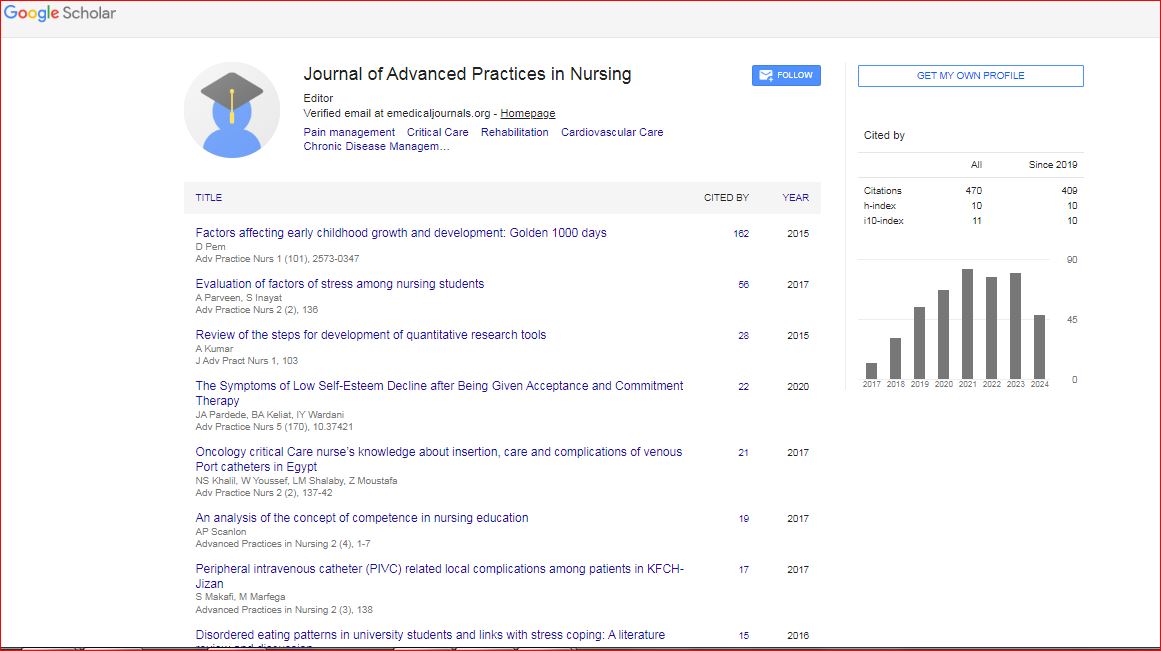
Journal of Advanced Practices in Nursing received 410 citations as per Google Scholar report