Short Communication - (2025) Volume 9, Issue 6
Received: 01-Nov-2025, Manuscript No. fsb-26-189977;
Editor assigned: 03-Nov-2025, Pre QC No. P-189977;
Reviewed: 17-Nov-2025, QC No. Q-189977;
Revised: 24-Nov-2025, Manuscript No. R-189977;
Published:
29-Nov-2025
, DOI: 10.37421/2577-0543.2025.9.263
Citation: Lindstrom, Sofia. ”Advancing Nutraceutical Bioavailability: Advanced Formulation Strategies.” J. Formul. Sci. Bioavailability 09 (2025):263.
Copyright: © 2025 Lindstrom S. This is an open-access article distributed under the terms of the Creative Commons Attribution License, which permits unrestricted use, distribution and reproduction in any medium, provided the original author and source are credited.
The development of nutraceuticals faces significant challenges in achieving adequate bioavailability, which is crucial for their therapeutic efficacy. Various formulation strategies have been explored to overcome these limitations, particularly for poorly soluble compounds. This introduction will explore key approaches detailed in recent research, highlighting their impact on absorption and therapeutic outcomes. One critical area of focus is the intricate relationship between formulation strategies and the bioavailability of nutraceutical products. Research demonstrates how various excipients and dosage forms, such as nanoemulsions and solid lipid nanoparticles, can significantly enhance the absorption and therapeutic efficacy of poorly soluble compounds. This underscores the importance of understanding physicochemical properties and employing advanced formulation techniques to overcome bioavailability challenges in nutraceutical development [1].
Lipid-based drug delivery systems have emerged as a powerful tool for improving the oral bioavailability of lipophilic nutraceuticals. Different types of lipid formulations, including self-emulsifying drug delivery systems (SEDDS) and liposomes, have been reviewed, along with their mechanisms of action in promoting absorption. Case studies of successful applications in enhancing the bioavailability of compounds like curcumin and coenzyme Q10 provide valuable insights into their potential [2].
The impact of particle size reduction techniques on the dissolution rate and bioavailability of phytoconstituents is another significant area of investigation. Studies have demonstrated that decreasing particle size, through methods such as micronization and nanosuspension formation, leads to increased surface area, thereby enhancing the solubility and absorption of poorly water-soluble plant-derived nutraceuticals like quercetin [3].
Novel approaches in nutraceutical formulation, such as amorphous solid dispersions (ASDs), are being explored to improve the bioavailability of high-dose, poorly soluble compounds. Research evaluating different polymers and manufacturing methods for ASDs has shown significant improvements in dissolution and Cmax for tested compounds, offering a promising avenue for formulation development [4].
The potential of cyclodextrin complexation as a strategy to enhance the solubility and bioavailability of lipophilic compounds, such as lutein, is also being investigated. Comparative studies assessing the efficacy of different cyclodextrins in forming stable complexes and the subsequent improvement in oral absorption of lutein from these formulations provide important data for guiding future development [5].
Formulation of nano-sized nutraceuticals using techniques like hot melt extrusion and spray drying is gaining traction. These nanoformulations have shown promise in overcoming absorption barriers, leading to increased therapeutic efficacy and reduced dosage requirements for compounds such as resveratrol [6].
Microemulsion systems are being evaluated for their efficacy in improving the oral delivery of specific nutraceuticals, like Coenzyme Q10. Research focusing on optimizing the composition of microemulsions to achieve thermodynamic stability and enhanced solubilization is crucial for significant improvements in pharmacokinetic profiles [7].
The development of solid dispersions with polymeric carriers is a key strategy for enhancing the bioavailability of compounds like silymarin. Exploration of various preparation techniques and characterization of the resulting solid dispersions for their dissolution properties and in vivo performance demonstrate improved absorption of silymarin [8].
Finally, nanoencapsulation techniques, including liposomes and nanostructured lipid carriers (NLCs), are being explored to improve the solubility, stability, and oral absorption of challenging lipophilic compounds like astaxanthin. These advanced methods address the inherent formulation challenges associated with such nutraceuticals [9].
The field of nutraceutical development is continuously seeking advanced formulation techniques to address the inherent challenges in achieving optimal bioavailability for various active compounds. A significant body of research highlights the critical role of formulation design in enhancing the absorption and therapeutic efficacy of nutraceuticals, particularly those with poor solubility or lipophilicity. Research in this area meticulously details how sophisticated formulation strategies, including the use of nanoemulsions and solid lipid nanoparticles, can profoundly influence the bioavailability of poorly soluble nutraceuticals. This approach emphasizes a deep understanding of the physicochemical properties of the active compounds and the strategic selection of excipients and dosage forms to overcome absorption barriers. The effective application of these techniques is paramount for maximizing the therapeutic potential of nutraceuticals [1].
Lipid-based delivery systems represent a cornerstone in enhancing the oral bioavailability of lipophilic nutraceuticals. The literature comprehensively reviews various lipid formulations, such as self-emulsifying drug delivery systems (SEDDS) and liposomes, elucidating their mechanisms that facilitate improved absorption. The presentation of case studies involving compounds like curcumin and coenzyme Q10 exemplifies the successful application of these systems in improving bioavailability [2].
Particle size reduction is another pivotal strategy explored in nutraceutical formulation. Techniques like micronization and nanosuspension formation are investigated for their ability to increase the surface area of poorly water-soluble phytoconstituents, thereby improving their dissolution rate and subsequent oral absorption. This is particularly relevant for compounds such as quercetin, where physical modifications play a direct role in bioavailability [3].
Amorphous solid dispersions (ASDs) are emerging as a promising approach for improving the bioavailability of high-dose, poorly soluble nutraceuticals. Studies have focused on identifying suitable polymers and optimizing manufacturing methods for ASDs, with findings consistently demonstrating significant enhancements in dissolution profiles and peak plasma concentrations (Cmax) of the active compounds [4].
Cyclodextrin complexation offers a versatile strategy for solubilizing and enhancing the bioavailability of lipophilic nutraceuticals, exemplified by its application to lutein. Research comparing the efficacy of different cyclodextrins in forming stable complexes and assessing the resultant improvements in oral absorption provides valuable insights into the practical application of this technique [5].
Nanoformulation strategies, including those employing hot melt extrusion and spray drying, are instrumental in creating nano-sized nutraceuticals. These advanced formulations are designed to circumvent absorption limitations, leading to increased therapeutic efficacy and potentially reduced dosages for compounds like resveratrol [6].
Microemulsion systems have been investigated for their potential to enhance the oral delivery of specific nutraceuticals, such as Coenzyme Q10. The optimization of microemulsion composition is critical for achieving thermodynamic stability and maximizing the solubilization of the active ingredient, which in turn significantly impacts its pharmacokinetic behavior [7].
Polymeric solid dispersions are a recognized method for improving the oral bioavailability of nutraceuticals like silymarin. The exploration of various preparation methods and thorough characterization of the resultant solid dispersions for their dissolution properties and in vivo performance are key to demonstrating their efficacy in enhancing absorption [8].
Finally, nanoencapsulation techniques, employing systems like liposomes and nanostructured lipid carriers (NLCs), are crucial for addressing the formulation challenges associated with lipophilic carotenoids such as astaxanthin. These methods aim to improve solubility, stability, and ultimately, oral absorption [9].
This collection of research papers explores various advanced formulation strategies aimed at enhancing the bioavailability of nutraceuticals. Key techniques discussed include the use of nanoemulsions, solid lipid nanoparticles, lipid-based delivery systems like SEDDS and liposomes, and particle size reduction methods such as micronization and nanosuspensions. Amorphous solid dispersions, cyclodextrin complexation, and nanoformulations created via hot melt extrusion and spray drying are also highlighted as effective means to improve absorption. Microemulsion systems and polymeric solid dispersions are further presented as valuable approaches for specific nutraceuticals. The overarching goal of these studies is to overcome bioavailability challenges associated with poorly soluble and lipophilic compounds, thereby maximizing their therapeutic efficacy.
None
None
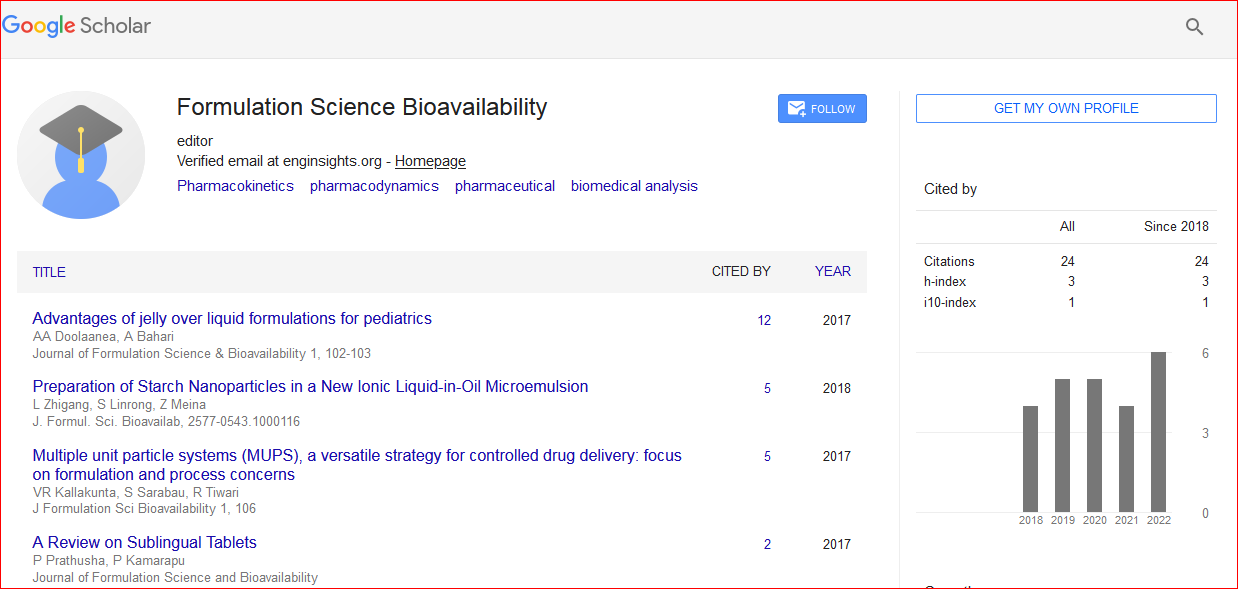
Journal of Formulation Science & Bioavailability received 23 citations as per Google Scholar report