Short Communication - (127) Volume 14, Issue 4
Received: 01-Dec-2025, Manuscript No. ara-25-175636;
Editor assigned: 03-Dec-2025, Pre QC No. P-175636;
Reviewed: 17-Dec-2025, QC No. Q-175636;
Revised: 22-Dec-2025, Manuscript No. R-175636;
Published:
29-Dec-2025
, DOI: 10.37421/2168-9695.2025.14.352
Citation: Moreau, Julien. ”Advancing Multi-Robot Collaboration and Resilience.” Adv Robot Autom 14 (2025):352.
Copyright: © 2025 Moreau J. This is an open-access article distributed under the terms of the Creative Commons Attribution License, which permits unrestricted use, distribution and reproduction in any medium, provided the original author and source are credited.
Coordinating multiple robots to achieve complex tasks is a fundamental challenge in modern robotics, particularly when considering real-world limitations such as unreliable communication, dynamic environments, and diverse robot capabilities. The quest for truly autonomous and collaborative multi-robot systems drives a wide array of research, focusing on innovative control strategies, robust planning algorithms, and efficient communication protocols. Understanding the complexities involved means appreciating the need for solutions that allow groups of robots to act cohesively and intelligently, often without a central orchestrator. This field is continuously advancing, seeking to overcome hurdles that prevent multi-robot deployments from reaching their full potential in various applications. One of the most pressing issues is enabling robots to work together effectively when their communication links are unreliable or inherently constrained. A particularly smart approach leverages decentralized learning, where individual robots are empowered to make independent decisions based on limited, local information from their immediate neighbors. This method significantly helps the entire group achieve complex tasks even when communication is spotty and prone to failure, moving beyond the need for a central brain [1].
In a similar vein, other research focuses on developing distributed optimal control strategies designed to maintain system efficiency and performance in multi-robot systems despite unpredictable and time-varying changes in communication networks. The aim here is to ensure robots can still achieve their collective goals efficiently, even as their communication topology shifts constantly [2].
Minimizing communication overhead and coping with inherent delays are also crucial for scalable multi-robot operations. An event-triggered distributed control strategy offers a clever solution by having robots communicate or act only when absolutely necessary. This intelligent approach significantly reduces network traffic and helps robots cooperate effectively even when messages aren't instant, making the overall system more efficient [10].
Furthermore, developing robust control methods, especially for maintaining specific group formations, becomes vital when communication topologies are prone to switching or when individual robot motors are subject to input constraints. Such methods are essential to ensure multi-robot systems can reliably maintain their formation and execute maneuvers despite these common practical limitations [9].
Beyond communication and control, navigation and collision avoidance in complex multi-robot environments pose significant hurdles. One clever strategy addresses this by implementing prioritized planning, where certain robots are given precedence for movement, with their paths planned accordingly to ensure safe and efficient navigation without the need for a central authority. It is akin to having a sophisticated, distributed traffic controller for robots [3].
For robots operating in environments where conditions are constantly changingâ??like a busy factory floorâ??they need to learn to plan their paths cooperatively without a central controller. This involves empowering each robot to make smart, cooperative decisions on the fly, allowing the system to adapt seamlessly to dynamic changes in real-time [5].
Moreover, when dealing with heterogeneous teams of robots, meaning those with different capabilities or roles, the challenge extends to efficient task allocation. A consensus-based approach helps such diverse teams figure out who does what and how they navigate to their respective objectives, effectively leveraging each robot's unique strengths to collectively achieve complex missions [6].
Maintaining specific group formations, like a synchronized aerial display or a precise ground patrol, while simultaneously avoiding obstacles and operating with limited inter-robot communication, is no small feat. Research presents detailed methods for achieving just that, enabling robots to maintain their desired shape as a group, navigate around objects, and do it all using only local information from their nearest neighbors [7].
To grasp the broader landscape of multi-robot collaboration and its evolution, comprehensive survey papers are invaluable. One such survey explores the trajectory of multi-robot systems, ranging from simple swarm intelligenceâ??where robots act like insects with minimal individual planningâ??to more sophisticated collaborative control strategies where deliberate coordination takes precedence. This provides a crucial framework for understanding the diverse ways multi-robot systems are designed and managed [4].
Another specialized review specifically breaks down how groups of robots can efficiently map an unknown area. It thoroughly examines different strategies robots employ to explore and build maps together, highlighting techniques that allow them to cover ground faster and more completely than a single robot ever could. This offers a good overview of the field's advancements in multi-robot exploration and mapping [8].
These collective efforts across various domains underscore the continuous push towards creating more adaptive, resilient, and intelligent multi-robot systems, poised to tackle increasingly complex real-world applications with greater autonomy and efficiency.
Multi-robot systems represent a promising frontier for tackling complex tasks, offering advantages in terms of efficiency, robustness, and scalability over single-robot solutions. However, realizing this potential requires addressing significant challenges, particularly in decentralized control, communication management, and cooperative planning. The research presented here highlights various innovative strategies to overcome these hurdles.
A primary focus involves enabling effective coordination when communication is unreliable or constrained. Here's the thing, getting multiple robots to work together without a central brain, especially when their communication is unreliable, is a huge challenge. One paper tackles that by using a smart, decentralized learning approach, meaning each robot learns to make decisions on its own, based on limited information from its neighbors, allowing the whole group to achieve complex tasks even when comms are spotty [1]. What this really means is that systems can remain effective even in dynamic networking conditions. Think about a scenario where robots need to cooperate, but their communication links keep changing, maybe dropping in and out. This work presents a way for multi-robot systems to maintain optimal control despite these unpredictable communication changes, ensuring the robots can still achieve their group goals efficiently, even when their network structure shifts [2]. Further enhancing this, a robust control method allows multi-robot systems to maintain formation reliably even under switching communication topologies and input constraints, which are common real-world limitations [9]. This is complemented by strategies like event-triggered distributed control, where robots only communicate or act when absolutely necessary. This smart approach reduces network traffic and helps robots cooperate effectively even when messages aren't instant, making the system more efficient overall, especially when dealing with communication delays [10].
Another significant area of development is cooperative navigation and path planning. Getting multiple robots to move around without bumping into each other, especially in tight spaces, is a classic problem. One paper suggests a clever approach by prioritizing certain robots and planning their paths accordingly, ensuring everyone gets where they need to go safely and efficiently. It's like having a traffic controller for robots, but without the central authority [3]. Imagine robots navigating a factory floor where things are constantly moving. This research focuses on how robots can learn to plan their paths together in these chaotic, dynamic environments without a central controller. It's about empowering each robot to make smart, cooperative decisions on the fly, adapting to changes in real-time [5]. Sometimes you have a team of robots, but they aren't all the same â?? they have different capabilities. This paper explores how such a diverse team can figure out who does what (task allocation) and how they get there (path planning) through a consensus-based approach. It's about leveraging each robot's strengths to collectively achieve complex missions [6]. For cases where robots need to maintain a specific arrangement, like a flying V, while avoiding obstacles and with limited chat between them, methods are detailed for achieving just that. It's a way for robots to maintain their shape as a group, navigate around objects, and do it all using only local information from their nearest neighbors [7].
The broader context of multi-robot systems also involves understanding the overall landscape and specific application areas. If you want to understand the bigger picture of how multiple robots work together, a survey is a good starting point. It covers a lot of ground, from simple swarm behaviors, where robots act like insects, to more complex collaborative control strategies, where they deliberately coordinate. It really helps frame the diverse ways multi-robot systems are designed and managed [4]. If you're wondering how a group of robots can efficiently map an unknown area, a review breaks it down. It goes through different strategies robots use to explore and build maps together, highlighting the techniques that allow them to cover ground faster and more completely than a single robot could. It gives you a good overview of the field's advancements [8]. These comprehensive overviews are crucial for researchers to contextualize their work and identify future directions, ensuring continuous progress in the field.
These varied research efforts collectively push the boundaries of multi-robot system capabilities. By addressing fundamental issues in communication, control, navigation, and coordination, these studies pave the way for more resilient, efficient, and intelligent robotic teams. From highly adaptive decentralized learning to sophisticated task allocation and robust formation control, the advancements described here are vital for deploying autonomous multi-robot systems in increasingly complex and unpredictable real-world scenarios.
The provided research highlights significant advancements and persistent challenges in multi-robot systems, focusing on how groups of robots can work together effectively, even under difficult conditions. A key area is dealing with unreliable or limited communication. Approaches include decentralized learning, where individual robots make decisions with sparse information from neighbors, allowing the group to complete tasks despite spotty communication. Another strategy involves distributed optimal control to maintain system efficiency even when communication networks are constantly changing. Path planning and collision avoidance are also central. Methods range from prioritized planning, where certain robots get precedence for movement, to learning-based decentralized cooperative planning that adapts to dynamic environments. For diverse robot teams, consensus-based strategies help allocate tasks and plan paths, leveraging each robot's unique strengths. Maintaining specific formations is another critical aspect, especially when communication is limited or system inputs are constrained. Researchers develop robust control methods, sometimes involving event-triggered communication, to ensure formations are held reliably while avoiding obstacles and minimizing network traffic. Furthermore, comprehensive surveys outline the evolution of multi-robot systems, from simple swarm behaviors to complex collaborative control, and dedicated reviews detail advancements in multi-robot exploration and mapping, emphasizing techniques for faster and more complete coverage of unknown areas. This collective research drives progress towards more autonomous, adaptable, and efficient multi-robot deployments across various applications.
None
None
Yuancheng L, Chao Y, Min X. "Decentralized Learning-Based Control for Multi-Robot Systems With Communication Constraints".IEEE Trans. Robot. 39 (2023):4403-4417.
Indexed at, Google Scholar, Crossref
Meng L, Haoping W, Jing Y. "Distributed Optimal Control for Multi-Robot Systems with Time-Varying Communication Topologies".IEEE/CAA J. Autom. Sin. 9 (2022):1726-1738.
Indexed at, Google Scholar, Crossref
Xiaomeng L, Shurui L, Xinming L. "Multi-Robot Navigation with Prioritized Planning and Collision Avoidance".Robot. Auton. Syst. 146 (2021):103893.
Indexed at, Google Scholar, Crossref
Bo L, Junmei L, Pengcheng L. "A Survey on Multi-Robot Systems: From Swarm Intelligence to Collaborative Control".IEEE Trans. Cybern. 50 (2020):3669-3683.
Indexed at, Google Scholar, Crossref
Jiaxin L, Hao S, Jiahong W. "Learning-based Decentralized Cooperative Path Planning for Multi-Robot Systems in Dynamic Environments".IEEE Robot. Autom. Lett. 8 (2023):3823-3830.
Indexed at, Google Scholar, Crossref
Yanan L, Liang H, Yuandan Z. "Consensus-based task allocation and path planning for heterogeneous multi-robot systems".Swarm Evol. Comput. 74 (2022):101168.
Indexed at, Google Scholar, Crossref
Hao Y, Xiang Y, Yuan W. "Distributed Formation Control of Multi-Robot Systems With Limited Communication and Obstacle Avoidance".IEEE Trans. Autom. Control 66 (2021):4972-4979.
Indexed at, Google Scholar, Crossref
Yiyang W, Shuo Y, Fan Y. "A review of multi-robot exploration and mapping algorithms".Robot. Auton. Syst. 167 (2023):104473.
Indexed at, Google Scholar, Crossref
Zheng L, Yang L, Long Z. "Robust Formation Control of Multi-Robot Systems Under Switching Topologies and Input Constraints".Int. J. Robust Nonlin. Control 30 (2020):5650-5668.
Indexed at, Google Scholar, Crossref
Bo Y, Huaguang Z, Qiushi C. "Event-Triggered Distributed Control for Multi-Robot Cooperation with Communication Delay".Automatica 101 (2019):421-428.
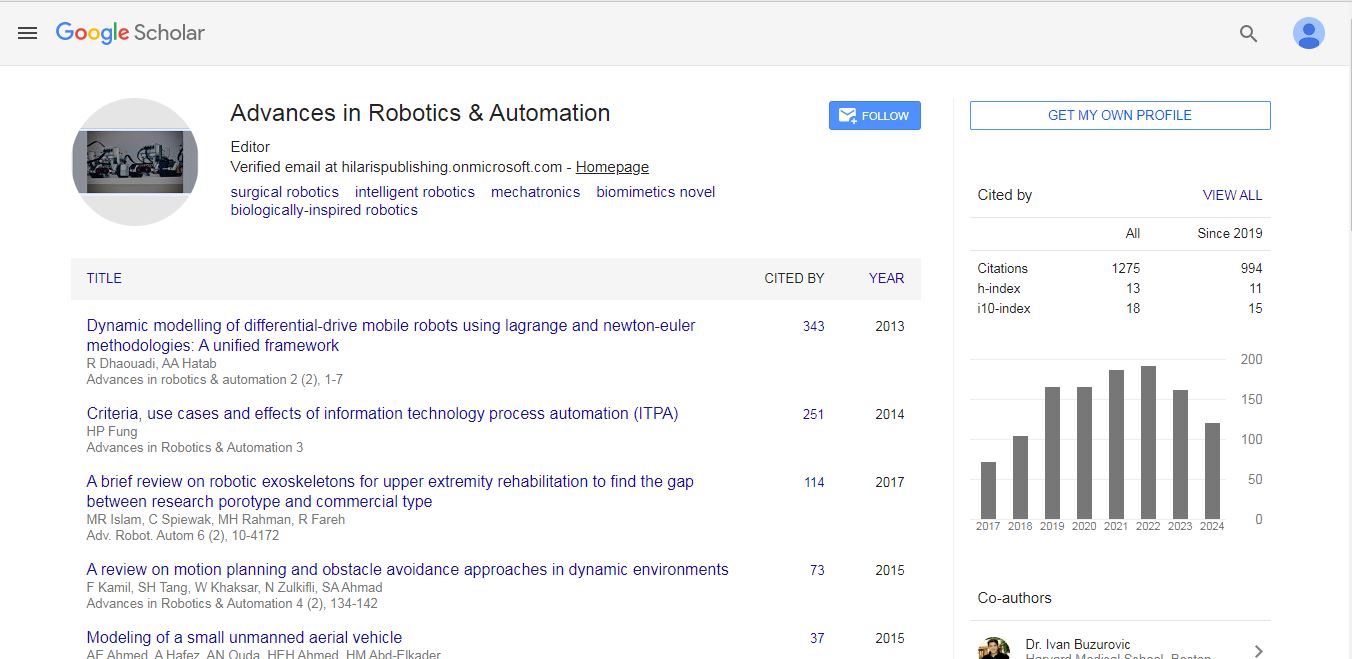
Advances in Robotics & Automation received 1275 citations as per Google Scholar report