Short Communication - (2025) Volume 11, Issue 3
Received: 02-Jun-2025, Manuscript No. abp-25-173827;
Editor assigned: 04-Jun-2025, Pre QC No. P-173827;
Reviewed: 18-Jun-2025, QC No. Q-173827;
Revised: 23-Jun-2025, Manuscript No. R-173827;
Published:
30-Jun-2025
, DOI: 10.37421/2472-0496.2025.11.329
Citation: Zhou, Mei-Ling. ”Advancing Mental Health: Innovation, Ethics, Principles.” Abnorm Behav Psychol 11 (2025):329.
Copyright: © 2025 Zhou M. This is an open-access article distributed under the terms of the Creative Commons Attribution License, which permits unrestricted use, distribution and reproduction in any medium, provided the original author and source are credited.
Modern mental health care is evolving rapidly, incorporating digital solutions, ethical considerations for new delivery methods, and a deeper understanding of diverse client needs. Online Cognitive Behavioral Therapy (CBT) has emerged as a highly effective intervention for managing depression and anxiety. What this really means is that digital platforms are becoming incredibly important tools in expanding access to effective mental health treatment, especially given the flexibility they offer. A thorough review and meta-analysis confirm these online interventions can be just as impactful as traditional face-to-face sessions for many people, proving a significant shift in therapeutic delivery [1].
Alongside the rise of digital therapy, there's the growing importance of telehealth in counseling. Here's the thing: it presents unique ethical challenges alongside its immense benefits. This paper dives into those considerations, offering best practices to ensure client safety, confidentiality, and professional boundaries in a virtual setting. Itâ??s crucial for practitioners to understand these nuances to provide high-quality care remotely, thereby safeguarding both clients and professional standards in a rapidly changing landscape [2].
A cornerstone of effective counseling is multicultural competence. Understanding and developing multicultural counseling competence is paramount. This meta-analysis shows what works in training interventions aimed at enhancing counselors' abilities to work effectively with diverse populations. It underscores the importance of ongoing education and self-reflection for cultural humility and responsiveness in practice, ensuring that all individuals receive culturally sensitive and appropriate care [3].
Furthermore, trauma-informed care is shaping how mental health services are delivered. Trauma-informed care is more than just a buzzword; it's a critical shift in how mental health services are provided. This systematic review synthesizes the evidence on integrating trauma-informed principles, showing how acknowledging and responding to the impact of trauma can significantly improve client engagement and outcomes across various settings. Itâ??s fundamentally about creating environments of safety and trust, which are essential for true healing and recovery [4].
Mental health support for younger populations, especially within educational settings, also plays a crucial role. Let's break down the impact of mental health services within schools: they play a vital role in student well-being and academic success. This review outlines how school-based counseling interventions positively influence student outcomes, from reducing symptoms of distress to improving academic performance. It emphasizes the undeniable need for accessible, integrated support systems where students spend much of their time, fostering a supportive environment for their development [5].
The connection between physical and mental health is increasingly recognized. Living with a chronic physical illness is tough, and psychological interventions can make a real difference. This systematic review and meta-analysis confirms that psychological support significantly improves mental health outcomes for adults managing long-term health conditions. It speaks to the undeniable link between physical and mental health, and the importance of integrated care models that address both aspects comprehensively for holistic well-being [6].
Beyond personal well-being, external stressors significantly impact mental health and career paths. The COVID-19 pandemic threw a wrench into career development for many. This article explores how career counseling had to adapt to help individuals navigate unprecedented disruption and uncertainty in the job market. It underscores the critical role counselors play in supporting resilience and strategic planning during times of economic and social upheaval, helping clients adapt to unforeseen challenges and rebuild their professional lives [7].
Effective therapeutic processes often hinge on core psychological concepts. Psychological flexibility is a key component of effective therapeutic change, especially in Acceptance and Commitment Therapy (ACT). This meta-analysis demonstrates the strong link between increased psychological flexibility and positive treatment outcomes in ACT. It suggests that helping clients become more adaptable and present is a powerful pathway to improved well-being, allowing them to engage more fully with their values despite life's difficulties [8].
Ultimately, the human connection in therapy remains paramount. The working alliance, or the collaborative and affective bond between client and therapist, is consistently shown to be a major predictor of therapy success. This comprehensive review and meta-analysis solidifies that connection, highlighting that a strong alliance is fundamental to positive treatment outcomes across various therapeutic modalities. It emphasizes the profound human element at the heart of counseling, which often determines the effectiveness of any intervention [9].
Finally, the reach of digital interventions extends to younger demographics. Digital mental health interventions are particularly relevant for young people. This systematic review and meta-analysis evaluates the effectiveness of these online tools for common mental disorders in youth. The findings suggest that these interventions can be a powerful and accessible resource, offering promising avenues for supporting the mental well-being of a younger generation, ensuring they have access to timely and appropriate care [10].
The contemporary landscape of mental health services is marked by significant advancements and evolving methodologies, aiming to enhance accessibility and efficacy for diverse populations. A key development is the widespread adoption of digital platforms for therapeutic interventions. For instance, online Cognitive Behavioral Therapy (CBT) has been thoroughly reviewed and shown to be highly effective for addressing depression and anxiety, with outcomes comparable to traditional in-person sessions [1]. This points to the increasing importance of digital tools in expanding mental healthcare reach, providing flexibility that benefits many individuals. Moreover, digital mental health interventions are proving especially relevant and effective for young people, offering an accessible resource for common mental disorders in this demographic [10]. These advancements highlight a clear shift towards leveraging technology to support mental well-being across different age groups.
The integration of technology, while beneficial, introduces new ethical considerations that practitioners must navigate carefully. Telehealth in counseling, for example, presents unique challenges alongside its numerous advantages. Itâ??s crucial for counselors to adhere to best practices concerning client safety, confidentiality, and professional boundaries in virtual settings, ensuring that high-quality care is maintained remotely without compromising ethical standards [2]. This careful approach ensures that the convenience of digital delivery does not come at the cost of patient trust or therapeutic integrity.
Beyond delivery methods, the effectiveness of counseling is deeply tied to its ability to meet individuals where they are, culturally and experientially. Developing multicultural counseling competence is paramount. A meta-analysis reveals that specific training interventions effectively enhance counselorsâ?? abilities to work with diverse populations, emphasizing the ongoing need for education and self-reflection to cultivate cultural humility and responsiveness [3]. This focus on cultural competence ensures that therapeutic approaches are tailored and respectful, leading to better engagement and outcomes. In parallel, understanding and responding to past experiences, particularly trauma, has become a central tenet of care. Trauma-informed care represents a critical shift, moving beyond mere symptom management to acknowledge and address the pervasive impact of trauma. Systematic reviews show that integrating trauma-informed principles significantly improves client engagement and outcomes across various settings, fostering environments of safety and trust essential for healing [4].
The scope of mental health support is also broadening to include specific contexts and needs. School-based mental health services, for instance, play a vital role in fostering student well-being and academic success. Reviews confirm that these interventions positively influence student outcomes, from reducing distress to enhancing academic performance, underscoring the necessity of integrated support systems within educational environments [5]. Furthermore, the profound link between physical and mental health is undeniable. Psychological interventions have been shown to significantly improve mental health outcomes for adults managing chronic physical illnesses, highlighting the importance of integrated care approaches that address both aspects for holistic recovery and improved quality of life [6].
Finally, external societal shifts, like global crises, continually shape the demands on mental health professionals. The COVID-19 pandemic, for example, introduced unprecedented disruption in career development, necessitating adaptation in career counseling. Counselors played a critical role in helping individuals navigate uncertainty and foster resilience during this economic and social upheaval [7]. Underlying the success of many therapeutic modalities are core principles such as psychological flexibility, which is a key component of effective therapeutic change, particularly in Acceptance and Commitment Therapy (ACT). Increased psychological flexibility strongly correlates with positive treatment outcomes, suggesting its importance in helping clients adapt and thrive [8]. Ultimately, regardless of the method or specific focus, the human element remains central. The working alliance â?? the collaborative and affective bond between client and therapist â?? consistently predicts therapy success across various modalities, emphasizing that a strong relational foundation is fundamental to achieving positive treatment outcomes [9].
Recent research highlights significant advancements and evolving best practices in mental health care. Digital platforms, notably online Cognitive Behavioral Therapy (CBT) and other digital interventions for youth, are increasingly effective and accessible tools for managing mental health challenges like depression and anxiety. This expansion into telehealth, however, also necessitates careful consideration of ethical boundaries and client safety in virtual settings. A core theme is the critical importance of therapist competence, especially in multicultural counseling, where specific training interventions prove vital for working effectively with diverse populations. Trauma-informed care is also reshaping service delivery, focusing on creating safe and trusting environments to improve client outcomes. Furthermore, mental health services are demonstrating impact in specialized contexts, such as school-based interventions that boost student well-being and academic success, and psychological support for adults managing chronic physical illnesses, emphasizing integrated care. The COVID-19 pandemic underscored the adaptive role of career counseling in navigating economic disruption. Across these diverse applications, foundational therapeutic elements remain crucial. Psychological flexibility is linked to positive outcomes in therapies like Acceptance and Commitment Therapy (ACT), and the strength of the working alliance between client and therapist is consistently identified as a major predictor of overall therapy success. Collectively, these insights paint a picture of an adaptable, client-centered mental health field that embraces innovation while upholding core therapeutic principles.
None
None
1. Yue X, Fan S, Jia L. "The effectiveness of online cognitive behavioral therapy in the treatment of depression and anxiety: A systematic review and meta-analysis".EClinicalMedicine 36 (2021):100919.
Indexed at, Google Scholar, Crossref
2. Jimmy BL, Jennifer GS, Kimberly SH. "Telehealth in counseling psychology: Ethical considerations and best practices".Couns Psychol 50 (2022):1109-1135.
Indexed at, Google Scholar, Crossref
3. Jesse JO, Benjamin CWJ, Michael TS. "Developing multicultural counseling competence: A meta-analysis of training interventions".J Couns Psychol 67 (2020):669-684.
Indexed at, Google Scholar, Crossref
4. Jenna KB, Sarah EC, Katherine MM. "Trauma-informed care in mental health service delivery: A systematic review".Psychiatr Serv 72 (2021):22-34.
Indexed at, Google Scholar, Crossref
5. Sharon HS, Ashley JSB, Kimberly H. "The impact of school-based mental health services on student outcomes: A systematic review".J Sch Health 93 (2023):1-10.
Indexed at, Google Scholar, Crossref
6. Ji C, Meng-Meng W, Qian Y. "Psychological interventions for adults with chronic physical illnesses: A systematic review and meta-analysis of randomized controlled trials".J Consult Clin Psychol 88 (2020):579-598.
Indexed at, Google Scholar, Crossref
7. Jane LS, V. SH, Jessica MG. "Career counseling in the era of COVID-19: Navigating disruption and uncertainty".J Career Dev 48 (2021):365-378.
Indexed at, Google Scholar, Crossref
8. Andreas TG, Georg HES, Thomas B. "Psychological flexibility and treatment outcomes in Acceptance and Commitment Therapy (ACT): A meta-analysis".J Context Behav Sci 18 (2020):203-221.
Indexed at, Google Scholar, Crossref
9. Christoph F, Julian R, Lena IN. "The working alliance in psychotherapy: A systematic review and meta-analysis of its relation to treatment outcome".J Consult Clin Psychol 88 (2020):447-464.
Indexed at, Google Scholar, Crossref
10. Rebecca G, Emily EC, Sarah MSS. "Effectiveness of digital mental health interventions for common mental disorders in young people: A systematic review and meta-analysis".J Child Psychol Psychiatry 62 (2021):938-952.
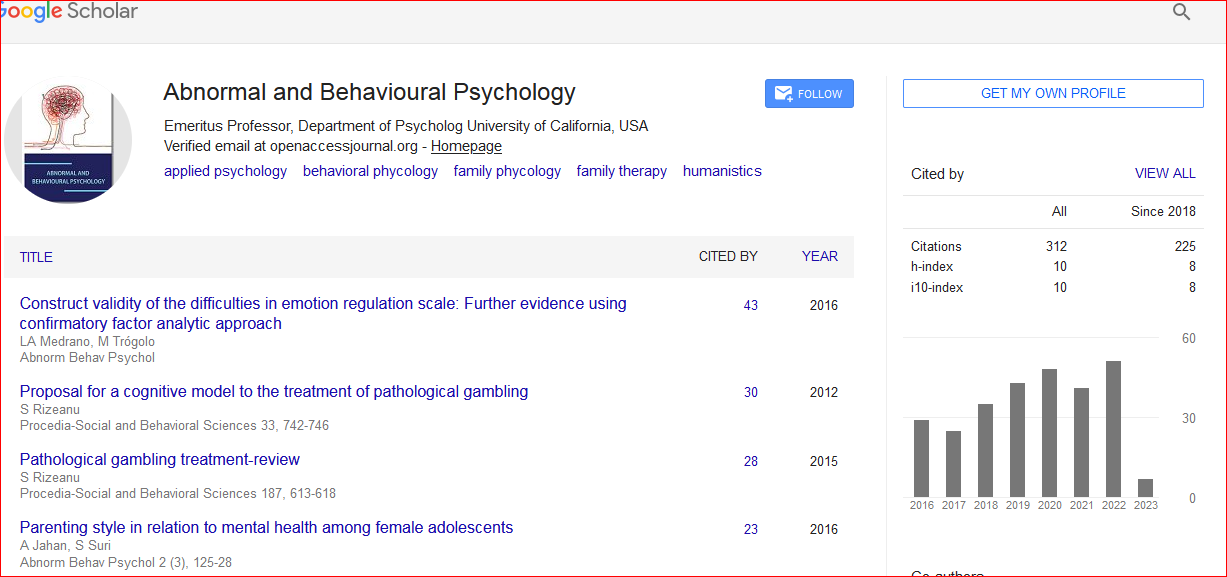
Abnormal and Behavioural Psychology received 361 citations as per Google Scholar report