Perspective - (2025) Volume 16, Issue 5
Received: 01-Oct-2025, Manuscript No. jvst-26-188124;
Editor assigned: 03-Oct-2025, Pre QC No. P-188124;
Reviewed: 17-Oct-2025, QC No. Q-188124;
Revised: 22-Oct-2025, Manuscript No. R-188124;
Published:
29-Oct-2025
, DOI: 10.37421/2157-7579.2025.16.319
Citation: Walker, Emily. ”Advancing Livestock Health, Productivity,
and Sustainability.” J Vet Sci Techno 16 (2025):319.
Copyright: © 2025 Walker E. This is an open-access article distributed under the terms of the Creative Commons Attribution License, which permits unrestricted use,
distribution and reproduction in any medium, provided the original author and source are credited.
The landscape of animal husbandry is undergoing a profound transformation, driven by technological advancements and a growing imperative for sustainable and efficient practices. Precision livestock farming, leveraging real-time data from sensors and wearable devices, is revolutionizing animal health monitoring. Artificial intelligence plays a pivotal role in early disease detection, optimizing feeding strategies, and enhancing overall animal welfare, with significant implications for reducing antibiotic use and promoting sustainability [1].
Enhancing the immune responses and disease resistance in farm animals is paramount for their health and productivity. Nutritional interventions, including specific dietary components, probiotics, and prebiotics, are crucial for mitigating pathogen impact and improving vaccine efficacy. Proactive nutritional strategies offer substantial economic benefits by preventing disease outbreaks [2].
Global climate change presents a significant challenge to livestock health, particularly concerning the prevalence of parasitic infections in cattle. Altered temperature and rainfall patterns directly influence parasite life cycles and the development of resistance to treatments, necessitating adaptive parasite control strategies [3].
Antimicrobial resistance (AMR) in livestock is a critical global health concern. The overuse of antibiotics is a primary driver of AMR. Strategies for responsible antimicrobial use, encompassing vaccination programs, improved biosecurity, and alternative therapies, are essential for combating this threat, with a strong emphasis on the One Health perspective [4].
Genomic technologies are accelerating progress in livestock health and productivity. Whole-genome sequencing and marker-assisted selection enable the identification of genetic traits related to disease resistance, feed efficiency, and reproductive performance, thereby speeding up genetic gain in breeding programs [5].
Effective disease surveillance systems are vital for rapid detection and response to outbreaks. Integrating syndromic surveillance, laboratory diagnostics, and data analytics, alongside mobile technologies and citizen science, enhances the speed and accuracy of livestock disease monitoring networks [6].
Animal welfare is intrinsically linked to health and productivity. Assessing dairy cow housing systems, considering factors like stall design, space allowance, and social grouping, provides evidence-based recommendations for improving conditions and reducing susceptibility to diseases such as mastitis and lameness [7].
As concerns about antibiotic use grow, bacteriophage therapy emerges as a promising alternative for controlling bacterial infections in poultry. Its efficacy against common pathogens and potential advantages in commercial settings warrant further investigation and implementation [8].
In developing countries, endemic livestock diseases pose significant socio-economic challenges. Diseases like Peste des Petits Ruminants (PPR) and Rift Valley Fever (RVF) require integrated control strategies, including vaccination, enhanced animal health services, and robust community engagement for effective management [9].
The safety and traceability of animal products are critical for consumer confidence and public health. Blockchain technology offers a transparent and immutable record of the supply chain, facilitating rapid recalls and improving animal health management through data integration [10].
Precision livestock farming represents a paradigm shift in animal health management, utilizing advanced technologies to monitor animals in real-time. Sensors and wearable devices gather critical data, enabling early detection of health issues and optimizing care. The integration of artificial intelligence further refines these processes, leading to improved animal welfare, reduced reliance on antibiotics, and enhanced sustainability in animal husbandry [1].
Nutritional strategies play a fundamental role in bolstering the immune systems of livestock, thereby increasing their resistance to diseases. By carefully selecting dietary components and incorporating probiotics and prebiotics, farmers can significantly mitigate the adverse effects of pathogens and improve the overall effectiveness of vaccination programs. This proactive approach also yields considerable economic advantages through disease prevention [2].
The increasing impact of climate change on livestock health is a growing concern, particularly in relation to parasitic diseases affecting cattle. Fluctuations in temperature and rainfall patterns directly influence the life cycles of various parasites and can accelerate the development of resistance to commonly used treatments, underscoring the necessity for dynamic and adaptive parasite control measures [3].
Antimicrobial resistance (AMR) is a formidable challenge in modern animal agriculture, largely driven by the extensive use of antibiotics. Effective strategies to combat AMR include implementing comprehensive vaccination programs, enforcing stringent biosecurity protocols, and exploring alternative therapeutic avenues. A holistic approach, embracing the One Health concept, is crucial for addressing this multifaceted issue [4].
Genomic technologies are proving instrumental in elevating livestock health and productivity. Techniques such as whole-genome sequencing and marker-assisted selection allow for the precise identification of genetic markers associated with enhanced disease resistance, improved feed conversion ratios, and superior reproductive capabilities, thereby accelerating genetic progress in breeding initiatives [5].
Advancements in livestock disease surveillance are critical for swift and effective responses to potential outbreaks. By combining syndromic surveillance methods with sophisticated laboratory diagnostics and data analytics, coupled with the utilization of mobile technologies and citizen science initiatives, surveillance networks can achieve unprecedented levels of early detection and rapid intervention [6].
The welfare of dairy cows is directly influenced by their housing environments. Detailed assessments of different housing systems, focusing on factors such as stall configuration, available space, and social dynamics, are essential for developing evidence-based recommendations to enhance living conditions and reduce the incidence of prevalent health issues like mastitis and lameness [7].
In the poultry sector, bacteriophage therapy is emerging as a highly promising alternative to conventional antibiotic treatments for managing bacterial infections. Research into the effectiveness of phages against prevalent poultry pathogens, such as Salmonella and E. coli, highlights their potential benefits and the practical considerations for their adoption in commercial farming operations [8].
Addressing endemic livestock diseases in developing nations is crucial for both animal health and economic stability. Diseases like Peste des Petits Ruminants (PPR) and Rift Valley Fever (RVF) have profound socio-economic consequences. Effective control relies on integrated strategies that encompass widespread vaccination, strengthened veterinary services, and active community participation [9].
The implementation of blockchain technology is revolutionizing the traceability and safety of animal products throughout the supply chain. By creating transparent and unalterable records from farm to table, this technology enhances consumer trust and enables swift product recalls when necessary, contributing to improved overall animal health management through better data integration [10].
This collection of research highlights significant advancements in livestock health and productivity. Precision farming utilizes real-time data and AI for improved monitoring and welfare, while nutritional interventions bolster immune systems. Climate change impacts parasitic diseases, necessitating adaptive strategies. Antimicrobial resistance remains a major concern, addressed by responsible use and alternatives like bacteriophage therapy. Genomic technologies accelerate genetic improvements, and innovative surveillance systems enable rapid outbreak detection. Animal housing systems are being assessed for welfare impacts, and endemic diseases in developing countries require integrated control. Blockchain technology enhances supply chain traceability and safety. Collectively, these efforts aim to create a more sustainable, healthy, and productive livestock sector.
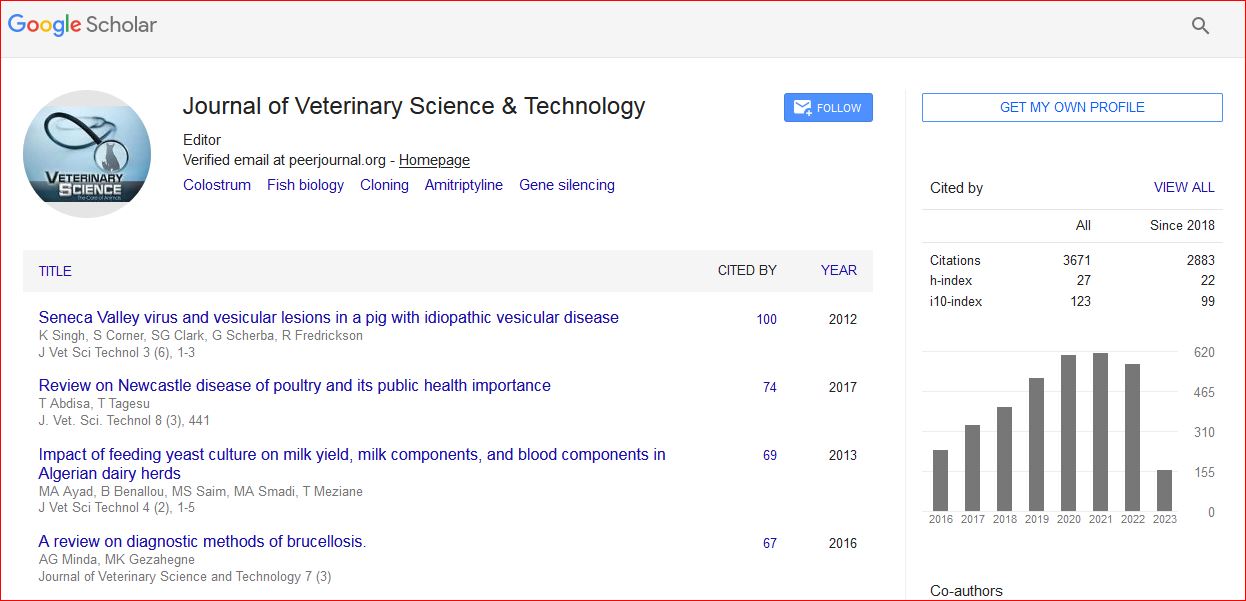
Veterinary Science & Technology received 4472 citations as per Google Scholar report