Brief Report - (2025) Volume 12, Issue 3
Received: 01-May-2025, Manuscript No. jlop-26-179022;
Editor assigned: 05-May-2025, Pre QC No. P-179022;
Reviewed: 19-May-2025, QC No. Q-179022;
Revised: 22-May-2025, Manuscript No. R-179022;
Published:
29-May-2025
, DOI: 10.37421/2469-410X. 2025.12.199
Citation: Müller, Anna. ”Advancing Laser Spectroscopy For Chemical and Biological Analysis.” J Laser Opt Photonics 12 (2025):199.
Copyright: © 2025 Müller A. This is an open-access article distributed under the terms of the Creative Commons Attribution License, which permits unrestricted use, distribution and reproduction in any medium, provided the original author and source are credited.
Laser-based spectroscopy has emerged as a transformative technology for the detailed analysis of chemical and biological samples, offering unparalleled sensitivity and specificity. Advanced laser techniques such as Raman, infrared, and fluorescence spectroscopy provide non-destructive methods for substance identification and quantification [1].
The continuous innovation in this field is driving the development of real-time monitoring capabilities, miniaturization of devices, and their integration into portable systems, thereby enabling on-site analysis across diverse domains including environmental monitoring and medical diagnostics [1].
The miniaturization of spectroscopic systems is paramount for the creation of field-deployable analytical tools. This pursuit has led to the exploration of compact, laser-driven Raman spectrometers designed for on-site elemental analysis. These devices are demonstrating detection limits comparable to traditional benchtop systems, making them ideal for rapid, in-situ chemical identification in applications like hazardous material detection and food safety testing [2].
In the realm of biological analysis, the ability to probe molecular vibrations without the need for labeling represents a significant advancement. Techniques such as coherent anti-Stokes Raman scattering (CARS) microscopy are at the forefront of this development, enabling label-free imaging of live cells and tissues with high spatial resolution and chemical specificity [3].
This capability is invaluable for understanding intricate cellular processes and for disease diagnosis. Surface-enhanced Raman spectroscopy (SERS) stands out as a particularly powerful technique for achieving extremely low detection limits. Recent studies focus on novel plasmonic nanostructures engineered to amplify SERS signals for the detection of trace contaminants in water. These advancements promise significantly improved sensitivity and reproducibility for environmental monitoring and food safety screening with exceptional accuracy [4].
Pulsed laser spectroscopy offers distinct advantages when analyzing fast chemical reactions and transient species. Time-resolved spectroscopy, particularly utilizing ultrafast laser systems, provides critical insights into reaction dynamics, photochemistry, and molecular energy transfer processes. These insights are fundamental for advancing scientific understanding and for the design of novel chemical processes [5].
The convergence of laser spectroscopy and artificial intelligence is rapidly expanding the analytical landscape. Hyperspectral imaging, when combined with machine learning algorithms, facilitates automated classification of chemical and biological samples. This synergy enhances the speed and accuracy of identification, leading to more efficient and robust analytical workflows [6].
Laser-induced fluorescence (LIF) is undergoing significant adaptation for point-of-care diagnostics. The development of portable LIF systems for detecting biomarkers in bodily fluids leverages the technique's inherent high sensitivity and specificity. This holds immense potential for rapid, non-invasive disease screening, which could revolutionize early diagnosis and patient management strategies [7].
The application of mid-infrared (MIR) laser spectroscopy is crucial for the identification of molecular functional groups. Quantum cascade laser (QCL)-based MIR spectrometers are being developed for the detection of volatile organic compounds (VOCs) in breath. The high sensitivity and selectivity of QCL-MIR spectroscopy present a promising non-invasive approach for both medical diagnostics and environmental monitoring [8].
Fiber-optic probes have fundamentally changed the way spectroscopic measurements are conducted, enabling remote and in-situ analysis. Laser-based fiber optic probes are particularly effective for chemical sensing in challenging environments. Their utility in industrial process monitoring and in harsh chemical settings highlights the benefits of remote access and system miniaturization [9].
Tunable diode laser absorption spectroscopy (TDLAS) is a highly valued tool for gas analysis due to its precision and versatility. Advanced TDLAS systems are being developed for trace gas detection in environmental and industrial applications, offering high selectivity, sensitivity, and real-time capabilities suitable for monitoring greenhouse gases, pollutants, and process gases [10].
Laser-based spectroscopy offers a versatile toolkit for the comprehensive analysis of chemical and biological substances, characterized by its non-destructive nature and high sensitivity. Techniques like Raman, infrared, and fluorescence spectroscopy are central to these advancements, facilitating precise identification and quantification of target analytes [1].
The ongoing evolution of laser technologies enables real-time analysis and the creation of compact, portable devices, extending the reach of analytical capabilities to remote and challenging environments for applications ranging from environmental surveillance to clinical diagnostics [1].
Significant efforts are directed towards the miniaturization of spectroscopic instrumentation to facilitate field deployment. This has led to the development of compact laser-driven Raman spectrometers capable of performing on-site elemental analysis. These portable systems are achieving performance levels comparable to established laboratory instruments, making them suitable for rapid, in-situ chemical identification, particularly in critical areas such as detecting hazardous materials and ensuring food safety [2].
The capability to perform label-free molecular vibrational analysis is a key advantage in biological applications. Coherent anti-Stokes Raman scattering (CARS) microscopy exemplifies this, providing high-resolution, label-free imaging of biological samples such as live cells and tissues. This technique's chemical specificity is crucial for elucidating cellular functions and aiding in the diagnosis of various diseases [3].
Surface-enhanced Raman spectroscopy (SERS) provides an exceptional pathway for achieving ultra-trace level detection. Research into novel plasmonic nanostructures is enhancing SERS sensitivity and reproducibility, specifically for the identification of trace contaminants in water samples. This advancement holds considerable potential for high-accuracy environmental monitoring and rigorous food safety assessments [4].
Pulsed laser spectroscopy is instrumental in studying the dynamics of rapid chemical processes and short-lived molecular species. Time-resolved spectroscopy, employing ultrafast laser systems, offers profound insights into reaction mechanisms, photochemistry, and energy transfer within molecules. This fundamental understanding is vital for both basic scientific research and the engineering of new chemical transformations [5].
The integration of artificial intelligence with laser spectroscopy is a rapidly advancing frontier. Hyperspectral imaging, when coupled with machine learning algorithms, enables automated classification of chemical and biological samples. This synergistic approach significantly boosts the efficiency and accuracy of analytical processes, leading to more robust and reliable detection workflows [6].
Laser-induced fluorescence (LIF) is being adapted for point-of-care diagnostic applications, particularly for the detection of biomarkers in biological fluids. The development of portable LIF devices capitalizes on the technique's inherent high sensitivity and specificity. This offers a promising route towards rapid, non-invasive disease screening, potentially transforming early diagnosis and patient care paradigms [7].
Mid-infrared (MIR) laser spectroscopy is essential for identifying specific molecular functional groups. The utilization of quantum cascade lasers (QCLs) in MIR spectrometers allows for sensitive detection of volatile organic compounds (VOCs) in breath samples. This QCL-MIR approach offers a highly sensitive and selective, non-invasive method for medical diagnostics and environmental surveillance [8].
The use of fiber-optic probes has revolutionized spectroscopic measurements by enabling remote sensing and in-situ analysis. Laser-based fiber optic probes are designed for chemical sensing in demanding environments, proving useful in industrial process monitoring and in corrosive or hazardous settings. These probes offer advantages in terms of remote access and device miniaturization [9].
Tunable diode laser absorption spectroscopy (TDLAS) is a precise and adaptable method for gas analysis. Sophisticated TDLAS systems are being developed for the detection of trace gases in diverse environmental and industrial contexts. The technique's high selectivity, sensitivity, and real-time monitoring capabilities make it well-suited for applications such as greenhouse gas monitoring and the detection of industrial pollutants [10].
Laser-based spectroscopy, encompassing techniques like Raman, infrared, and fluorescence, offers sensitive and specific methods for analyzing chemical and biological samples. Innovations are driving miniaturization, portability, and real-time monitoring for applications in environmental science and medicine. Raman spectroscopy, particularly miniaturized and SERS variants, enables on-site analysis and ultra-trace detection. CARS microscopy facilitates label-free biological imaging, while pulsed laser spectroscopy probes fast chemical dynamics. The integration of AI with hyperspectral imaging enhances sample classification. LIF is being developed for point-of-care diagnostics, and QCL-MIR spectroscopy aids in breath analysis. Fiber-optic probes allow for remote sensing, and TDLAS provides precise gas analysis. These advancements collectively push the boundaries of analytical chemistry and its practical applications.
None
None
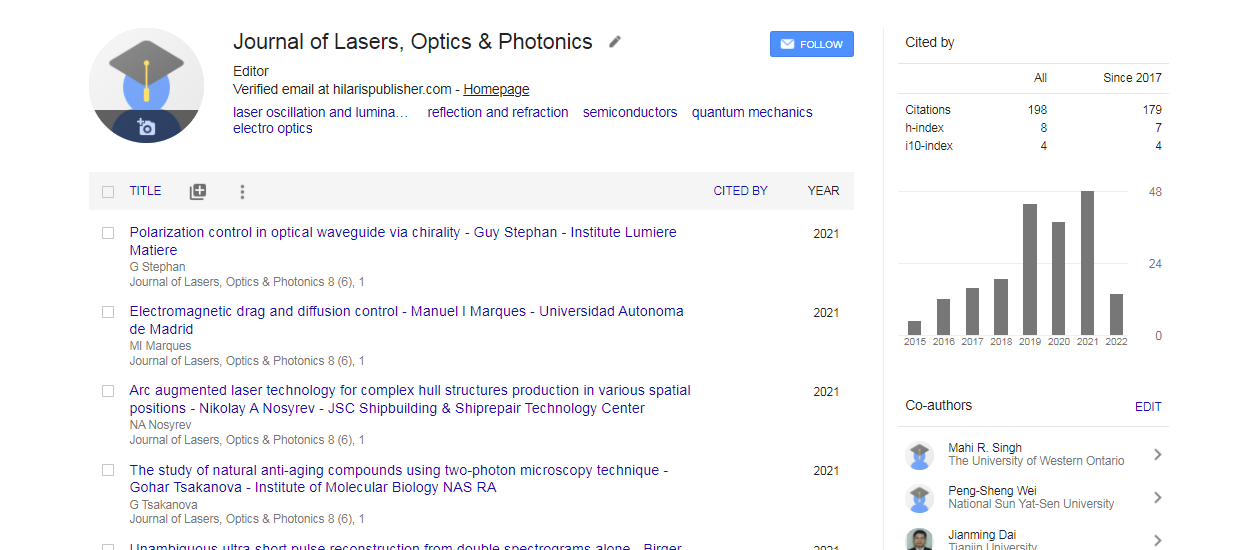
Journal of Lasers, Optics & Photonics received 279 citations as per Google Scholar report