Commentary - (2025) Volume 14, Issue 3
Received: 01-Jun-2025, Manuscript No. idse-26-182807;
Editor assigned: 03-Jun-2025, Pre QC No. P-182807;
Reviewed: 17-Jun-2025, QC No. Q-182807;
Revised: 23-Jun-2025, Manuscript No. R-182807;
Published:
30-Jun-2025
, DOI: 10.37421/2168-9768.2025.14.490
Citation: Torres, Miguel Angel. "Advancing Irrigation For Sustainable
Water Use." Irrigat Drainage Sys Eng 14 (2025):490.
Copyright: © 2025 Torres A. Miguel This is an open-access article distributed under the terms of the Creative Commons Attribution License, which permits unrestricted use,
distribution and reproduction in any medium, provided the original author and source are credited.
The field of irrigation engineering is undergoing a significant transformation, driven by the imperative to enhance water use efficiency and exert greater control over agricultural water application. Recent advancements in smart irrigation technologies, encompassing sensor-based systems, sophisticated data analytics, and comprehensive automation, are at the forefront of this revolution. These innovations are pivotal in optimizing water application, minimizing wasteful practices, and ultimately boosting crop yields, thereby contributing to more sustainable agricultural systems [1].
The semi-arid regions, particularly vulnerable to water scarcity, are intensely researching and implementing strategies to maximize water productivity. Studies have investigated the direct impact of various irrigation scheduling approaches on the amount of crop produced per unit of water consumed. Precision in timing and volume of irrigation has been shown to be a critical factor in achieving higher output with less water, emphasizing the need to deeply understand crop requirements and environmental nuances [2].
The integration of geospatial technologies, such as remote sensing and Geographic Information Systems (GIS), is revolutionizing precision irrigation management. By leveraging satellite imagery and drone-derived data, it is now possible to precisely monitor crop health, soil moisture levels, and indicators of water stress. This capability allows for highly targeted irrigation interventions, ensuring water is delivered precisely where and when it is needed, leading to significant water savings and improved crop performance [3].
In arid and semi-arid environments, where water conservation is paramount, deficit irrigation strategies are gaining traction. Research has demonstrated that controlled water stress, applied strategically at specific crop growth stages, can paradoxically enhance water productivity without substantial yield penalties. This approach offers a viable method for managing limited water resources effectively in water-scarce agricultural settings [4].
Beyond field-level applications, optimizing irrigation water management at a broader scale, such as agricultural watersheds, is crucial for sustainable water resource allocation. Simulation models are being developed to assess the hydrological impacts of different irrigation scenarios, providing a framework for informed decision-making that improves water use efficiency across entire watersheds [5].
The application of advanced computational techniques, particularly Artificial Intelligence (AI) and Machine Learning (ML), is opening new frontiers in irrigation control. These algorithms can predict crop water needs with remarkable accuracy, identify irrigation system malfunctions, and dynamically optimize water delivery by processing complex environmental data, promising substantial gains in irrigation efficiency and responsiveness [6].
The performance of automated irrigation systems is intrinsically linked to the accuracy of the data guiding their operation. Research highlights the significant impact of soil moisture sensors, which provide real-time, in-situ data that is far more reliable for irrigation decisions than traditional time-based schedules. This leads to reduced water consumption and healthier crops through precise water application [7].
A critical aspect of water-saving in agriculture involves the comparative assessment of various irrigation technologies. Drip irrigation, micro-sprinklers, and subsurface irrigation systems each offer distinct water-saving potentials, with their suitability depending on factors such as crop type, soil characteristics, and economic considerations. A thorough understanding of these technologies is vital for selecting the most efficient methods [8].
The strategic integration of weather data into irrigation scheduling represents another leap forward in water management. By forecasting weather patterns, including anticipated rainfall and evapotranspiration rates, irrigation decisions can be optimized to prevent over-watering and ensure crops receive precisely the amount of water they need, thereby enhancing water use efficiency and reducing operational costs [9].
Finally, the physical distribution of water across the field is a fundamental determinant of irrigation efficiency. Studies focusing on irrigation uniformity in closed-loop systems emphasize that ensuring consistent water delivery to all plants is paramount for maximizing water use efficiency and minimizing losses due to uneven distribution or excessive deep percolation [10].
Advanced irrigation engineering is increasingly focused on harnessing smart technologies to elevate water use efficiency and enhance control over water application in agriculture. This involves the integration of sensor networks, robust data analytics platforms, and automated systems that allow for dynamic adjustments in irrigation based on real-time data. Such innovations are crucial for optimizing water delivery, reducing losses, and improving crop yields, underpinning the move towards more sustainable farming practices [1].
In regions facing water scarcity, such as semi-arid areas, the efficacy of different irrigation scheduling strategies is a primary research concern. The core principle involves maximizing water productivity, which is defined as the amount of crop output generated per unit of water consumed. Precisely timed irrigation events, coupled with the delivery of appropriate water volumes, are consistently shown to be key drivers of this efficiency, underscoring the importance of accurate crop water requirement data and environmental monitoring [2].
The application of remote sensing and GIS technologies is transforming precision irrigation management by providing unprecedented insights into field conditions. Through the analysis of satellite and drone imagery, irrigators can gain detailed information on crop health, soil moisture variability, and the presence of water stress. This allows for the precise application of water only to areas that require it, at the optimal time, leading to substantial water savings and improved crop performance [3].
Deficit irrigation strategies are being recognized as a valuable tool for water conservation, particularly in arid and semi-arid agricultural systems. This approach involves intentionally applying less water than the crop's full evapotranspirational demand at specific, non-critical growth stages. Research indicates that this controlled water stress can improve water productivity by stimulating root growth and enhancing water uptake efficiency without significantly impacting overall yield [4].
Optimizing irrigation at the watershed level requires sophisticated modeling approaches that consider the complex hydrological dynamics at play. Simulation models are employed to analyze the impacts of various irrigation management scenarios on water availability and demand within a watershed. This provides a crucial framework for sustainable water resource allocation and enhances overall water use efficiency across a larger geographical area [5].
The integration of Artificial Intelligence (AI) and Machine Learning (ML) into irrigation control systems is a rapidly advancing area with immense potential. AI/ML algorithms can analyze vast amounts of data to predict crop water needs, detect anomalies in irrigation system performance, and optimize water distribution based on intricate environmental variables. This level of intelligent control promises significant improvements in both efficiency and responsiveness of irrigation operations [6].
The reliability of automated irrigation systems hinges on the accuracy of the data used to inform their operations. Soil moisture sensors are proving to be indispensable for this purpose, offering real-time, in-situ measurements that provide a far more precise basis for irrigation decisions compared to traditional time-based schedules. This leads to a direct reduction in water consumption and better crop health outcomes [7].
A comprehensive understanding of the water-saving potential of different irrigation technologies is essential for effective water management. Comparative analyses of systems such as drip irrigation, micro-sprinklers, and subsurface irrigation reveal varying degrees of water savings, influenced by factors like crop type, soil texture, and the economic viability of implementation. This information is critical for guiding the selection of appropriate technologies [8].
The proactive integration of weather forecasting into irrigation scheduling offers a significant advantage in optimizing water use. By anticipating future weather conditions, such as rainfall events and changes in temperature and humidity, irrigation can be adjusted to prevent over-watering and ensure that crops receive adequate moisture. This predictive capability enhances water use efficiency and can also lead to energy savings associated with irrigation pumping [9].
Ensuring uniformity in water distribution across the entire irrigated area is a fundamental principle for maximizing water use efficiency. Research into closed-loop irrigation systems highlights the critical importance of achieving high irrigation uniformity. When water is distributed evenly, all plants receive the intended amount, minimizing water wastage through uneven wetting patterns or excessive deep percolation below the root zone [10].
This collection of research highlights advancements in irrigation engineering aimed at enhancing water use efficiency and control. Key areas include smart irrigation technologies like sensors and automation, which optimize water application by responding to real-time crop and environmental needs. Precision irrigation management is being revolutionized by remote sensing and GIS, enabling targeted water delivery. Deficit irrigation strategies show promise for water conservation in arid regions by strategically applying controlled water stress. Simulation models are being developed for watershed-level water management, and AI/ML are being integrated into control systems for predictive capabilities. The accuracy of soil moisture sensors is crucial for automated systems, while comparative analyses of irrigation technologies like drip and micro-sprinklers inform selection for water savings. Integrating weather data into scheduling improves planning, and ensuring irrigation uniformity is vital for minimizing water wastage. These collective efforts underscore a commitment to sustainable agricultural water management.
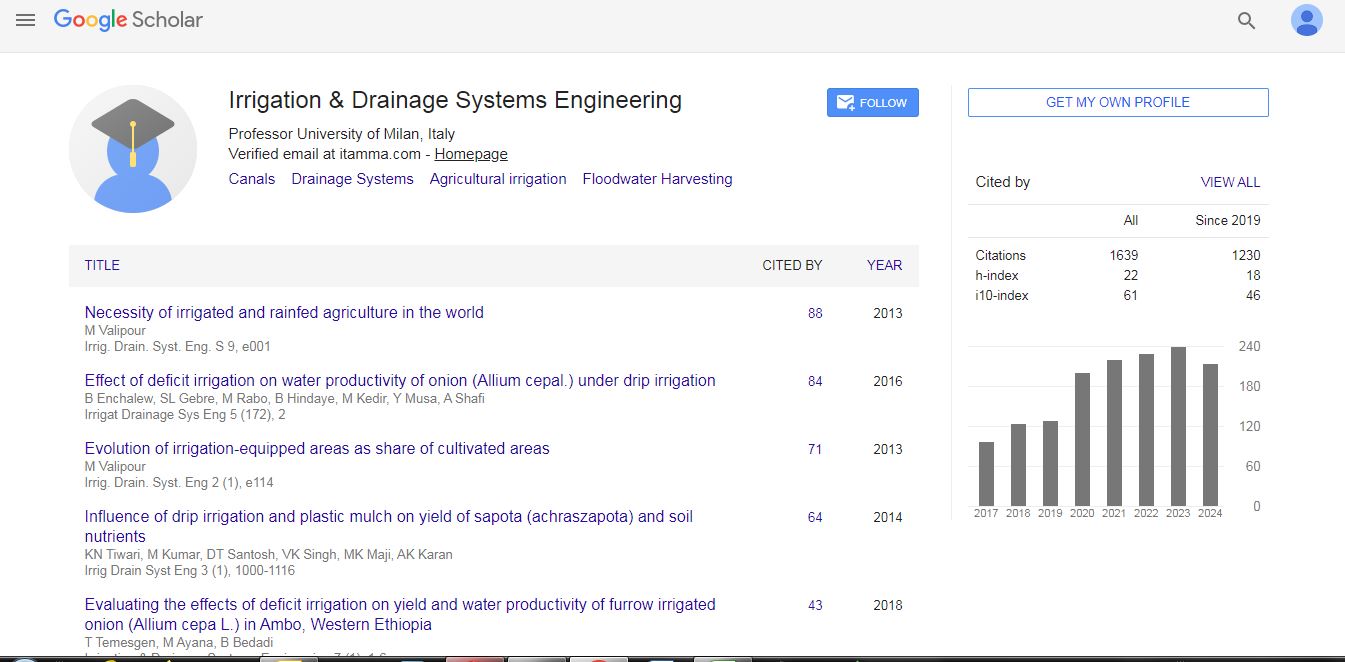
Irrigation & Drainage Systems Engineering received 835 citations as per Google Scholar report