Perspective - (2025) Volume 14, Issue 4
Received: 01-Jul-2025, Manuscript No. iem-26-179816;
Editor assigned: 03-Jul-2025, Pre QC No. P-179816;
Reviewed: 14-Jul-2025, QC No. Q-179816;
Revised: 22-Jul-2025, Manuscript No. R-179816;
Published:
29-Jul-2025
, DOI: 10.37421/2169- 0316.2025.14.311
Citation: Julia. âAdvancing Industrial Engineering: Efficiency, Quality, and Innovation.â J Ind Eng Manag 14 (2025):311.
Copyright: © 2025 Müller J. This is an open-access article distributed under the terms of the Creative Commons Attribution License, which permits unrestricted use, distribution and reproduction in any medium, provided the original author and source are credited.
Industrial engineering plays a pivotal role in optimizing operational efficiency and product quality across various sectors. This field continuously evolves, driven by advancements in technology and methodology. The strategic adoption of sophisticated process improvement techniques is paramount for organizations seeking to maintain a competitive edge in today's dynamic manufacturing landscape. These techniques enable a systematic approach to identifying and rectifying inefficiencies, thereby fostering a culture of continuous improvement. The integration of Lean Six Sigma, Agile methodologies, and Design Thinking, supported by data-driven insights and feedback loops, empowers engineering teams to overcome complex challenges and achieve superior outcomes. By leveraging these frameworks, industrial engineers can effectively pinpoint bottlenecks, minimize waste, and optimize the allocation of resources in intricate production settings [1].
The advent of Industry 4.0 has ushered in a new era of industrial transformation, presenting unprecedented opportunities for industrial engineers. Technologies such as the Internet of Things (IoT) and artificial intelligence (AI) are central to this revolution, facilitating real-time data acquisition and intelligent decision-making. These advancements allow for enhanced process control, predictive maintenance, and automated operations, leading to significant gains in efficiency and productivity. A well-defined, phased implementation strategy and the development of a skilled workforce are crucial for harnessing the full potential of these transformative technologies [2].
Simulation modeling and the deployment of digital twins have emerged as indispensable tools for refining industrial processes. These virtual representations of physical systems allow engineers to rigorously test diverse operational scenarios, identify potential pitfalls, and fine-tune system performance without impacting live production. This approach significantly mitigates risks, accelerates design and development cycles, and deepens the understanding of complex system dynamics, offering a powerful means of optimization [3].
Furthermore, the integration of human-centered design principles into industrial engineering processes is gaining prominence. By prioritizing the user experience and considering cognitive ergonomics, organizations can achieve substantial improvements in worker safety, reduce operational errors, and enhance overall productivity. Incorporating user feedback and adopting participatory design methods early in the process development lifecycle is essential for creating more effective and humane industrial systems [4].
Predictive maintenance, powered by advanced analytics and machine learning, is revolutionizing how industrial equipment is managed. Analyzing historical operational data allows for the accurate forecasting of potential equipment failures, enabling proactive maintenance scheduling. This proactive approach minimizes unplanned downtime, leading to substantial cost savings and improved operational continuity. Data-driven strategies are fundamental to achieving these benefits [5].
The concept of the 'smart factory' represents a holistic vision for the future of manufacturing, underpinned by key technological pillars. The integration of IoT, cloud computing, and robust cybersecurity measures forms the foundation of these intelligent production environments. Industrial engineers are central to orchestrating these technologies, fostering greater flexibility, agility, and efficiency within manufacturing operations through comprehensive integration strategies [6].
Advanced statistical process control (SPC) techniques are vital for maintaining and enhancing product quality, particularly in high-volume manufacturing settings. Moving beyond traditional methods, more sophisticated approaches like CUSUM and EWMA charts are proving effective in detecting subtle yet critical shifts in production processes. The practical implementation of these advanced SPC methods, supported by real-world industrial examples, demonstrates their significant contribution to quality assurance [7].
The strategic application of Artificial Intelligence (AI) and Machine Learning (ML) offers substantial advantages for optimizing supply chain operations. These technologies enhance critical functions such as demand forecasting, inventory management, logistics planning, and risk assessment, contributing to more resilient and efficient supply chains. A clear roadmap for integrating AI and ML is essential for realizing these benefits [8].
Sophisticated scheduling and optimization algorithms are instrumental in enhancing manufacturing efficiency. By employing advanced techniques to optimize resource allocation, machine utilization, and order sequencing, organizations can achieve higher production throughput, reduced lead times, and minimized operational costs. Case studies consistently demonstrate the significant gains in operational performance derived from these methods [9].
Additive manufacturing, commonly known as 3D printing, serves as a powerful catalyst for process innovation and product customization. This technology facilitates rapid prototyping, enables on-demand production, and allows for the creation of intricate geometries that were previously unattainable. Consequently, it leads to enhanced product performance and considerably shorter manufacturing lead times [10].
The field of industrial engineering is undergoing a profound transformation, driven by the adoption of advanced methodologies aimed at enhancing production efficiency and quality. Methodologies such as Lean Six Sigma, Agile, and Design Thinking are being strategically implemented, with a strong emphasis on data-driven decision-making and continuous feedback loops. These approaches empower engineering teams to effectively identify operational bottlenecks, reduce waste, and optimize resource allocation within complex manufacturing environments. The integration of these advanced techniques is crucial for sustained improvement and competitive advantage [1].
The rise of Industry 4.0 technologies, including the Internet of Things (IoT) and artificial intelligence (AI), presents a significant paradigm shift for industrial engineers. These technologies enable real-time monitoring of production processes, facilitate predictive maintenance strategies, and drive intelligent automation. The collective impact of IoT and AI leads to substantial improvements in process control and overall operational efficiency. Successful adoption necessitates a carefully planned, phased approach and the cultivation of a workforce equipped with the requisite skills to manage these advanced systems [2].
Simulation modeling and the utilization of digital twins have become indispensable tools for industrial process improvement. By creating virtual replicas of physical systems, engineers can meticulously explore various operational scenarios, identify potential issues before they arise, and optimize system performance without disrupting ongoing production. The benefits of this approach are manifold, including reduced risk, accelerated design cycles, and a deeper comprehension of intricate system dynamics, all contributing to enhanced optimization [3].
Integrating human-centered design principles into industrial engineering processes is increasingly recognized as vital for operational success. A focus on the end-user experience and cognitive ergonomics can lead to significant improvements in worker safety, a reduction in operational errors, and a boost in overall productivity. The proactive incorporation of user feedback and participatory design methods during the early stages of process development is key to achieving these positive outcomes [4].
Predictive maintenance strategies, powered by advanced analytics and machine learning, are transforming the maintenance of industrial equipment. By analyzing historical operational data, organizations can accurately forecast potential equipment failures, thereby enabling proactive maintenance scheduling. This approach is highly effective in minimizing unplanned downtime and generating considerable cost savings and operational benefits through data-driven insights [5].
The concept of the 'smart factory' encapsulates a holistic approach to industrial process transformation, supported by foundational technologies such as IoT, cloud computing, and cybersecurity. Industrial engineers are instrumental in orchestrating these technologies to achieve unprecedented levels of flexibility, agility, and efficiency in manufacturing operations. A cohesive and integrated strategy is essential for the successful realization of the smart factory vision [6].
Advanced statistical process control (SPC) techniques are critical for assuring and enhancing product quality, especially within high-volume manufacturing. Beyond traditional charting methods, advanced techniques like CUSUM and EWMA charts are highly effective in detecting minor but significant process variations. The practical application and proven benefits of these methods, illustrated through industrial examples, underscore their importance in quality management [7].
The deployment of Artificial Intelligence (AI) and Machine Learning (ML) is strategically optimizing supply chain operations across various industries. These technologies enhance fundamental aspects such as demand forecasting, inventory management, logistics, and risk assessment, ultimately fostering more resilient and efficient supply chains. A well-defined roadmap for integrating AI and ML is crucial for leveraging these advancements effectively [8].
Advanced scheduling and optimization algorithms play a crucial role in improving manufacturing efficiency. By utilizing sophisticated techniques to optimize resource allocation, machine utilization, and order sequencing, companies can achieve enhanced production throughput, reduced lead times, and minimized operational costs. Empirical evidence from case studies consistently highlights substantial improvements in operational performance resulting from these algorithms [9].
Additive manufacturing, or 3D printing, offers a novel approach to process innovation and product customization in industrial applications. This technology enables rapid prototyping, supports on-demand production, and facilitates the creation of complex geometries that were previously unfeasible. The adoption of additive manufacturing leads to improved product performance and significantly reduced manufacturing lead times [10].
This collection of research highlights key advancements in industrial engineering focused on enhancing production efficiency and quality. It covers process improvement techniques like Lean Six Sigma and Agile, alongside the transformative impact of Industry 4.0 technologies such as IoT and AI. Simulation modeling and digital twins are presented as powerful tools for process optimization, while human-centered design principles aim to improve worker experience and productivity. Predictive maintenance leveraging machine learning and advanced analytics is crucial for minimizing downtime. The concept of the smart factory, advanced statistical process control, AI/ML in supply chains, and additive manufacturing are also discussed as vital elements for modern industrial operations. These advancements collectively drive towards more efficient, resilient, and innovative manufacturing.
None
None
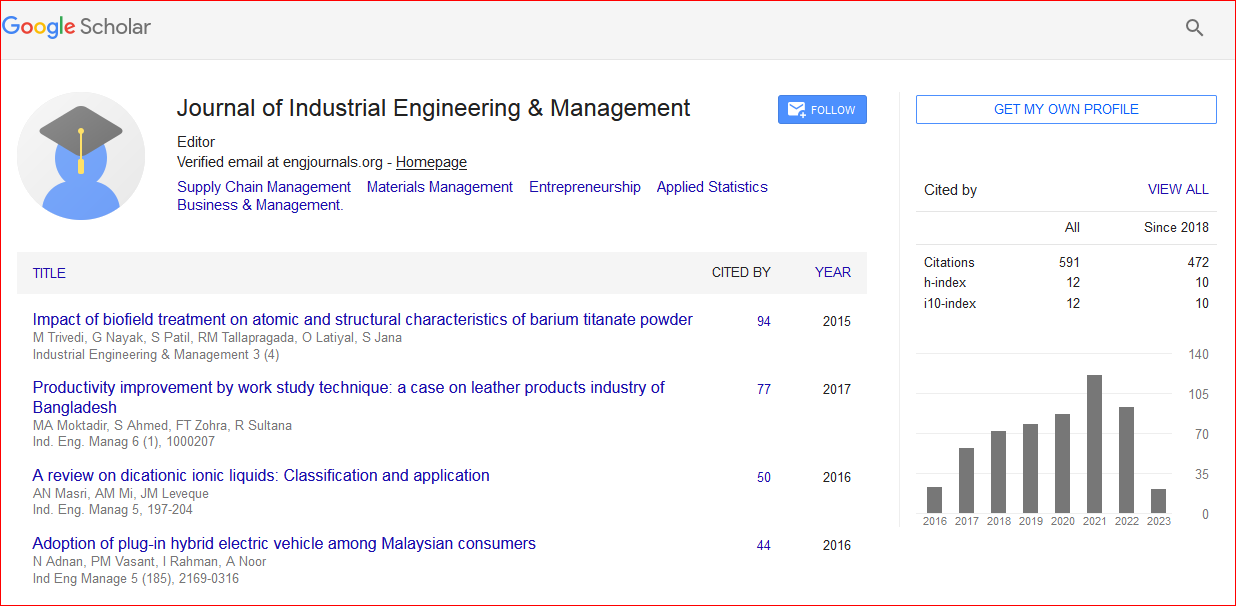
Industrial Engineering & Management received 739 citations as per Google Scholar report