Commentary - (2025) Volume 12, Issue 2
Received: 01-Apr-2025, Manuscript No. jreac-26-185797;
Editor assigned: 03-Apr-2025, Pre QC No. P-185797;
Reviewed: 17-Apr-2025, QC No. Q-185797;
Revised: 22-Apr-2025, Manuscript No. R-185797;
Published:
29-Apr-2025
, DOI: 10.37421/2380-2391.2025.12.421
Citation: Tanaka, Hiroshi. ”Advancing Environmental Pollutant Analysis: Sensors, Techniques, AI.” J Environ Anal Chem 12 (2025):421.
Copyright: © 2025 Tanaka H. This is an open-access article distributed under the terms of the Creative Commons Attribution License, which permits unrestricted use, distribution and reproduction in any medium, provided the original author and source are credited
The intricate landscape of environmental monitoring is continuously evolving, driven by the urgent need to detect and quantify an ever-increasing array of pollutants. Nanotechnology has emerged as a powerful ally in this endeavor, offering novel materials with exceptional properties for enhanced analytical performance. The application of nanomaterials in sensor design significantly boosts sensitivity and selectivity for trace contaminant detection, a crucial advancement in environmental science [1].
Furthermore, the challenges posed by emerging contaminants, such as per- and polyfluoroalkyl substances (PFAS) and microplastics, necessitate sophisticated analytical strategies. Developing robust sample preparation methods and highly sensitive detection techniques, like liquid chromatography coupled with high-resolution mass spectrometry (LC-HRMS), is paramount to achieving the required low detection limits for these pervasive substances [2].
Beyond laboratory-based analysis, the demand for rapid, on-site environmental monitoring is growing. Portable and field-deployable analytical instruments, including electrochemical sensors and compact mass spectrometers, are being developed for real-time assessment of air quality. These technologies offer immediate data availability, which is invaluable for emergency response and distributed surveillance of pollutants like volatile organic compounds (VOCs) and particulate matter [3].
The sheer volume and complexity of environmental analytical data present significant interpretational hurdles. Artificial intelligence (AI) and machine learning (ML) are proving instrumental in this domain, enabling predictive modeling of pollutant behavior, source apportionment, and the identification of potential health risks, thereby streamlining the analysis of intricate datasets [4].
Water quality monitoring, a cornerstone of public health and ecosystem preservation, benefits immensely from advancements in electrochemical sensing. Modified electrodes incorporating nanomaterials, such as graphene and metal oxides, are enhancing the sensitivity and selectivity of devices designed for detecting heavy metal ions, addressing a critical need in water analysis [5].
Organic pollutants, including pesticides and dyes, represent another significant class of environmental contaminants requiring precise detection. Surface-enhanced Raman spectroscopy (SERS), particularly when combined with nanostructured substrates, provides a highly sensitive and specific method for identifying these compounds, with potential applications in portable systems for rapid, on-site analysis [6].
The miniaturization and automation of analytical systems are key trends in environmental monitoring, with microfluidic devices leading the way. These platforms offer advantages in sample handling, reduced reagent consumption, and the integration of multiple analytical steps, enabling rapid screening and multiplexed detection of pollutants in various matrices [7].
Characterizing the increasingly prevalent issue of plastic pollution, especially microplastics and nanoplastics, demands specialized analytical techniques. Methods like pyrolysis-GC/MS and FTIR microscopy are vital for identifying and quantifying these particles, while understanding their surface properties and degradation products is crucial for assessing their environmental impact [8].
Biosensors represent another promising avenue for environmental monitoring, leveraging biological recognition elements to achieve highly sensitive and selective detection of specific pollutants. The integration of enzymes, antibodies, or aptamers with transducer systems offers versatile platforms for environmental analysis, with potential for continuous monitoring applications [9].
Finally, the pursuit of comprehensive trace organic pollutant analysis in complex environmental samples has driven the development of advanced hyphenated techniques. Methods like GCÃ?GC-TOFMS and LC-IM-HRMS offer unparalleled separation and identification capabilities, proving essential for environmental forensics and the elucidation of unknown contaminants [10].
Nanotechnology is revolutionizing environmental pollutant analysis by enabling the creation of highly sensitive and selective sensors. The unique properties of nanomaterials, such as their high surface area, enhance the ability of sensors to detect even trace amounts of contaminants. This advancement is critical for accurate environmental assessments and the development of effective remediation strategies [1].
The environmental matrices in which pollutants are found are often complex, posing significant analytical challenges. Emerging contaminants like PFAS and microplastics, due to their persistence and widespread distribution, require specialized analytical approaches. The development and validation of advanced techniques, including LC-HRMS, are essential for achieving the ultra-low detection limits necessary for their reliable monitoring [2].
In addition to sophisticated laboratory analysis, there is a growing need for immediate, on-site environmental data. Portable analytical instruments, such as electrochemical sensors and compact mass spectrometers, are being designed to provide real-time information on air quality. This capability is invaluable for rapid response to pollution events and for continuous environmental surveillance [3].
The interpretation of large and complex environmental datasets is a significant bottleneck. AI and ML algorithms are being employed to analyze this data, enabling predictive modeling of pollutant fate and transport, identifying pollution sources, and assessing potential health risks. This facilitates a more comprehensive understanding of environmental pollution dynamics [4].
Electrochemical sensing platforms are undergoing significant advancements, particularly in the detection of heavy metal ions in water. The use of nanomaterial-modified electrodes is improving the sensitivity and selectivity of these sensors, making them more effective for routine water quality monitoring and contributing to safeguarding aquatic ecosystems [5].
Surface-enhanced Raman spectroscopy (SERS) has emerged as a powerful technique for the detection of organic pollutants. Coupled with nanostructured substrates, SERS offers high sensitivity and specificity, enabling the identification of a wide range of organic contaminants. Its potential for use in portable systems further enhances its utility for on-site analysis [6].
Microfluidic devices are transforming environmental analysis by enabling miniaturized, automated, and integrated systems. Their advantages include reduced sample and reagent volumes, and the capacity for multiplexed analysis, making them suitable for rapid screening and on-site monitoring of pollutants in both water and air [7].
The characterization of plastic pollution, particularly microplastics and nanoplastics, requires sophisticated analytical tools. Techniques like pyrolysis-GC/MS and various spectroscopic methods are crucial for identifying and quantifying these particles. Understanding their behavior and degradation in the environment is key to mitigating their impact [8].
Biosensors offer a highly specific and sensitive approach to detecting environmental pollutants. By combining biological recognition elements with electrochemical or optical transducers, these devices can be tailored for the detection of specific contaminants. Their potential for continuous monitoring is a significant advantage for environmental management [9].
Hyphenated techniques, which combine multiple analytical methods, are continuously advancing, providing unprecedented capabilities for analyzing complex environmental samples. Techniques like GCÃ?GC-TOFMS and LC-IM-HRMS are vital for separating and identifying intricate mixtures of pollutants, aiding in forensic investigations and the identification of novel contaminants [10].
This collection of research highlights advancements in environmental pollutant analysis, focusing on innovative sensor technologies, sophisticated analytical techniques, and data interpretation methods. Nanomaterial-based sensors and electrochemical platforms are enhancing sensitivity and selectivity for detecting trace contaminants and heavy metals in water. The study of emerging contaminants like PFAS and microplastics relies on advanced techniques such as LC-HRMS and pyrolysis-GC/MS. Portable sensors and microfluidic devices are enabling real-time, on-site monitoring of air and water quality. Furthermore, the integration of AI and machine learning is crucial for interpreting complex environmental data, while hyphenated techniques like GCÃ?GC-TOFMS and LC-IM-HRMS offer powerful capabilities for identifying unknown pollutants. Biosensors also play a role in targeted pollutant detection. Overall, these advancements are crucial for improving environmental monitoring and safeguarding public health.
None
None
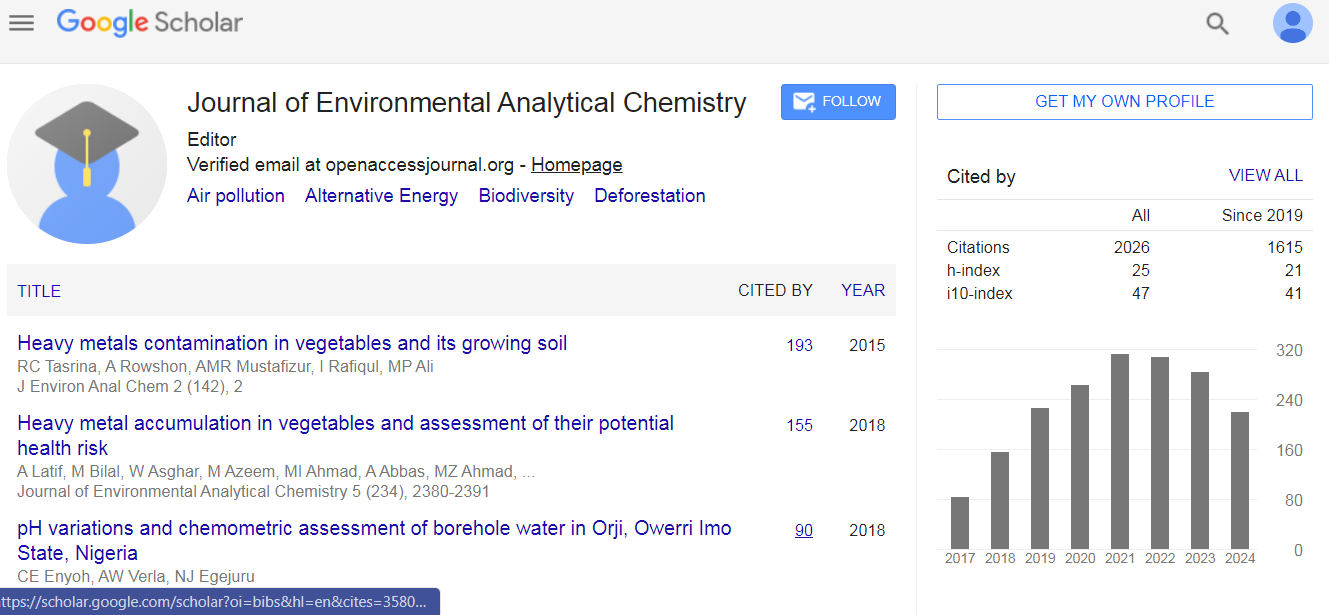
Journal of Environmental Analytical Chemistry received 1781 citations as per Google Scholar report