Brief Report - (2025) Volume 11, Issue 2
Received: 02-May-2025, Manuscript No. jotr-25-175563;
Editor assigned: 05-May-2025, Pre QC No. P-175563;
Reviewed: 19-May-2025, QC No. Q-175563;
Revised: 23-May-2025, Manuscript No. R-175563;
Published:
30-May-2025
, DOI: 10.37421/2476-2261. 2025.11.301
Citation: Mercer, Liana. ”Advancing Cancer Biomarkers: Detection to Therapy.” J Oncol Transl Res 11 (2025):301.
Copyright: © 2025 Mercer L. This is an open-access article distributed under the terms of the Creative Commons Attribution License, which permits unrestricted use, distribution and reproduction in any medium, provided the original author and source are credited.
This research illuminates the dynamic landscape of cancer biomarker discovery and its pivotal role in advancing precision medicine. A primary area of focus involves liquid biopsy, which provides a less invasive approach to understanding cancer. Here's the thing, this method effectively uses circulating tumor DNA, cells, and exosomes to achieve early detection, monitor treatment efficacy, and identify resistance mechanisms [1].
Diving deeper, one significant stride in this field comes from studies on circulating tumor DNA, or ctDNA. This particular research emphasizes ctDNA's remarkable potential for the early detection of solid tumors. It explores various detection methods, highlighting the increasing sensitivity and specificity of these techniques. What this really means is ctDNA offers immense promise for non-invasive early diagnosis and screening, even though challenges persist concerning its low concentration in the early stages of disease and the overall complexity of its analysis [2].
Exosomes also play a fascinating role as biomarkers in cancer. These tiny vesicles are powerhouses, carrying a rich array of molecular information, including proteins, lipids, and nucleic acids, all of which directly reflect the characteristics of the parent cancer cell. This specific article details their potential for both diagnosing cancer and tracking treatment responses. A major advantage of exosomes is their stability within biofluids, though future research needs to focus on improving their isolation and standardization [3].
Moreover, non-coding RNAs are proving to be critical players, especially in colorectal cancer. The authors explain that microRNAs, long non-coding RNAs, and circular RNAs are not just involved in cancer progression; they also hold substantial promise as diagnostic biomarkers and even as targets for therapy. Understanding the dysregulation of these non-coding RNAs is key to developing more precise and less invasive strategies for managing colorectal cancer [4].
The intersection of technology and cancer research is undeniably exciting. Artificial Intelligence and Machine Learning are profoundly revolutionizing cancer biomarker discovery. What's clear is how these technologies are enabling the identification of complex biomarker patterns that traditional analytical methods might often miss. While their potential for faster, more accurate biomarker development is incredible, significant challenges remain, such as ensuring data quality, improving interpretability, and robustly validating their findings to truly harness their power in clinical oncology [5].
On the therapeutic front, identifying predictive biomarkers for cancer immunotherapy has become paramount. With the rise of immunotherapies, knowing which patients will benefit is crucial. This paper discusses established biomarkers like PD-L1 expression and tumor mutational burden, while also exploring newer, emerging markers. The ongoing effort here is to refine patient selection, avoid unnecessary toxicities, and ultimately achieve more personalized treatment strategies [6].
Proteomics also makes a strong case for its power in uncovering cancer biomarkers. Analyzing the entire set of proteins in cells or tissues can reveal intricate changes associated with cancer initiation and progression. What's compelling is the discussion of advanced proteomic techniques, from mass spectrometry to array-based approaches, and how these are driving the discovery of new protein biomarkers that could improve diagnosis, prognosis, and the prediction of treatment outcomes [7].
Complementing these approaches, metabolomics offers unique insights into cancer diagnosis. By studying small-molecule metabolites, researchers can understand the metabolic reprogramming characteristic of cancer cells. The article showcases various metabolic signatures emerging as promising biomarkers for early detection and disease monitoring, providing a valuable addition to genetic and proteomic strategies. However, robust analytical platforms and large-scale validation still present challenges [8].
Nanotechnology is also shaking up biomarker detection in cancer. The key here is the use of nanomaterials to create highly sensitive and specific biosensors, which significantly improve upon traditional methods. These tiny structures can enhance signal amplification and target recognition, making it possible to detect very low concentrations of biomarkers. This capability is critical for early diagnosis, though scaling these complex systems for widespread clinical use remains an engineering hurdle [9].
Finally, circulating tumor cells (CTCs) stand out as critical liquid biopsy biomarkers. What this article makes clear is how CTCs provide invaluable real-time information about tumor progression, metastatic potential, and treatment response. They offer a non-invasive way to track disease evolution. Advancements in CTC isolation and characterization techniques emphasize their potential for personalized cancer management, even as challenges in standardization and clinical validation persist [10].
Cancer biomarker research is rapidly evolving, driven by the need for more effective strategies in early detection, disease monitoring, and personalized therapies. A major frontier in this domain is liquid biopsy, which utilizes non-invasive samples like blood to analyze cancer-derived components. This approach is proving immensely useful for diagnosing cancer, tracking how patients respond to treatment, and even identifying when a tumor becomes resistant to therapies. It leverages various components such as circulating tumor DNA (ctDNA), circulating tumor cells (CTCs), and exosomes, each offering distinct molecular insights into the disease [1].
Let's break it down further. Circulating tumor DNA (ctDNA) represents a significant advancement for the early detection of solid tumors. Research shows substantial progress in detection methods, which are becoming increasingly sensitive and specific. The promise of ctDNA for non-invasive early diagnosis and screening is huge, but it's important to acknowledge the hurdles, particularly the low concentration of ctDNA in early-stage disease and the complexity involved in its analysis [2]. Parallel to this, exosomes are gaining recognition as potent biomarkers. These minuscule vesicles are rich in molecular cargo, including proteins, lipids, and nucleic acids, all of which directly mirror the biological state of the originating cancer cells. Their stability in biofluids makes them particularly attractive for diagnostic and treatment monitoring applications, although standardizing their isolation methods is still a key focus for researchers [3]. Adding to the liquid biopsy arsenal, circulating tumor cells (CTCs) offer real-time, dynamic information about tumor progression, its potential to metastasize, and how it responds to treatment. Improved techniques for isolating and characterizing CTCs underscore their value in guiding personalized cancer management, even as challenges related to standardization and clinical validation continue [10].
Beyond these liquid biopsy components, other molecular entities are also proving critical. Non-coding RNAs, encompassing microRNAs, long non-coding RNAs, and circular RNAs, are deeply involved in cancer progression, with specific emphasis in conditions like colorectal cancer. These non-coding RNAs are not just indicators; they represent promising diagnostic biomarkers and potential therapeutic targets, paving the way for more precise and less invasive management strategies through a deeper understanding of their dysregulation [4]. Similarly, proteomics, which involves the large-scale study of proteins, is powerful in uncovering cancer biomarkers. By analyzing the entire protein landscape of cells and tissues, scientists can identify intricate changes linked to the onset and progression of cancer. Advanced proteomic techniques, such as mass spectrometry and array-based methods, are propelling the discovery of new protein biomarkers that can improve diagnosis, predict patient prognosis, and forecast treatment efficacy [7]. In a complementary fashion, metabolomics provides unique insights into cancer by studying small-molecule metabolites. Cancer cells often exhibit distinct metabolic reprogramming, and these metabolic signatures are emerging as valuable biomarkers for early detection and disease monitoring, complementing genetic and proteomic approaches, despite ongoing challenges in developing robust analytical platforms and large-scale validation [8].
Here's the thing, technological innovations are dramatically accelerating biomarker discovery. The integration of Machine Learning and Artificial Intelligence is revolutionizing how we identify complex biomarker patterns that are often missed by traditional methods. This offers incredible potential for faster and more accurate biomarker development. However, realizing this potential requires addressing significant challenges such as ensuring high data quality, enhancing the interpretability of AI models, and conducting rigorous validation studies [5]. Furthermore, nanotechnology is significantly enhancing cancer biomarker detection. By utilizing nanomaterials, highly sensitive and specific biosensors are being developed. These tiny structures boost signal amplification and target recognition, making it possible to detect extremely low concentrations of biomarkers, which is vital for early diagnosis. Yet, scaling these sophisticated systems for widespread clinical use remains an engineering challenge [9].
Finally, the era of immunotherapy necessitates sophisticated predictive biomarkers. As these groundbreaking treatments become more common, identifying patients who are most likely to benefit is crucial. Established biomarkers like PD-L1 expression and tumor mutational burden are routinely used, and newer, emerging markers are constantly being explored. The core goal is to refine patient selection, thereby avoiding unnecessary toxicities and moving closer to truly personalized treatment strategies in cancer care [6]. The collective effort across these diverse research avenues underscores a robust push towards more precise, early, and effective cancer management.
Cancer biomarker research is rapidly advancing, focusing on non-invasive detection, monitoring, and personalized treatment strategies. Liquid biopsy, a key area, leverages circulating tumor DNA (ctDNA), circulating tumor cells (CTCs), and exosomes for early detection, tracking disease progression, and identifying treatment resistance. Each of these components offers unique insights: ctDNA shows great promise for early solid tumor detection despite challenges with low concentrations in early stages, while exosomes provide stable molecular information reflecting parent cancer cells for diagnosis and monitoring. Similarly, CTCs offer real-time data on tumor progression and metastatic potential. Beyond liquid biopsy, other molecular biomarkers like non-coding RNAs (microRNAs, long non-coding RNAs, and circular RNAs) are proving crucial in understanding cancer progression and serving as diagnostic tools, especially in cancers like colorectal cancer. Proteomics and metabolomics are also uncovering intricate changes in proteins and small-molecule metabolites, offering complementary approaches for diagnosis, prognosis, and predicting treatment outcomes. The field is being revolutionized by advanced technologies. Machine Learning and Artificial Intelligence are accelerating the discovery of complex biomarker patterns, though data quality and validation remain critical. Nanotechnology is enhancing biomarker detection sensitivity through nanomaterial-based biosensors, allowing for the detection of extremely low concentrations. Finally, predictive biomarkers are essential for optimizing cancer immunotherapy, guiding patient selection to maximize benefits and minimize side effects. While significant progress is evident, challenges like standardization, sensitivity, and clinical validation persist across these diverse approaches, highlighting ongoing efforts to translate these innovations into routine clinical practice.
None
None
Yuqian F, Yang C, Xin Z. "Liquid Biopsy for Precision Medicine in Cancer: Advances and Challenges".Int J Mol Sci 24 (2023):3824.
Indexed at, Google Scholar, Crossref
Xianghong S, Ming Z, Guangying S. "Advances in circulating tumor DNA for early detection of solid tumors".Front Oncol 12 (2022):1042761.
Indexed at, Google Scholar, Crossref
Yanan J, Yujie X, Jing H. "Exosomes as Potential Biomarkers for Cancer Diagnosis and Therapy".Int J Mol Sci 22 (2021):7338.
Indexed at, Google Scholar, Crossref
Fan Z, Jing L, Wen-Hong G. "Non-coding RNAs as potential biomarkers and therapeutic targets for colorectal cancer".World J Gastrointest Oncol 16 (2024):1-19.
Indexed at, Google Scholar, Crossref
Amjad K, Zahid K, Muhammad S. "Machine Learning and Artificial Intelligence for Cancer Biomarker Discovery and Development: Challenges and Opportunities".Cancers 15 (2023):3662.
Indexed at, Google Scholar, Crossref
Francesco S, Federica P, Giovanni FDS. "Predictive Biomarkers for Immunotherapy in Cancer".Int J Mol Sci 23 (2022):7578.
Indexed at, Google Scholar, Crossref
Yu L, Zhaode W, Minhui J. "Proteomics and its application in cancer biomarker discovery and validation".J Proteomics 236 (2021):104107.
Indexed at, Google Scholar, Crossref
Jiawen L, Zhenqiang F, Hongtao L. "Metabolomic biomarkers for cancer diagnosis: a review".Theranostics 10 (2020):4744-4759.
Indexed at, Google Scholar, Crossref
Wenjuan L, Xin G, Mingjun H. "Nanomaterials-Based Biosensors for Cancer Biomarker Detection".ACS Omega 8 (2023):30869-30883.
Indexed at, Google Scholar, Crossref
Yu W, Qingmei L, Bing X. "Circulating Tumor Cells as Liquid Biopsy Biomarkers for Cancer Diagnosis, Prognosis, and Treatment Monitoring".Cancers 14 (2022):4429.
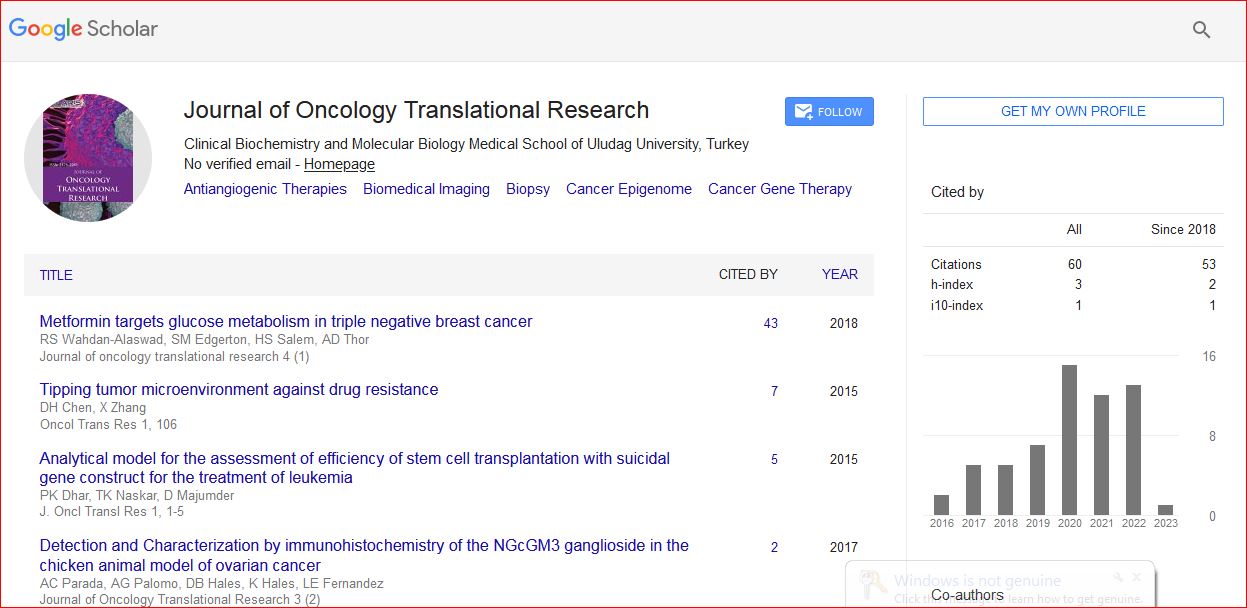
Journal of Oncology Translational Research received 93 citations as per Google Scholar report