Opinion - (127) Volume 16, Issue 3
Received: 01-May-2025, Manuscript No. jch-26-178758;
Editor assigned: 03-May-2025, Pre QC No. P-178758;
Reviewed: 19-May-2025, QC No. Q-178758;
Revised: 24-May-2025, Manuscript No. R-178758;
Published:
29-May-2025
, DOI: 10.37421/2157-7099.2025.16.796
Citation: Haddad, Noura A.. ”Advancing Bone Marrow Diagnostics for Better Care.” J Cytol Histol 16 (2025):796.
Copyright: v© 2025 Haddad A. Noura This is an open-access article distributed under the terms of the Creative Commons Attribution License, which permits unrestricted use, distribution and reproduction in any medium, provided the original author and source are credited.
Recent advancements in bone marrow cytology and histology are significantly enhancing diagnostic accuracy and therapeutic guidance. Techniques like liquid-based cytology, multiplex immunohistochemistry, and molecular profiling are providing deeper insights into hematological malignancies and non-neoplastic bone marrow disorders. These innovations facilitate earlier detection, more precise classification, and personalized treatment strategies, ultimately improving patient outcomes [1].
The integration of flow cytometry and next-generation sequencing into bone marrow diagnostics is revolutionizing the identification of minimal residual disease (MRD) in hematological malignancies. These technologies offer unparalleled sensitivity, enabling clinicians to monitor treatment response more effectively and adapt therapeutic interventions in real-time. This personalized approach is crucial for optimizing patient care and improving survival rates [2].
Histomorphometric analysis of bone marrow biopsies, coupled with advanced imaging techniques, provides critical information for diagnosing and managing myelodysplastic syndromes (MDS) and other bone marrow failure disorders. Quantitative assessments of cellularity, stromal changes, and iron stores offer objective measures that complement morphological evaluation, leading to more accurate prognostication and treatment decisions [3].
The application of artificial intelligence (AI) and machine learning in the analysis of bone marrow cytology smears shows immense promise for improving efficiency and accuracy. AI algorithms can assist pathologists in identifying subtle cellular abnormalities, classifying subtypes of leukemia, and predicting treatment responses, thereby augmenting human expertise and reducing diagnostic variability [4].
Immunohistochemistry plays a pivotal role in the detailed characterization of bone marrow pathology, particularly in differentiating lymphoid and myeloid neoplasms and assessing lineage infidelity. Advances in antibody panels and multiplexing techniques allow for simultaneous detection of multiple markers, providing crucial diagnostic and prognostic information that guides therapeutic decisions [5].
Liquid-based cytology (LBC) for bone marrow aspirates offers improved cellular preservation and reduced background artifact compared to conventional smear preparation. This technique enhances the quality of cytological material, facilitating more reliable morphological assessment and ancillary testing, which is particularly beneficial for the diagnosis of hematolymphoid disorders [6].
Molecular pathology is increasingly indispensable in the diagnosis and classification of acute myeloid leukemia (AML). Gene mutation profiling and cytogenetic analysis, often integrated with morphological and immunophenotypic data, are crucial for defining specific AML subtypes, predicting prognosis, and guiding targeted therapy [7].
The diagnostic utility of bone marrow histology in managing aplastic anemia has evolved with the incorporation of specialized staining and molecular techniques. Beyond assessing cellularity and identifying dysplastic changes, histopathology helps exclude other causes of marrow failure and aids in prognostication, particularly in refractory cases [8].
Multiplex immunohistochemistry (mIHC) is a powerful tool for simultaneously evaluating multiple protein markers in bone marrow biopsies, enhancing diagnostic precision for lymphomas and other lymphoid neoplasms. This approach allows for a more comprehensive understanding of tumor microenvironment and cellular interactions, which can impact treatment response and prognosis [9].
The evolving landscape of bone marrow diagnostics necessitates continuous education and standardization in both cytology and histology. Harmonizing diagnostic criteria and embracing new technologies are essential for accurate patient management and for advancing research in hematopathology [10].
Recent innovations in bone marrow cytology and histology are significantly improving the precision of diagnoses and the effectiveness of therapeutic strategies. Advanced methods such as liquid-based cytology, multiplex immunohistochemistry, and molecular profiling are providing unprecedented insights into both hematological malignancies and non-neoplastic bone marrow conditions. These cutting-edge techniques are crucial for enabling earlier detection, enabling more accurate classification of diseases, and facilitating the development of personalized treatment plans, all of which contribute to better patient outcomes [1].
The incorporation of flow cytometry and next-generation sequencing technologies into the realm of bone marrow diagnostics represents a transformative shift in the identification of minimal residual disease (MRD) within hematological malignancies. These powerful tools offer exceptional sensitivity, which empowers clinicians to more accurately monitor patient responses to treatment and to make timely adjustments to therapeutic interventions. This highly personalized approach is paramount for optimizing patient care and for enhancing survival rates [2].
Histomorphometric analysis of bone marrow biopsies, when combined with sophisticated imaging techniques, delivers vital information essential for the diagnosis and ongoing management of myelodysplastic syndromes (MDS) and other disorders characterized by bone marrow failure. The quantitative evaluation of cellularity, stromal alterations, and iron storage provides objective data that complements traditional morphological assessments, ultimately leading to more reliable prognoses and more informed treatment decisions [3].
The deployment of artificial intelligence (AI) and machine learning algorithms in the examination of bone marrow cytology specimens holds substantial promise for enhancing both the efficiency and the accuracy of diagnostic processes. AI-driven tools can provide invaluable assistance to pathologists in identifying subtle cellular anomalies, accurately classifying various leukemia subtypes, and predicting patient responses to specific treatments, thereby augmenting human expertise and minimizing diagnostic inconsistencies [4].
Immunohistochemistry serves a critical function in the detailed characterization of bone marrow pathology, proving particularly valuable in distinguishing between lymphoid and myeloid neoplasms and in evaluating the presence of lineage infidelity. The evolution of antibody panels and multiplexing technologies now permits the simultaneous detection of numerous markers, yielding indispensable diagnostic and prognostic information that directly influences therapeutic choices [5].
Liquid-based cytology (LBC) applied to bone marrow aspirates offers distinct advantages over conventional smear preparation, primarily through improved cellular preservation and a reduction in background artifacts. This methodological enhancement results in higher quality cytological material, which in turn supports more dependable morphological evaluations and more effective ancillary testing, proving especially beneficial for diagnosing hematolymphoid disorders [6].
Molecular pathology has become an increasingly integral and indispensable component in the diagnosis and precise classification of acute myeloid leukemia (AML). Comprehensive gene mutation profiling and detailed cytogenetic analyses, when integrated with existing morphological and immunophenotypic data, are essential for accurately defining distinct AML subtypes, predicting patient prognosis, and guiding the selection of appropriate targeted therapies [7].
The diagnostic significance of bone marrow histology in the management of aplastic anemia has undergone considerable evolution, notably through the integration of specialized staining protocols and advanced molecular techniques. Beyond the assessment of cellularity and the identification of dysplastic changes, histopathology plays a crucial role in ruling out alternative causes of bone marrow failure and in contributing to prognostic assessments, especially in cases that prove refractory to initial treatments [8].
Multiplex immunohistochemistry (mIHC) stands out as a potent technique for the simultaneous evaluation of multiple protein markers within bone marrow biopsies, thereby elevating the diagnostic accuracy for lymphomas and other lymphoid neoplasms. This sophisticated approach facilitates a more thorough comprehension of the tumor microenvironment and intercellular interactions, factors that can significantly influence treatment efficacy and patient prognosis [9].
The continuously evolving landscape of bone marrow diagnostics mandates a commitment to ongoing education and the rigorous standardization of both cytologic and histologic practices. Harmonizing diagnostic criteria across institutions and actively embracing novel technologies are fundamental prerequisites for ensuring accurate patient management and for propelling forward the frontiers of research in hematopathology [10].
Recent advancements in bone marrow diagnostics are revolutionizing patient care. Techniques like liquid-based cytology, multiplex immunohistochemistry, and molecular profiling enhance diagnostic accuracy for hematological malignancies and bone marrow disorders, leading to earlier detection and personalized treatments. Flow cytometry and next-generation sequencing are crucial for identifying minimal residual disease, allowing for real-time treatment adjustments. Histomorphometric analysis and advanced imaging provide objective measures for myelodysplastic syndromes. Artificial intelligence shows promise in improving efficiency and accuracy in cytology analysis. Immunohistochemistry is vital for characterizing bone marrow pathology and differentiating neoplasms. Liquid-based cytology improves sample quality for diagnosis. Molecular pathology is essential for acute myeloid leukemia classification and targeted therapy. Bone marrow histology, aided by molecular techniques, is important for aplastic anemia management. Multiplex immunohistochemistry offers comprehensive insights into lymphomas. Standardization and education are key to navigating these evolving diagnostic approaches.
None
None
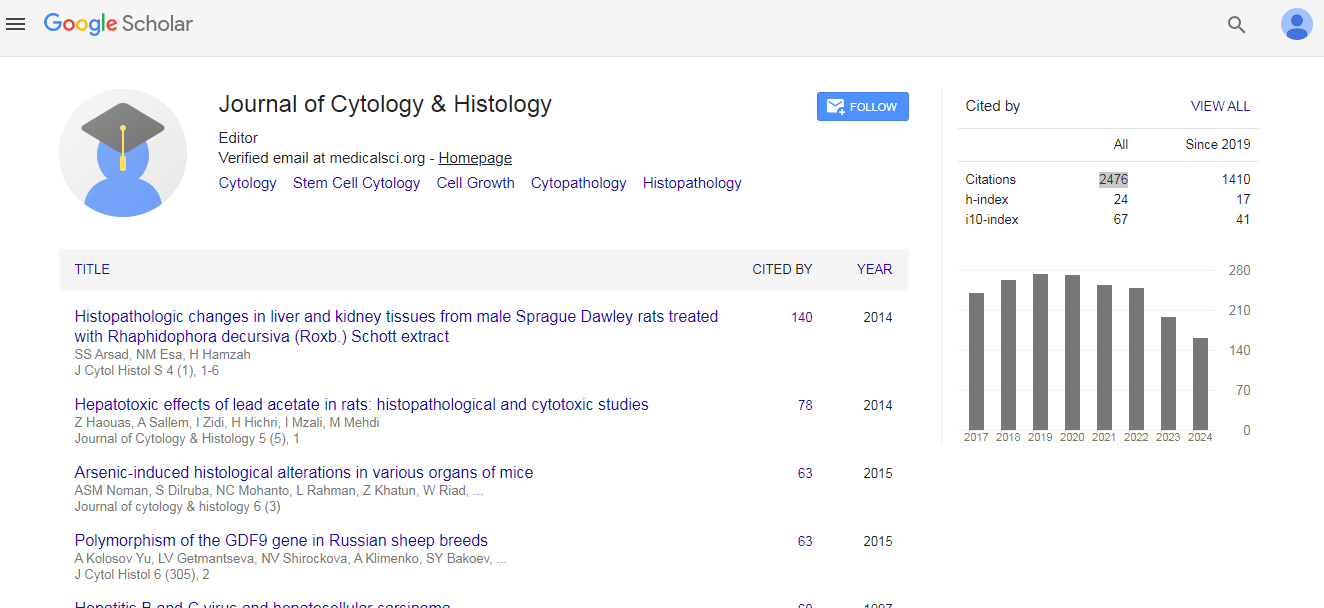
Journal of Cytology & Histology received 2476 citations as per Google Scholar report