Perspective - (2025) Volume 10, Issue 5
Received: 01-Oct-2025, Manuscript No. jidm-26-188098;
Editor assigned: 04-Oct-2025, Pre QC No. P-188098;
Reviewed: 18-Oct-2025, QC No. Q-188098;
Revised: 22-Oct-2025, Manuscript No. R-188098;
Published:
29-Oct-2025
, DOI: 10.37421/2576-1420.2025.10.426
Citation: Garcia, Maria. ”Advancing Antimicrobial Stewardship
For A Global Fight.” J Infect Dis Med 10 (2025):426.
Copyright: © 2025 Garcia M. This is an open-access article distributed under the terms of the Creative Commons Attribution License, which permits unrestricted use,
distribution and reproduction in any medium, provided the original author and source are credited.
Antimicrobial stewardship programs (ASPs) represent a critical strategy in the global effort to combat the escalating threat of antimicrobial resistance (AMR).
The landscape of ASPs is continually evolving, with recent advancements focusing on optimizing diagnostic methodologies to quickly and accurately identify pathogens and their susceptibility patterns. A significant area of development involves the leveraging of real-time data analytics, which allows for continuous monitoring of antibiotic prescribing patterns and immediate feedback to clinicians. Furthermore, there is a growing imperative to expand the reach of ASP principles beyond traditional hospital settings, extending them to outpatient and community environments. These concerted efforts are fundamentally aimed at improving the appropriateness of antibiotic utilization, thereby minimizing the occurrence of adverse drug events and clinical complications. The ultimate goal of these advancements is to significantly curb the relentless rise of multidrug-resistant pathogens that pose a severe risk to public health worldwide. Novel approaches are also being explored, including patient-centered interventions designed to empower individuals in their treatment decisions and promote responsible antibiotic use. Essential to the success and efficacy of these programs is the concept of interdisciplinary collaboration, bringing together diverse healthcare professionals to tackle the complex challenges of antibiotic management. The integration of rapid diagnostic technologies is a cornerstone of modern ASPs, enabling faster and more precise pathogen identification and susceptibility testing. By embracing these multifaceted strategies, ASPs are positioned to play an even more pivotal role in preserving the effectiveness of antimicrobial agents for future generations.Antimicrobial stewardship programs (ASPs) are fundamental to addressing the complex challenge of antimicrobial resistance (AMR).
Recent progress in the field has seen a significant focus on refining diagnostic strategies to enhance the speed and accuracy of pathogen identification and susceptibility testing, which is crucial for guiding appropriate antibiotic selection. Leveraging real-time data analytics is another key development, enabling continuous monitoring of antibiotic prescribing patterns, identification of outliers, and providing timely feedback to clinicians to foster evidence-based antibiotic use. There is a recognized need and ongoing effort to expand the application of ASP principles beyond hospital walls, into outpatient and community settings, where a substantial volume of antibiotic prescriptions are issued. These advancements collectively aim to improve the judicious use of antibiotics, reduce the incidence of adverse drug events associated with antibiotic therapy, and ultimately mitigate the emergence and spread of resistant pathogens. Novel interventions are also being developed and implemented, including patient-centered approaches that aim to educate and engage individuals in their treatment, promoting shared decision-making regarding antibiotic use. Interdisciplinary collaboration, involving a diverse range of healthcare professionals such as infectious disease physicians, pharmacists, microbiologists, nurses, and public health experts, is recognized as essential for the comprehensive and effective implementation of ASPs. The integration of rapid diagnostic technologies into ASP workflows has demonstrated a significant enhancement in the speed and accuracy of pathogen identification and susceptibility testing, allowing for quicker treatment adjustments. Expanding ASPs to outpatient settings presents a critical frontier, requiring the development of tailored guidelines, educational initiatives, and decision support tools for primary care physicians to manage antibiotic prescriptions in community environments. These evolving strategies underscore the dynamic nature of antimicrobial stewardship and its critical importance in preserving the efficacy of existing antibiotics and developing new approaches to combat AMR.Antimicrobial stewardship programs (ASPs) are vital for combating antimicrobial resistance (AMR). Recent advancements include optimizing diagnostic strategies, utilizing real-time data analytics, and extending ASPs to outpatient settings. These efforts aim to improve antibiotic use, reduce adverse events, and slow the rise of resistant pathogens. Novel approaches such as patient-centered interventions and interdisciplinary collaboration are also key. Rapid diagnostics enable faster pathogen identification and tailored treatment, while data analytics and EHR integration allow for continuous monitoring and feedback. Expanding stewardship to outpatient settings is crucial for managing community-based prescriptions. Patient education and shared decision-making empower individuals, and interdisciplinary teamwork ensures a holistic approach. AI and machine learning offer promise for predicting risk and personalizing treatment. Global collaboration and data sharing are essential for a united front against AMR. The economic benefits of robust ASPs further highlight their importance in healthcare.
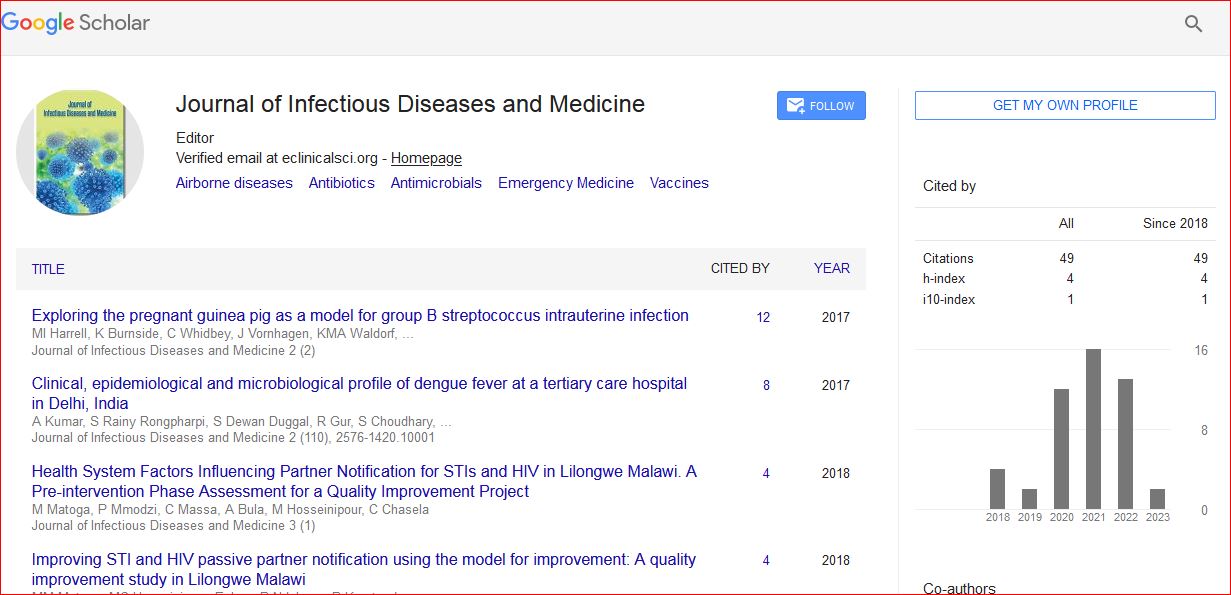
Journal of Infectious Diseases and Medicine received 1059 citations as per Google Scholar report