Short Communication - (2025) Volume 11, Issue 4
Received: 01-Aug-2025, Manuscript No. jssc-26-188298;
Editor assigned: 04-Aug-2025, Pre QC No. P-188298;
Reviewed: 18-Aug-2025, QC No. Q-188298;
Revised: 22-Aug-2025, Manuscript No. R-188298;
Published:
29-Aug-2025
, DOI: 10.37421/2472-0437.2025.11.314
Citation: Johansson, Sara. ”Advances in Steel Arch Bridge Engineering
Research.” J Steel Struct Constr 11 (2025):314.
Copyright: © 2025 Johansson S. This is an open-access article distributed under the terms of the Creative Commons Attribution License, which permits unrestricted use,
distribution and reproduction in any medium, provided the original author and source are credited.
The structural integrity and performance of steel arch bridges are paramount considerations in civil engineering, given their often iconic status and critical role in transportation infrastructure. Advanced finite element modeling techniques have become indispensable tools for understanding the complex behaviors these structures undergo, particularly under dynamic and extreme loading conditions. These methods allow for detailed analysis of material nonlinearity and geometric instability, which are crucial for accurate predictions of bridge performance and ensuring overall safety. The development of efficient computational strategies is also a key focus, enabling rapid analysis of large-scale structures for both design and ongoing assessment. [1]
Wind loading represents a significant environmental factor that can induce substantial dynamic responses in long-span steel arch bridges. Comprehensive studies utilizing a combination of wind tunnel testing and computational fluid dynamics (CFD) are essential for developing accurate wind load models. The insights gained from such investigations provide critical information on the aeroelastic behavior of arch bridges, offering practical guidance to designers for mitigating wind-induced vibrations and thereby improving serviceability and safety. [2] Seismic events pose a major threat to bridge structures, and robust seismic performance assessment is vital. Novel approaches, such as incremental dynamic analysis (IDA), are being employed to evaluate the seismic vulnerability of steel arch bridges. These methods often incorporate the influence of soil-structure interaction and a wide range of earthquake ground motion characteristics to establish comprehensive fragility curves. This probabilistic framework is instrumental for seismic risk evaluation and resilience planning. [3] The durability and long-term reliability of steel arch bridges are heavily dependent on the performance of their critical components, particularly welded connections. Research into the fatigue behavior of these connections, employing advanced experimental and numerical simulation techniques, is crucial for identifying potential crack initiation sites and predicting crack propagation life. This understanding underpins the development of robust design and inspection strategies to ensure the longevity of these vital structural elements. [4] Effective structural health monitoring (SHM) systems are increasingly being implemented for steel arch bridges to ensure their continued safe operation. The application of fiber optic sensing technology offers a powerful means for continuous measurement of key parameters such as strain, temperature, and displacement across the bridge structure. These SHM systems are instrumental in detecting early signs of damage and providing invaluable data for condition assessment and proactive maintenance planning. [5] The quest for more efficient and economical bridge designs has led to the exploration of high-strength steels. Evaluating the mechanical properties and weldability of various high-strength steel grades is essential to understand their impact on structural efficiency and cost-effectiveness. This research informs recommendations for selecting appropriate materials to achieve lighter, more slender, and ultimately more economical arch bridge designs. [6] Stability is a fundamental requirement for arch bridge components, and the buckling behavior of steel arch ribs under combined axial load and bending is a critical area of study. The development of accurate analytical and numerical solutions for predicting critical buckling loads, considering the influence of boundary conditions and geometric imperfections, is essential. These findings directly contribute to preventing premature structural failure and ensuring the overall stability of arch members. [7] For concrete-filled steel tube (CFST) arch bridges, understanding long-term performance is key. The research into long-term deflection and creep behavior of these composite structures incorporates advanced material creep models into finite element analyses. This allows for accurate prediction of accumulated deformations over the bridge's service life, highlighting the necessity of considering creep effects in design and rehabilitation to maintain serviceability. [8] Tied-arch bridges, with their unique structural configurations, present specific challenges and opportunities for seismic design. Investigating their seismic response involves understanding the crucial role of the tie-girder system in dissipating seismic energy and influencing overall bridge performance. This research provides valuable insights for enhancing the seismic resilience of tied-arch bridge designs. [9] Innovative structural forms can significantly enhance the aesthetic appeal and functional efficiency of steel arch bridges. Exploring designs such as basket-handle arches and bowstring arches allows for a comparative study of their advantages and challenges. This research aims to inspire novel design concepts for future arch bridge projects, balancing structural performance with constructability and visual impact. [10]Advanced finite element modeling (FEM) plays a pivotal role in the detailed analysis of steel arch bridges, enabling engineers to capture intricate behaviors under diverse loading scenarios. The focus on material nonlinearity and geometric instability is crucial for accurately predicting bridge performance and ensuring structural integrity throughout its lifespan. The pursuit of efficient computational strategies further supports the rapid analysis of large-scale bridge structures, significantly aiding both the design and assessment phases. [1]
Wind-induced vibrations are a primary concern for long-span steel arch bridges, necessitating thorough investigations into their dynamic response. The integration of wind tunnel testing with computational fluid dynamics (CFD) allows for the development of precise wind load models. Understanding the aeroelastic behavior of these bridges through such studies provides practical guidance for designers to mitigate vibrations, thereby enhancing safety and ensuring long-term serviceability. [2] Seismic performance assessment of steel arch bridges is a complex undertaking that benefits from advanced analytical techniques like incremental dynamic analysis (IDA). Incorporating factors such as soil-structure interaction and various earthquake ground motion characteristics allows for the quantification of structural vulnerability. The establishment of fragility curves through IDA provides a probabilistic framework essential for effective seismic risk evaluation and the planning of resilient infrastructure. [3] The durability of steel arch bridges hinges on the robust performance of their welded connections. Advanced experimental and numerical simulation techniques are employed to study the fatigue behavior of these critical components. Identifying crack initiation sites and predicting propagation life is vital for developing effective design and inspection strategies that ensure the long-term reliability of the bridge. [4] Structural health monitoring (SHM) systems are becoming integral to the management of steel arch bridges, with fiber optic sensing technology offering a promising solution. These systems enable continuous measurement of strain, temperature, and displacement, providing real-time data on the bridge's condition. The effectiveness of SHM in early damage detection supports proactive maintenance planning and enhances overall structural safety. [5] The application of high-strength steel in arch bridge design offers significant advantages in terms of structural efficiency and material utilization. Comprehensive evaluation of the mechanical properties and weldability of different high-strength steel grades is necessary. This research contributes to informed decisions regarding material selection, leading to the development of lighter, more slender, and cost-effective arch bridge designs. [6] Ensuring the stability of steel arch ribs is fundamental, and studies focusing on buckling behavior under combined axial load and bending are essential. The development and application of analytical and numerical solutions to determine critical buckling loads, considering various boundary conditions and geometric imperfections, are crucial. These analyses directly contribute to preventing premature failure and maintaining structural integrity. [7] Long-term performance aspects, such as deflection and creep, are critical for concrete-filled steel tube (CFST) arch bridges. Advanced finite element analyses incorporating material creep models allow for accurate predictions of accumulated deformations over the bridge's service life. This understanding is vital for effective design and rehabilitation strategies aimed at preserving serviceability. [8] Tied-arch bridges possess unique structural characteristics that influence their seismic response. Research in this area focuses on understanding how the tie-girder system contributes to seismic energy dissipation and affects overall bridge performance during earthquakes. This knowledge is invaluable for developing improved seismic design approaches tailored to these specific bridge types. [9] Exploring innovative structural forms for steel arch bridges, such as basket-handle and bowstring arches, can lead to more efficient and aesthetically pleasing designs. A comparative study of these forms, considering their structural efficiency, aesthetic qualities, and constructability, provides valuable insights. This research fosters the development of novel and creative solutions for future arch bridge projects. [10]This collection of research papers delves into various critical aspects of steel arch bridge engineering. Studies cover advanced finite element analysis for predicting structural behavior under complex loads, including seismic and wind forces, emphasizing nonlinearities and instability [1].
The dynamic response to wind buffeting is investigated using wind tunnel and CFD methods to improve mitigation strategies [2].
Seismic performance assessment employs incremental dynamic analysis to establish fragility curves and probabilistic risk frameworks [3].
Fatigue behavior and durability of welded connections are analyzed experimentally and numerically to ensure long-term reliability [4].
Structural health monitoring using fiber optic sensing is presented as a key tool for damage detection and maintenance planning [5].
The application of high-strength steel is explored for achieving more efficient and economical designs [6].
Buckling analysis of arch ribs under combined loading is crucial for stability [7].
Long-term deflection and creep in concrete-filled steel tube arch bridges are studied using advanced modeling [8].
The seismic response of tied-arch bridges, with their distinct structural features, is analyzed to enhance design [9].
Finally, innovative structural forms like basket-handle and bowstring arches are examined for their efficiency and aesthetic potential, inspiring future designs [10].
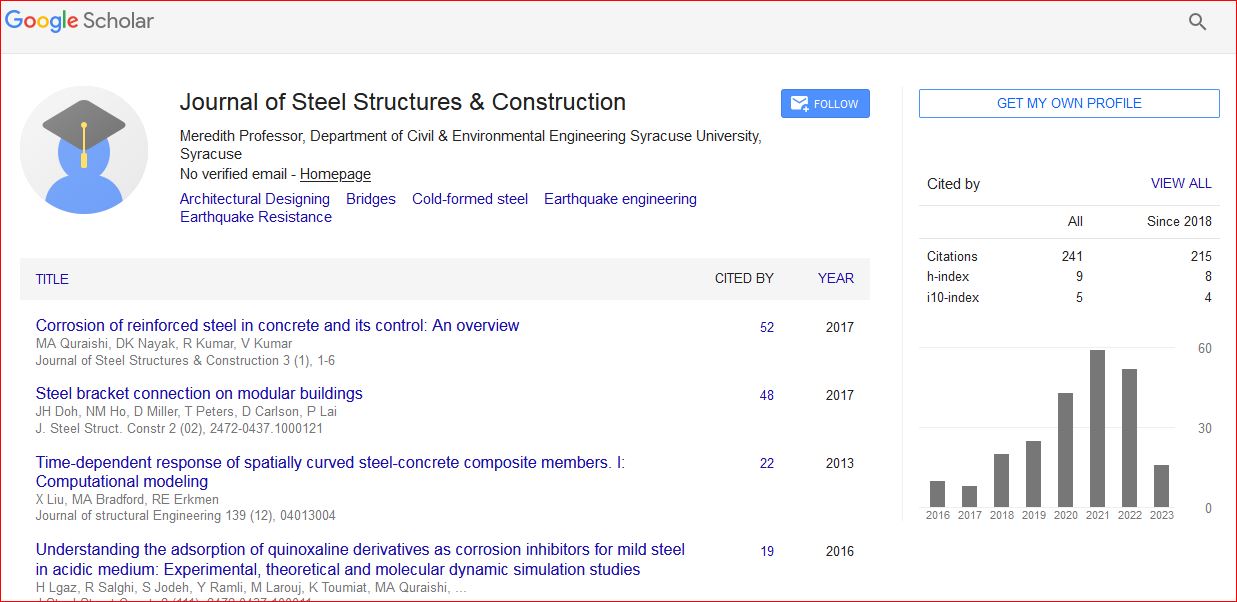
Journal of Steel Structures & Construction received 583 citations as per Google Scholar report