Perspective - (2025) Volume 12, Issue 2
Received: 01-Apr-2025, Manuscript No. jreac-26-185793;
Editor assigned: 03-Apr-2025, Pre QC No. P-185793;
Reviewed: 17-Apr-2025, QC No. Q-185793;
Revised: 22-Apr-2025, Manuscript No. R-185793;
Published:
29-Apr-2025
, DOI: 10.37421/2380-2391.2025.12.425
Citation: Carter, Emily. ”Advances In POPs Detection: Chromatographic And Sample Preparation Innovations.” J Environ Anal Chem 12 (2025):425.
Copyright: © 2025 Carter E. This is an open-access article distributed under the terms of the Creative Commons Attribution License, which permits unrestricted use, distribution and reproduction in any medium, provided the original author and source are credited
The accurate and sensitive detection of Persistent Organic Pollutants (POPs) in various environmental matrices remains a significant challenge for analytical chemists worldwide. These compounds, due to their persistence, bioaccumulation potential, and toxicity, pose substantial risks to ecosystems and human health, necessitating robust monitoring programs and stringent regulatory frameworks [1].
Chromatographic techniques, particularly when coupled with advanced mass spectrometry, have emerged as indispensable tools in this ongoing analytical endeavor. High-Performance Liquid Chromatography (HPLC) and Gas Chromatography coupled with Mass Spectrometry (GC-MS) are foundational methods that have undergone continuous refinement to meet the increasing demands for selectivity and lower detection limits in complex samples [1].
The development of novel sample preparation strategies, innovative stationary phases, and sophisticated detection methodologies has been crucial in overcoming the inherent difficulties associated with POP analysis, such as matrix effects, which can significantly interfere with accurate quantification [1].
Recent advancements in QuEChERS (Quick, Easy, Cheap, Effective, Rugged, and Safe) extraction techniques, when integrated with sensitive detectors like GC-MS/MS, offer an efficient pathway for the simultaneous determination of a broad range of POPs in water samples, thereby facilitating high-throughput environmental monitoring and risk assessment [2].
Emerging POPs, which often exhibit complex chemical structures and are found in diverse matrices like food, present unique analytical hurdles. Ultra-High-Performance Liquid Chromatography coupled with tandem Mass Spectrometry (UHPLC-MS/MS), in conjunction with strategies like solid-phase extraction and matrix-matched calibration, provides the necessary sensitivity and selectivity for reliable quantification in these challenging food matrices, ensuring food safety and regulatory compliance [3].
The landscape of POP analysis is continually evolving with the introduction of more powerful hyphenated chromatographic techniques. Methods combining liquid chromatography with tandem mass spectrometry (LC-MS/MS) and gas chromatography with high-resolution mass spectrometry (GC-HRMS) are critical for the comprehensive detection and identification of a wide array of POPs in environmental samples such as soil and sediment [4].
High-resolution mass spectrometry, in particular, plays a pivotal role in elucidating the structures of unknown POPs and their transformation products, furnishing essential data for informed environmental risk assessments and policy development [4].
Beyond the widely established chromatographic techniques, alternative methods are also gaining traction. Supercritical Fluid Chromatography (SFC) coupled with mass spectrometry, for instance, offers advantages in speed and reduced solvent consumption for the analysis of specific POPs like Polychlorinated Biphenyls (PCBs) in air samples, providing a viable alternative for routine monitoring [5].
Certain classes of POPs, such as dioxins and dioxin-like PCBs, are of particular toxicological concern and require highly specialized analytical approaches. GC-HRMS, when meticulously applied with optimized sample preparation and clean-up procedures, is essential for detecting these contaminants at ultra-trace levels in various environmental and biological matrices, addressing the persistent challenges in their analysis [6].
To further enhance analytical capabilities, techniques like Ion Mobility Spectrometry coupled with Mass Spectrometry (IMS-MS) are being explored as complementary tools. IMS-MS can significantly improve the selectivity and identification power of chromatographic methods, aiding in the detailed characterization of complex POP mixtures found in environmental samples, particularly for isomeric differentiation [7].
Within the realm of HPLC, innovations in stationary phase technology are also contributing to improved POP analysis. The development and application of novel monolithic stationary phases for HPLC have demonstrated the potential for faster analysis times and enhanced chromatographic performance, offering more efficient separation of critical POP groups like organophosphorus pesticides in environmental and food safety contexts [8].
Microextraction techniques, such as Solid-Phase Microextraction (SPME), coupled with GC-MS, represent another area of advancement, offering preconcentration and simplified sample handling for POPs analysis in water. These methods are particularly attractive for field-based monitoring and the analysis of low-concentration contaminants due to their reduced solvent usage and straightforward operational procedures [9].
The evolution of chromatographic detectors is paramount in meeting increasingly stringent regulatory limits for POPs. Advanced detectors, including tandem mass spectrometers (MS/MS) and high-resolution mass spectrometers (HRMS), when integrated with effective chromatographic separations, provide the necessary sensitivity and selectivity for accurate quantification in environmental and food safety applications, underscoring their indispensable role in modern POP analysis [10].
The analysis of Persistent Organic Pollutants (POPs) in environmental samples is a critical field that relies heavily on sophisticated chromatographic techniques to ensure accurate and sensitive detection. Advances in High-Performance Liquid Chromatography (HPLC) and Gas Chromatography coupled with Mass Spectrometry (GC-MS) have been instrumental in this regard, with ongoing improvements in sample preparation, stationary phases, and detection methods enhancing selectivity and lowering quantification limits for complex matrices [1].
The challenges inherent in POP analysis, such as matrix effects, demand robust and validated methodologies for regulatory compliance and effective environmental monitoring. The development of streamlined extraction protocols, such as the QuEChERS method, when combined with sensitive detection systems like GC-MS/MS, allows for the simultaneous determination of a wide spectrum of POPs in water samples. This approach significantly reduces analysis time and is well-suited for high-throughput environmental monitoring and risk assessment endeavors [2].
Analyzing emerging POPs, especially in complex food matrices, presents unique challenges. The application of Ultra-High-Performance Liquid Chromatography coupled with tandem Mass Spectrometry (UHPLC-MS/MS) offers high sensitivity and selectivity. Strategies like solid-phase extraction (SPE) and matrix-matched calibration are crucial for achieving reliable quantification, thereby ensuring food safety and adherence to evolving POP regulations [3].
Hyphenated chromatographic techniques, including LC-MS/MS and GC-HRMS, are indispensable for the comprehensive analysis of diverse POP classes in environmental matrices like soil and sediment. High-resolution mass spectrometry is particularly vital for identifying unknown POPs and their transformation products, providing essential data for environmental risk assessment and policy formulation [4].
In addition to traditional methods, Supercritical Fluid Chromatography (SFC) coupled with mass spectrometry is emerging as an efficient alternative for POP analysis, such as for Polychlorinated Biphenyls (PCBs) in air. SFC offers benefits in terms of speed and reduced solvent consumption, making it a promising option for routine monitoring of airborne POPs [5].
The analysis of highly toxic POPs, including dioxins and dioxin-like PCBs, requires specialized techniques. GC-HRMS, when coupled with rigorous sample preparation and clean-up procedures, is essential for detecting these compounds at ultra-trace levels in various environmental and biological matrices, addressing the ongoing challenges in their analysis [6].
Ion Mobility Spectrometry coupled with Mass Spectrometry (IMS-MS) is emerging as a valuable complementary technique for POPs analysis, especially for differentiating isomers. IMS-MS enhances the selectivity and identification capabilities of chromatographic methods, aiding in the characterization of complex POP mixtures found in environmental samples [7].
Innovations in HPLC stationary phases are also contributing to improved POP analysis. The use of novel monolithic stationary phases has shown potential for faster analysis times and better peak shapes in the separation of organophosphorus pesticides, a significant group of POPs, thus enhancing efficiency in environmental and food safety laboratories [8].
Microextraction techniques, such as Solid-Phase Microextraction (SPME) coupled with GC-MS, offer advantages for the preconcentration and analysis of POPs in water. These methods are attractive for field-based monitoring due to reduced solvent usage and simpler sample handling, making them suitable for analyzing low-concentration contaminants [9].
The evolution of chromatographic detectors, particularly tandem mass spectrometers (MS/MS) and high-resolution mass spectrometers (HRMS), is critical for meeting stringent regulatory limits for POPs. These advanced detectors, when used with appropriate chromatographic separations, are essential for sensitive and selective quantification in environmental and food safety applications [10].
This compilation of research highlights the advancements in analytical techniques for detecting Persistent Organic Pollutants (POPs). It emphasizes the critical role of chromatographic methods, including HPLC, GC-MS, UHPLC-MS/MS, and SFC-MS, in achieving sensitive and selective quantification of POPs across various environmental matrices like water, soil, sediment, air, and food. Innovations in sample preparation, such as QuEChERS and microextraction techniques, alongside developments in stationary phases and advanced detectors like HRMS and IMS-MS, are crucial for overcoming matrix effects, enhancing analytical performance, and meeting stringent regulatory requirements for environmental and food safety monitoring.
None
None
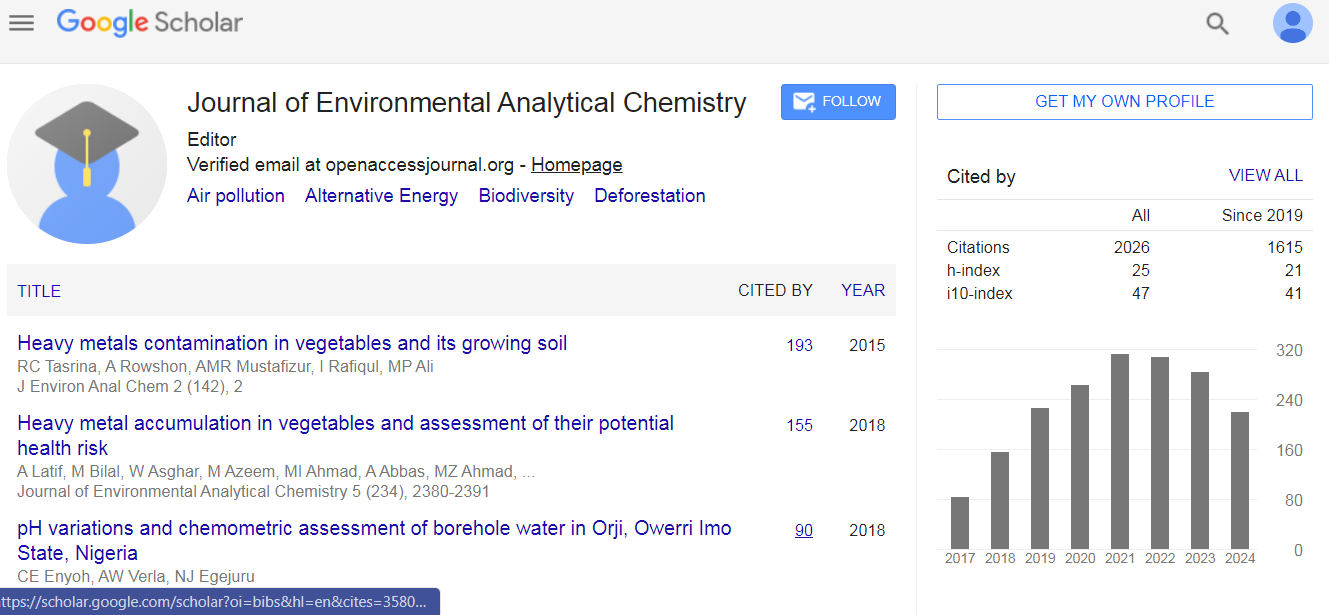
Journal of Environmental Analytical Chemistry received 1781 citations as per Google Scholar report