Short Communication - (2025) Volume 10, Issue 4
Received: 01-Aug-2025, Manuscript No. arwm-26-182734;
Editor assigned: 04-Aug-2025, Pre QC No. P-182734;
Reviewed: 18-Aug-2025, QC No. Q-182734;
Revised: 22-Aug-2025, Manuscript No. R-182734;
Published:
29-Aug-2025
Citation: Mendes, Carlos. ”Recycling’s Role In Carbon Footprint Reduction.” Adv Recycling Waste Manag 10 (2025):420.
Copyright: © 2025 Mendes C. This is an open-access article distributed under the terms of the Creative Commons Attribution License, which permits unrestricted use, distribution and reproduction in any medium, provided the original author and source are credited.
Recycling represents a cornerstone of contemporary environmental stewardship, fundamentally altering our relationship with waste and resource consumption. Its significance in mitigating the environmental impact of human activities is increasingly recognized across various sectors. The diversion of waste from traditional landfill sites is a critical initial step, as landfills are substantial emitters of methane, a greenhouse gas with a potency significantly higher than carbon dioxide over shorter timeframes. This process directly addresses a key contributor to global warming [1].
Furthermore, the very nature of recycling involves the conservation of finite natural resources. By reprocessing used materials, the demand for virgin raw materials is reduced, thereby lessening the environmental burden associated with their extraction and initial processing. This includes the significant energy expenditures and associated emissions inherent in mining, logging, and drilling operations [1].
The energy savings achieved through recycling are often substantial. Manufacturing products from recycled materials typically requires less energy than producing them from scratch. This reduction in energy demand translates directly into lower greenhouse gas emissions, as a considerable portion of global energy production still relies on fossil fuels [1].
The scientific community has dedicated considerable effort to quantifying these environmental benefits. Studies employing life cycle assessment methodologies provide robust data on the reduction in carbon footprints attributable to enhanced recycling practices. These assessments confirm recycling's vital role in achieving broader climate change mitigation goals [1].
Research has specifically focused on the impact of improving waste management strategies, particularly in relation to plastics and metals. Elevated recycling rates for these materials have been demonstrably linked to a measurable decrease in their associated carbon footprints. The comparative analysis of using recycled content versus virgin resources clearly illustrates these savings [2].
These studies meticulously detail the reduction in energy consumption and the consequent decrease in greenhouse gas emissions. The economic advantages of adopting circular economy models, which are intrinsically driven by effective recycling, are also increasingly being highlighted, underscoring a synergistic relationship between environmental sustainability and economic viability [2].
On a more localized level, the efficacy of community-level recycling programs has been a subject of investigation. These initiatives demonstrate a direct correlation between increased public participation, improved sorting of recyclables, and significant reductions in landfill waste. Lower landfill volumes, in turn, lead to diminished methane emissions [3].
Such research provides actionable insights for policymakers and community organizers. By understanding the mechanisms through which community recycling programs function, stakeholders can develop and implement strategies to enhance their effectiveness and maximize their environmental benefits, thereby contributing to broader climate action [3].
Beyond household waste, the construction sector is also exploring the role of recycling. The incorporation of recycled materials in building projects offers a tangible pathway to reducing the embodied carbon of construction. This encompasses the carbon emissions associated with material extraction, manufacturing, and transportation, all of which can be lowered through the use of recycled aggregates, steel, and other components [4].
Integrating recycled content into construction is emerging as a critical strategy for achieving significant reductions in the sector's overall carbon footprint. The potential for carbon savings through these practices is substantial and warrants continued investigation and widespread adoption [4].
The environmental impact of waste management is a critical area of study, with recycling emerging as a primary strategy for mitigating greenhouse gas emissions and conserving resources. Landfills, a common destination for waste, are significant sources of methane, a potent greenhouse gas. Diverting waste through recycling directly reduces these emissions, contributing to a lower carbon footprint [1].
Moreover, the recycling process inherently conserves energy and raw materials. By reprocessing materials, the need for extracting and processing virgin resources is diminished, thereby lessening the associated environmental burdens, including energy consumption and emissions from these industrial activities [1].
Life cycle assessments have been instrumental in quantifying the environmental benefits of recycling. These studies confirm that enhanced recycling practices lead to quantifiable reductions in carbon emissions, underscoring their importance in achieving climate change mitigation objectives [1].
Specific research has investigated how improved waste management, particularly increased recycling rates for materials like plastics and metals, directly contributes to a lower carbon footprint. These studies analyze the energy savings and associated greenhouse gas reductions achieved by utilizing recycled materials compared to virgin resources [2].
The findings consistently highlight the advantages of circular economy models, which are powered by effective recycling systems. These models not only offer environmental benefits but also present economic incentives for sustainable resource management [2].
Community-based recycling programs have also been examined for their impact on household carbon footprints. Increased participation and more effective sorting of recyclable materials lead to a notable decrease in landfill waste and, consequently, a reduction in methane emissions from waste decomposition [3].
These studies offer practical guidance for policymakers and community leaders aiming to optimize recycling efforts. Understanding the dynamics of community engagement and material sorting is crucial for maximizing the environmental benefits at the local level [3].
The construction industry is another significant area where recycling plays a role. The use of recycled materials in construction projects can substantially reduce the embodied carbon of building materials. This includes the utilization of recycled aggregates, steel, and other components, leading to direct carbon savings [4].
Integrating recycled content into construction practices is identified as a key strategy for lowering the carbon footprint of the building sector. The quantification of these carbon savings demonstrates the material contribution of recycling to environmental sustainability in this industry [4].
Emerging technologies in recycling, such as chemical recycling for plastics, are also being evaluated for their carbon footprint reduction potential. These advanced methods are compared against traditional recycling and landfilling to assess their capacity to process complex waste streams and produce valuable materials with a reduced environmental impact [5].
Recycling significantly reduces carbon footprints by diverting waste from landfills, which are major sources of methane. It conserves energy and raw materials, lessening emissions from extraction and manufacturing. Studies show improved recycling rates for plastics and metals lead to lower carbon footprints, highlighting the benefits of circular economy models. Community recycling programs effectively reduce household emissions by decreasing landfill waste. The construction sector can lower its embodied carbon by using recycled materials. Advanced recycling technologies also offer potential for carbon footprint reduction. Electronic waste recycling minimizes raw material consumption and emissions. Corporate recycling strategies contribute to reducing Scope 1, 2, and 3 emissions. Glass, paper, and cardboard recycling offer substantial energy savings and emissions reductions. Supportive policy frameworks are crucial for driving recycling rates and achieving climate mitigation goals.
None
None
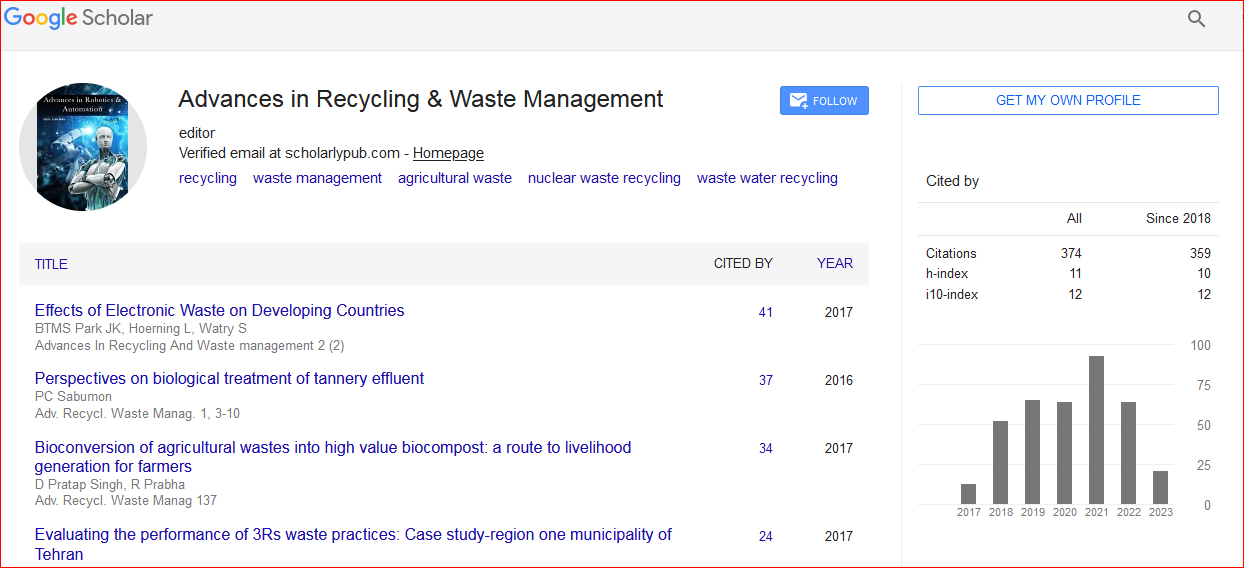
Advances in Recycling & Waste Management received 438 citations as per Google Scholar report